On June 2, 2025, Israel and the US launched “operation Midnight Hammer” against Iran after the collapse of nuclear talks. They declared Iran on the verge of a making a nuclear weapon.
The attack was a military demonstration of superiority in stealth and precision. The US sent seven B-2 Spirit stealth bombers out of its arsenal of 20. The plane is ghost, invisible to radar.
To support this clan of ghosts, it sent a total of 120 aircraft, among them the most advanced fighter planes in modern warfare – F-35s, F-22 Raptors and enough refuelling tankers to block out the run over Iran – 52 of them.
The US and Israel are the most powerful military tag team in the known universe. When they went back to Iran after only eight months and for reasons which are not as clear as they were the first round, it was not so much about precision and stealth, it was taking a grinder to the meat of Iran.
This time they brought everything, including the kitchen sink: Two carrier strike groups - the USS Abraham Lincoln in the Arabian Sea and the USS Gerald R. Ford in the Eastern Mediterranean.
Israel has committed more than 500 fighter jets while the US has deployed its new Precision Strike Missiles (PrSM) and "Lo-cost Uncrewed Combat Attack Systems" (LUCAS) to mimic Iranian drone swarms.
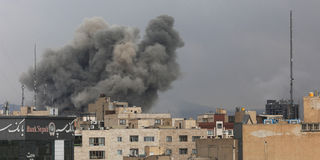
In just five days, over 2,000 strikes have been recorded across Iran, targeting the Islamic Republican Guard Corp's command structure and every known missile silo from Kermanshah to Shiraz, and places in between.
Iran, badly hurt but not defeated, struck back with more than 500 ballistic missiles and 2,000 drones, attacking multiple countries at once. It attacked the US Fifth Fleet Headquarters in Bahrain, where satellite terminals were destroyed. It also hit Ali Al Salem Air Base in Kuwait, Al Udeid base in Qatar, America’s largest in the Middle East and Erbil.
Tehran’s strategy is not to confront the US in set piece battle which it is guaranteed to lose a million times over. Its ruthless approach is to go for the giant’s underbelly - the oil infrastructure and other facilities crucial for the wealth Gulf states which are also America’s leading allies: Drones struck the Ras Tanura refinery in Saudi Arabia, Fujairah Oil Terminal in the UAE and Qatar Energy’s LNG facilities at Ras Laffan forcing total production halt.
The cost of this war, on its fifth day at the time of writing, is already staggering. The US says six of its service personnel have been killed, the Iranian civilian toll is estimated to have surpassed 1,000, including 180 children. American pilots are flying with one blind eye, a lot of radar facilities have been destroyed.
In terms of economic impact, the Gulf economy, crucial to the East African and global economies, is in a state of paralysis.
The desert kingdoms are delicate – they have no natural clean water, produce no food and small populations. Their water is made from sea water in vulnerable desalination plants.
Roughly all their food is imported and in some countries, 80 per cent of the population is foreign, mainly expatriates. With its swarms of Shaheed drones, Iran can render these countries uninhabitable in one afternoon: cripple the water plants, burn the oil and power infrastructure, attack landmark buildings to cause panic – and a stampede of labour and capital.
At the time of writing, the Strait of Hormuz, which handles 20 per cent of the world’s oil, is effectively "closed" by the threat of Iranian "fire-on-sight" orders.
The insurance majors have cancelled insurance policies for ships on that route. President Donald Trump has stepped in and ordered the US Development Finance Corporation to provide insurance and guarantees for ships in the Gulf and said the US Navy will escort them if necessary.
However, DFC is not an insurance company, as has been pointed out, it has no expertise, no risk models. And playing bodyguard for tankers in the Strait of Hormuz is a hazardous task even for the mightiest navy in the world.
Energy markets are in turmoil, Brent crude has surged to $83 per barrel, with analysts predicting a jump to $100 if the blockade persists.
Natural gas prices in Europe have reached 2022-level highs. China and Indiaare suffering energy strangulation. Here in East Africa, we rely heavily on Gulf refined oil products, we could see fuel prices skyrocket, threatening food security as transport costs rise.
So, again, what was the aim of this war and has it been achieved? Militarily, America and Israel have done what was once thought impossible: the physical elimination of the Islamic Republic’s top-tier leadership and the sinking of at least nine major Iranian naval vessels.
However, "victory" is a problematic term. While the military apparatus of Iran is being dismantled, the war has radicalised the survivors, exposed the fragility of Gulf countries and left the global economy on edge.