Since independence, Kenya inherited a state designed like a pyramid, with power pooled at the apex and authority flowing downward in thin streams. The logic was order; the consequence was rigidity. When power concentrates at the centre, imagination thins at the edges and policy becomes uniform. As the proverb warns, when one finger does all the pointing, the hand grows tired. For decades, this constitutional design limited experimentation, delayed learning, and denied the country the quiet genius that often emerges far from Nairobi.
The turn of the millennium nudged the country onto a wiser path. The Constituency Development Fund, followed later by devolution, loosened the knot. They allowed Kenya to behave less like a command post and more like a living laboratory. A constituency or a county could try an idea; neighbours could copy it; the nation could adopt it. Policy began to travel by imitation rather than instruction. As Scripture puts it, “Plans succeed with counsel; with many advisers they succeed” (Proverbs 20:18). In public policy, counties became advisers to the Republic.
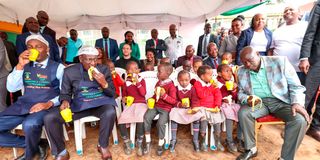
Few ideas illustrate this better than school meals. Between 2017 and 2022, Dagoretti South and Kiambu Town constituencies quietly experimented with feeding programmes. There was no national directive, no donor fanfare. In October 2022, Murang’a County picked up the idea and implemented it for 40,000 Early Childhood Development Education learners. Other counties followed suit, each adapting the model to local realities. Murang’a then began to test a bolder expansion into its 520 primary schools, covering about 205,000 pupils in both primary and junior secondary levels.
Wisdom rarely arrives fully formed but grows through pilots. Murang’a started with two schools in each of its 35 wards. The pilot has since expanded to 90 schools, reaching about 45,000 pupils—roughly 20 per cent of all learners in the county. The pilot has yielded lessons that any policymaker serious about school meals should heed.
The first lesson is legal clarity. Primary and junior secondary education remain national government functions. Counties that wish to provide meals beyond ECDE must therefore act within the law by executing Intergovernmental Partnership Agreements with the national government, endorsed by their county assemblies. “Let all things be done decently and in order” (1 Corinthians 14:40) is not bad advice for public administration.
The second lesson concerns partnerships. Some counties attempt to run school meals entirely through their own bureaucracies. The intention is noble; the execution often falters. Government systems are built for control, not always for speed. Outsourcing delivery to competent entities—while retaining oversight—can dramatically improve efficiency. Moses learned this early, when Jethro advised him to delegate lest he wear himself out (Exodus 18). The lesson endures: leadership is not doing everything, but ensuring everything gets done well.
The third lesson is cost. Through economies of scale and smart partnerships, a nutritious plate can be delivered at about Sh30 per pupil. In the open market, the same plate costs roughly Sh70. Prepared at home, factoring in time and fuel, it averages about Sh50. The most sustainable model is cost-sharing, with parents contributing half. At Sh15 per meal per child, dignity is preserved and ownership deepens. For a county like Murang’a, with about 205,000 pupils, this translates to approximately Sh584 million per year.
At first glance, the figure appears daunting. Yet public finance is as much about classification as it is about cash. Counties can nudge the Controller of Budget to recognise school meals as a development investment rather than a recurrent expense. Recurrent expenditures are tightly capped; development spending enjoys more room. More importantly, feeding children is not consumption; it is capital formation. It builds brains before it builds balance sheets.
Institutionalise school feeding
When benefits are weighed, the arithmetic turns generous. School meals improve attendance, concentration, and completion rates. A hungry child struggles to learn; a fed child leans forward. Better learning outcomes raise human capital, which in turn lifts productivity. Over time, this translates into higher GDP per capita. Conservative international evidence suggests that effective school feeding can raise lifetime earnings by 5–10 per cent for beneficiaries, nudging national income upward year by year.
Poverty rates also respond. For poor households, a guaranteed meal at school is a quiet social protection programme. It frees up household income, reduces child labour, and cushions families against shocks. Counties that sustain school meals can expect gradual but measurable reductions in child poverty and vulnerability, particularly in rural and peri-urban areas.
Human Development Index scores tell a similar story. Education and health are two of HDI’s three pillars. School meals touch both. Better nutrition improves health outcomes; improved attendance and learning outcomes lift education indices. Over a decade, counties that institutionalise school feeding can reasonably expect steady HDI gains, not through grand speeches, but through daily plates served faithfully.
National government would need only Sh29 billion if it scales this idea to all 10 million pupils in Kenya. With an annual Sh4 trillion budget, universal meals would be 0.7 per cent of the total budget. With a wage bill of Sh1.1 trillion for only 900,000 employees, meals would be 2.6 per cent of the wage bill. Kenya can afford it. The issue is priority.
Kenya’s future will not be secured by slogans alone. It will be built, piece by piece, by policies that travel from the classroom to the kitchen and back again. When counties are allowed to experiment, the nation learns. When children are fed, the country grows. In the end, leadership is choosing the long table over the short speech, and remembering that “whoever gives a cup of water to one of these little ones… will certainly not lose their reward” (Matthew 10:42).