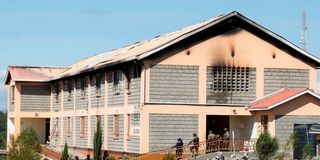
School fires have been killing Kenyan children for over two decades. The country grieves loudly for a week, politicians stand at podiums and give emotionally charged speeches, then the cameras leave, and the schools stay exactly as they were.
Kyanguli 2001, Moi Girls 2017, Endarasha 2024, Utumishi 2026 — 16 girls who went to sleep in Gilgil and never woke up.
Today we mourn them, 16 young souls whose lives were cut short before they had barely begun. And we ask, why do we keep coming back to the same story?
When I posted on X that we owed it to everyone to ask harder questions about what produces this kind of violence in young people, Kenyans told me to sit down.
Heavy security outside Naivasha Law Courts as nine Utumishi Girls fire suspects are arraigned
“Did you kill 16 people when you were acting out?” someone replied. Another: “They literally locked those kids inside. That is evil, not trauma.” Hundreds of similar responses, thousands of likes affirming them. Kenyans had decided — the girls who did this were monsters, and anyone suggesting otherwise was excusing murder.
Frantz Fanon spent the last chapter of The Wretched of the Earth talking about mental disorders in the colonial war in Algeria. One of the cases that stays with me is that of a young Frenchwoman, 21, who came to him with anxiety and an inability to function.
Her father was a highly placed civil servant killed in an ambush. But her breakdown was not simply grief.
Every time she came home, she told Fanon, she spent entire nights unable to sleep because screams rose from the cellar, where her father had Algerians tortured for information.
She knew them. When he died and the government offered her money, she refused. The price of that money was blood, and she wanted no part of it.
Utumishi Girls' Academy is managed and sponsored by the police, and most of its students are daughters of officers.
These are girls who grew up in homes where the institution of the state came through the front door every evening.
In June 2024, during the Finance Bill protests, young Kenyans were shot dead on live television. Children of police officers watched too, old enough to understand whose hand was on the trigger.
In a country where the colonial legacy rages on, it is not surprising that human life has stopped feeling sacred.
Just as in Algeria, where killing Algerians was not considered murder but a heroic act in service of empire, Kenya inherited a state built on the same logic: that certain lives are expendable, that violence from above is order and violence from below is crime. The young absorb this lesson without being taught it.
They live it. Fanon documented two Algerian boys, aged 13 and 14, who murdered a young European who was their friend, a boy they played with, a boy they had no personal quarrel with. When asked why, the 13-year-old said: “The Europeans want to kill all the Arabs. We could not kill big people. But we could kill ones like him, because he was the same age as us.”
They could not reach the guilty. The friend was reachable. The Utumishi girls had grievances against the school administration. They chose a soft target which was the dormitory.
Kenya’s boarding schools were built by colonial governments and missionaries to contain and discipline indigenous bodies, designed to produce obedient labour for the colonial project.
Utumishi fire: Families begin painful process of identifying loved ones
They have not been fundamentally redesigned since independence. There are no smoke detectors in the dormitories.
There are no functioning emergency exits. The door at Utumishi was found locked during the panic, 200 girls packed into a building not designed for that number.
These are rather the expression of a philosophy: that the children inside do not need to be protected, only contained as in a prison. The same philosophy that tells a teenage girl she cannot question her punishment, complain about her food, or raise her voice to a teacher. She is there to follow orders.
The backlash to my tweet reproduced almost perfectly what Fanon observed: colonial societies locate the evil inside the individual, refusing to find it inside the system that produced them.
My critics are not colonial psychiatrists. But the argument is structured identically. Nobody asking for a hanging is asking what a teenage girl, a police officer’s daughter, deposited in a punishing institution, tried to say before she said it with a burning mattress.
Accountability is not the enemy of understanding. The nine girls in custody should face the full consequence of the law. And this system, this colonial inheritance we have polished, renamed, and handed down intact from one generation to the next, must face its own reckoning.
We built institutions with no safety protocols and called them schools. We removed every avenue for a child to be heard and called it discipline. Then we expressed horror when the children inside, shaped by that same contained violence, became violent.
Kenya has had 17 task force reports on school safety and student welfare since the Kyanguli fire in 2001. Every single one of them produced recommendations that were noted, filed and ignored while children kept dying.
The problem in Kenya has never been a lack of knowledge but rather a question of political goodwill.
Mr Amenya is a whistleblower, strategy consultant and startup mentor. www.nelsonamenya.com