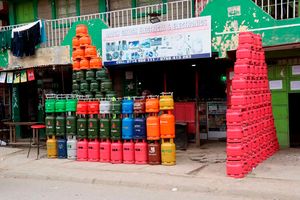
Cooking gas consumers in 17 counties face volatility in supplies due to lack of storage facilities for the key commodity.
A Ministry of Energy report shows that 30 counties, excluding Mombasa, have facilities with a combined capacity of 6,619.40 tonnes. Mombasa is home to facilities for handling imported Liquified Petroleum Gas ( LPG) and storing it with a total capacity of 36,850 tonnes.
The lack of storage facilities in 17 counties has left consumers relying on the trucking of the commodity on a need basis, exposing them to the negative impact of supply shocks in case of disruptions in the 30 counties where cooking gas is stored in bulk.
Nairobi has the biggest storage for LPG in the hinterland at 3,214.90 tonnes followed by neighbouring Kiambu at 578.50 tonnes, Machakos (385.50 tonnes), while Uasin Gishu is fourth with a capacity of 295 tonnes.
The Ministry of Energy has raised concerns about the lack of storage facilities in the 17 counties, amid the government’s plan to promote LPG as the number one cooking fuel.
“Prioritising and expediting LPG storage infrastructure is essential to enhance supply security and support the clean cooking agenda,” the ministry says in its Petroleum Policy for the 2025-2029 period.
“While expansion of storage at Kenya Petroleum Refineries Limited (KPRL) is underway, there is an urgent need to accelerate complementary storage investments in hinterland regions such as Nairobi, Kisumu, and Eldoret, ” it added.
Kenya Pipeline Company will build a 30,000-tonne facility at KPRL’s land in Changamwe to handle imports as the State-owned firm seeks to compete with two private firms in the handling of imported LPG at the port of Mombasa.
Lake Gas of Tanzania recently completed a 10,000-tonne facility in Vipingo, Kilifi County, with the firm keen to take on the African Gas and Oil Company, which has a 25,000 tonnes-facility.
Nyandarua and Kakamega Counties have the joint smallest storage of LPG at 10 tonnes apiece, while Marsabit has more than double the two with 21 tonnes. Wajir completes the list of those with the smallest storage capacity at 24 tonnes.
“Due to the expected growth of demand in LPG, the country shall need an additional 6.5 thousand tonnes of storage capacity needed to be installed by 2028 to cater for both national and transit markets,” the Ministry of Energy says.
The government is seeking to spur the use of LPG as the premier cooking fuel as part of the wider plan to reduce environmental pollution by dirty fuels, notably kerosene, charcoal, and firewood.
Increased use of LPG for cooking is hinged on increased facilities to handle imported cooking gas at the port of Mombasa and also in the hinterland.
LPG consumption hit a record high last year at 413,960 tonnes, which was a jump of 14.8 percent from the 360,590 tonnes in 2023.
Firewood remains the leading cooking fuel in Kenya, with half of the national population and 84 percent of rural homes relying on it.