The State will use private terminals to start importing cooking gas under the Open Tender System (OTS) in a move that sets the stage for price controls on the commodity.
Daniel Kiptoo, Director General of the Energy and Petroleum Authority (Epra), said gazettement of the Petroleum (Operation of Common User Petroleum Facilities) Regulations 2025 will allow for the designation of private handling terminals for cooking gas common-user facilities.
Importation of liquefied petroleum gas (LPG) under OTS, just like petrol, diesel and kerosene, will allow for price controls with competitive bidding set to make it more affordable to consumers.
The private terminals will act as the short-term common-user facility until Kenya Pipeline Company sets up its 30,000-tonne terminal at Changamwe.
Prices of cooking gas have largely remained high, especially at the retail outlets of the major oil marketers, despite tax breaks from the State and the impact of falling prices of butane and propane in the global market. LPG used in Kenya comprises butane and propane in a ratio of 60:40, respectively.
“That is the intention (use of private terminals as common-user) and that could not have happened without the regulations on the common user facilities, where as a private firm, one can offer their facility for common use,” said Mr Kiptoo of the plan to control LPG prices.
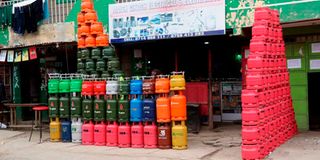
Retailers selling liquefied petroleum gas. Cooking gas is among the items for which businesses have not passed on State incentives to the consumers.
Photo credit: File | Nation Media Group
“We are engaging stakeholders now that the regulations are in place, then we go to the OTS agreement and finally engage with terminal owners.”
Under the OTS model, the tender to ship fuel is awarded to the bidder who quotes the lowest price, ensuring Kenya imports the cheapest but quality fuel.
Epra will set tariffs for handling and storage of the LPG and allow owners of the chosen terminal to make revenues by opening up their facilities for use by the State.
Tanzanian oil marketer, Lake Gas, recently opened its 10,000-tonne LPG handling terminal in Vipingo, Kilifi County, handing the government more options in the use of private facilities to handle cooking gas in an OTS.
Before the entry of Lake Gas, local oil firms and dealers relied on the 25,000-tonne facility owned by African Gas and Oil Company to import more than 92 percent of cooking gas for the local market.
Mr Kiptoo, however, said that there is a transition period that will allow owners of the private terminals to fully honour deals signed with other firms in the importation of cooking gas.
Bringing LPG under OTS is key to lowering cooking gas prices and ensuring dealers and oil marketers do not make huge profits at the expense of consumers.
Prices of cooking gas at the major oil marketers like Vivo Energy, Rubis and TotalEnergies Marketing Kenya have largely remained unchanged despite tax breaks and drops in the global and wholesale prices at the port of Mombasa.
The cost of the 13-kilogramme and the six-kilogramme containers at the three top oil marketers in Kenya have averaged Sh3,300 and Sh1,300 respectively for more than a year despite removal of eight percent Value Added Tax, 3.5 percent Import Declaration Fee and the 2.5 Railway Development Levy on LPG two years ago.
The wholesale price of a kilogramme of cooking gas in Mombasa dropped to an average of Sh88 last month from Sh100 at the start of this year in the wake of the entry of Lake Gas and also the global drop in prices of butane and propane.
A pricing schedule by Saudi Aramco shows that the cost of a tonne of propane dropped 16.8 percent to $520 (Sh67,158) last month compared to $625 (Sh80,562) for same quantity in January this year, while that of butane fell to $490 (Sh63,283) from $615 (Sh79,273) in the same period.