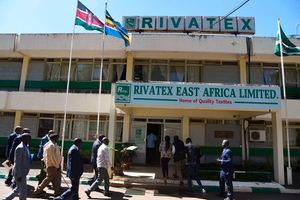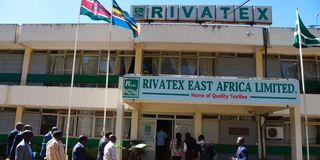
Rivatex East Africa Limited in Eldoret town, Uasin Gishu County.

Rivatex East Africa Limited has been leased to a private investor in a 21-year lease, in a bid to revive the once-dominant textile giant that has been making loses.
The Eldoret-based textile firm was officially handed over on Tuesday by the Ministry of Trade, Industry, and Cooperatives to Arise IIP Limited, a company that runs textile processing facilities in Togo, Benin, and other African countries.
The handover of the struggling firm marks a critical step toward addressing years of financial losses, operational inefficiencies, mounting debts, and State dependence, with the new investor promising fresh capital, restructuring, and a streamlined workforce.
The financial terms of the lease, however, were not disclosed at the handover ceremony.
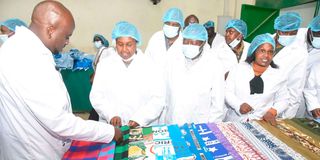
Members of the National Assembly Committee on Trade, Industry and Cooperatives during a visit to Rivatex East Africa Limited in Eldoret City, Uasin Gishu County on August 1, 2025.
The Principal Secretary for Industrialisation, Dr Juma Mukhwana, said the investor is expected to inject capital to address Rivatex’s operational and financial challenges, including accumulated losses, overstaffing, high energy costs, and administrative inefficiencies.
“The financially troubled company has been operating at below 10 percent capacity despite the government and development partners injecting billions. It currently owes Sh180 million in electricity bills, and employees have gone for months without salaries,” Dr Mukhwana said.
He said Arise IIP has already paid Sh94 million in employee salaries as part of its initial actions, which include a retrenchment exercise aimed at streamlining operations and reviving Kenya’s textile and cotton industry.
“The investor will retain only 118 out of 625 employees and will inject substantial capital to ensure quality, efficiency, and innovation,” the PS stated.
Despite Sh7.55 billion spent on modernising equipment, Rivatex continued reporting losses and has failed to pay dividends for 50 years. The firm was placed under receivership before being acquired by Moi University in 2007 for Sh205 million.
Arise IIP Chief Executive Officer George Olaka said the company would cover all operational costs and pay a fixed lease amount to the government through the National Treasury, but declined to disclose the figure.
“All existing Rivatex employees have been formally released through a redundancy process in accordance with labour laws to allow for a fresh and transparent staffing structure,” he said.
The company had 347 contract workers and 278 permanent employees. Contracts for many workers expired on August 30, 2025 and were not renewed as part of the restructuring plan.
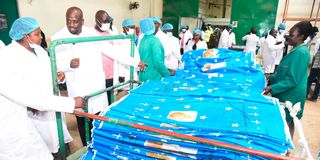
Members of the National Assembly Committee on Trade, Industry and Cooperatives during a visit to Rivatex East Africa Limited in Eldoret City, Uasin Gishu County on August 1, 2025.
Mr Olaka noted that Rivatex is central to the ongoing Africa Textile Renaissance, which includes operations in Kenya, Cameroon, Rwanda, Nigeria, and Benin, with Kenya poised to become a flagship hub.
“We have supported the development of the National Cotton, Textile and Apparel (CTA) Policy 2024 and donated over 1,560 tonnes of certified cotton seed to farmers,” he noted.
Trade union leaders, including the Kenya Tailors and Textile Workers Union (KTTWU) Secretary-General Joel Chebii, have urged the new management to ensure that all retrenched employees are paid their terminal benefits.
“We are not opposed to the handover, but measures must be taken to ensure workers receive all their dues before the new entity assumes full operations,” he said.
Rev Chebii, who also chairs the Central Union of Trade Unions in Kenya, urged the investor to prioritise re-hiring employees who wish to renew their contracts following the restructuring.
Last month, President William Ruto announced that the National Treasury and the Ministry of Investments, Trade and Industry would oversee the transfer of Rivatex to a new private investor, whom he said was selected through a competitive tendering process.
“We are bringing the private sector on board to provide seeds, planting materials, and a predictable offtake of cotton products. Rivatex has immense production capacity that needs to be harnessed,” the President said.
Despite significant investments, Rivatex has continued to struggle due to high energy costs, insufficient raw materials, and inefficient production systems, leading to heavy financial losses. In the financial year ending June 2023, it reported a loss of Sh347.6 million, bringing cumulative losses to over Sh3 billion.
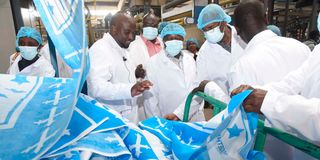
Members of the National Assembly Committee on Trade, Industry and Cooperatives during a visit to Rivatex East Africa Limited in Eldoret City, Uasin Gishu County on August 1, 2025.
Prior to being placed under receivership in 2000 due to financial and administrative mismanagement, the firm produced 15.73 million metres of fabric annually.
In recent years, Rivatex has implemented cost-cutting measures, including recycling 32,800 kilogrammes of fibre waste worth Sh9.8 million to produce yarn for school uniforms. However, it continues to operate below capacity.
According to the National Assembly Committee on Trade, Industry, and Cooperatives, despite massive financial injections for revival, Rivatex has made minimal market impact due to operational inefficiencies, primarily driven by high power costs.
“The cost of electricity is a major hurdle. While countries like Ethiopia and Uganda offer attractive tariffs to investors, Kenya has yet to operationalise affordable industrial power rates,” Mr Bernard Shinali, the chairperson of the parliamentary committee, said during a recent visit to the facility.
The committee recommended increased support from government departments by sourcing uniforms and textile products from Rivatex to boost revenue and sustain operations.
The firm also faces an unstable supply of raw cotton, low working capital, and rising global prices of fibres, dyes, and chemicals, which further hamper its operational capacity.
Kenya currently produces only 5,300 tonnes of cotton annually, against a national demand of 38,000 tonnes, with the Sh17 billion deficit being imported from neighbouring countries.