Young Kenyans emerged among the biggest beneficiaries of the 2026/27 budget unveiled by Treasury Cabinet Secretary John Mbadi, with billions of shillings earmarked for education, employment, digital innovation, sports, housing and social protection.
Kenya's youth unemployment challenge remains structural, with thousands graduating annually into a labour market that does not expand at the same pace. In response, the Treasury proposed more than Sh20 billion in direct youth empowerment programmes under the targeted initiatives section of the budget.
The National Youth Service (NYS) received Sh12.5 billion, the National Youth Opportunities Towards Advancement (Nyota) programme Sh4.9 billion, the Youth Employment Support Programme Sh1.6 billion and Film Development Services Sh1.0 billion.
"The Nyota programme has also supported 51,604 youth through On-Job-Experience in 26 Counties across the Country," Mbadi said.
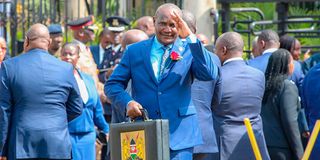
Cabinet Secretary for the National Treasury and Economic Planning John Mbadi delivers the FY 2026/27 Budget Highlights at Parliament Buildings, Nairobi, on Thursday, June 11, 2026.
Photo credit: Dennis Onsongo| Nation Media Group
He further reported that over 91,000 youth have received start-up grants, while thousands more benefit from skills training and mentorship.
The government says it has stepped up youth empowerment efforts through expanded access to financing and enterprise support programmes targeting young entrepreneurs across the country.
The government also proposed Sh2.4 billion for Kenya Jobs and Economic Transformation, which Mbadi positioned as supporting industrial clustering and job creation, though this allocation sits outside the dedicated youth empowerment budget line.
Mbadi noted that the state has strengthened skills development and wealth creation by providing loans to 93,559 youth entrepreneurs through the Youth Enterprise Development Fund aimed at boosting small business growth and self-employment.
He also highlighted that 91,253 young people have benefited from start-up grants under the Nyota Programme, positioning it as a key driver of youth-led enterprise.
In addition, the government implemented the Vijana Vuka na Afya (ViVA) project in Nairobi, Kisumu and Mombasa, where 72,623 youths have benefited from subsidised Sexual Reproductive Health services, an intervention the Budget links to broader youth wellbeing and productivity outcomes.
As Kenyan youth increasingly distinguish themselves through science, technology and engineering innovations, from robotics projects to AI and digital solutions emerging from universities and TVET institutions, education emerged as the biggest winner in the 2026/27 budget, receiving Sh784.5 billion.
Treasury proposed Sh24.3 billion for teacher resource management under the Teachers Service Commission, Sh56.7 billion for HELB financing, Sh54.6 billion for Free Day Secondary Education and Sh30.7 billion for Junior Secondary School capitation.
"Nearly 500,000 university and TVET students have benefited from scholarships and loans based on need and merit," Mbadi said.
CS Mbadi reads Sh4.8 trillion election year budget
The budget also provides Sh30.9 billion for university scholarships and Sh9.2 billion for TVET scholarships, alongside Sh4.9 billion for converting 20,000 intern teachers into permanent and pensionable terms and Sh8.2 billion to support intern teachers.
"The substantial allocation underscores the Government's continued prioritization of access to education, teacher recruitment," the Budget and Appropriations Committee said, "and support for the transition and implementation of the Competency-Based Curriculum."
Mbadi said education reforms had already expanded access to learning, noting that nearly 500,000 university and TVET students had benefited from scholarships and loans under the Student-Centred Funding Model.
He also pointed to the recruitment of 100,000 teachers and the construction of over 23,000 classrooms, alongside the commencement of 1,600 laboratories to support implementation of the Competency-Based Curriculum.
Technical and Vocational Education and Training institutions have also recorded rising enrolment, increasing from 562,499 trainees in 2022 to 825,484 in 2025.
According to Mbadi, the goal, at least in policy framing, is to align skills production with labour market demand.
The digital economy, increasingly viewed as a source of employment for young people, attracted billions more.
Treasury proposed Sh8.6 billion for the Digital Superhighway programme, including funding for digital hubs, cybersecurity and expansion of internet infrastructure.
Sports, culture and tourism received Sh45.6 billion, including Sh25.2 billion for the Sports, Arts and Social Development Fund and Sh14.3 billion for the Tourism Fund, while vulnerable children and school-going girls were covered through allocations such as Sh8.9 billion for cash transfers to orphans and vulnerable children and Sh900 million for sanitary towels.
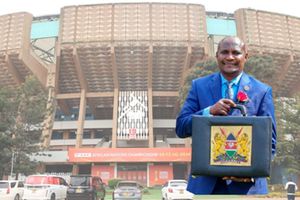
National Treasury Cabinet Secretary John Mbadi has proposed the allocation of Sh45.6 billion to the Sports, Culture, Recreation and Tourism sector in the 2026/27 financial year.
Photo credit: Dennis Onsongo and File | Nation
"Our focus is not only on navigating the immediate challenges," Mbadi said, "but also on accelerating structural transformation, creating jobs at scale, and ensuring that the benefits of growth are broadly shared among all Kenyans."
He said the government would continue advancing youth empowerment through targeted investments in skills development, entrepreneurship, digital opportunities and access to affordable financing.
The allocations are "intended to enhance youth employability, entrepreneurship, skills development and access to financing," the Budget and Appropriations Committee explained, "thereby contributing to job creation and inclusive economic growth."
Treasury also proposed Sh110.2 billion for what Mbadi called "targeted interventions for youth, women and constituencies." Beyond the youth empowerment line items, this allocation funds support for women entrepreneurs, regional equity programmes and constituency development initiatives.
The CS highlighted several programmes the government says have already reached thousands of young people.
According to Mbadi, 93,559 youth entrepreneurs have received loans through the Youth Enterprise Development Fund while 91,253 young people have benefited from start-up grants under the Nyota programme.
The Nyota programme has also provided on-job experience opportunities to 51,604 youth in 26 counties.
To expand support structures, the government says it has constructed four Youth Empowerment Centres in Mwea, Chepalungu, Dagoretti North and Mandera South constituencies, while equipping 25 others, bringing the total number of centres across the country to 156.
"Given the scale of the youth employment challenge, the Government further calls upon Development Partners, the private sector, philanthropic organizations and other stakeholders to join this national effort," Mbadi said, "creating opportunities for young people extends beyond the capacity of Government alone."
The Affordable Housing Programme, which received Sh50 billion, is also being positioned as a source of employment for young people.
According to the Budget and Appropriations Committee, the allocation is intended to "stimulate job creation in the construction sector, and support the growth of urban centres through improved infrastructure."
The programme will also support the construction of 177,686 student beds across universities.
"The initiative aims to improve living conditions for students," Mbadi said, "while simultaneously creating jobs, stimulating local manufacturing and supporting MSMEs."
Treasury proposed Sh8.6 billion for the Digital Superhighway programme, including Sh4.3 billion for the Kenya Digital Economy Acceleration Project, Sh400 million for digital hubs and Sh 382 million for cybersecurity.
The Budget and Appropriations Committee noted that these investments are expected to enhance digital inclusion, improve access to ICT infrastructure and services, strengthen cybersecurity resilience and promote innovation and employment opportunities within the digital economy.
"Digital transformation is a strategic enabler for competitiveness in the Fourth Industrial Revolution," Mbadi explained. "Digital connectivity and literacy are essential for education, healthcare, finance, markets, public services, and emerging digital opportunities."
The government is also banking on local assembly of smartphones, laptops and tablets to deepen digital access.
Under the Finance Bill, Kenya secured zero-duty remission on inputs used in the assembly of smartphones, laptops and tablets.
Mbadi said mobile phones had become essential tools for enhancing communication, access to information and delivery of services.
"They support, among others, education, businesses, financial services, e-commerce, healthcare and social interactions," he explained, "while also promoting digital inclusion, productivity and socio-economic development."
The government is additionally strengthening regulation of virtual assets following enactment of the Virtual Assets Service Providers Act, 2025, introducing a reporting framework aimed at improving oversight of cryptocurrency transactions.
Mbadi described film, music, fashion, arts, digital content and design as a powerful engine of growth and youth employment.
Treasury allocated Sh1.0 billion for film development services and Sh45.6 billion to sports, culture, recreation and tourism.
This includes Sh25.2 billion for the Sports, Arts and Social Development Fund and Sh14.3 billion for the Tourism Fund.
"These allocations will stimulate jobs, community development and foreign exchange earnings," Mbadi said.
The government says it has established film hubs in Dedan Kimathi University, Bomet and Migori, while a 150-seat cinema theatre has been set up at Dedan Kimathi University of Technology.
According to the CS, 1,745 local and foreign films have been facilitated and 1,847 filmmakers trained.
Beyond jobs and education, billions were allocated to programmes targeting vulnerable children.
The budget proposes Sh8.9 billion for cash transfers to orphans and vulnerable children, Sh4.3 billion for the Hunger Safety Net Programme and Sh900 million for sanitary towels for school-going girls.
Secondary school students head home for the April holidays on March 27, 2026.
Photo credit: Jared Nyataya | Nation Media Group
According to the Budget Committee, the allocations are aimed at enhancing social welfare, reducing vulnerability and poverty, promoting dignity among disadvantaged groups and improving access to education and basic needs support.
Treasury further proposed Sh 1.1 billion for the Child Welfare Society of Kenya and Sh 200 million for autism and albinism programmes.
Despite the billions committed, Parliament's Budget and Appropriations Committee warned that major challenges persist.
"The Youth Enterprise Development Fund services remain centralized and inaccessible to many young people, particularly those residing in rural constituencies," stakeholders who participated in the budget process said.
They further observed that many youth enterprises face challenges arising from collateral requirements, limited mentorship, inadequate business development support and insufficient financing.
Several stakeholders called for constituency offices, digitisation of services and increased funding.
The Committee agreed, stating that youth empowerment remains a critical priority that requires sustained policy attention and adequate resource allocation.
"There is a need for decentralization of youth-focused programmes to the constituency level as well as enhancing the allocation to the Youth Enterprise Development Fund," it said. "This will enhance access to affordable credit and entrepreneurship support."
Stakeholders submitted that child protection services and child welfare programmes continue to face significant funding constraints adding that inadequate staffing had affected implementation of child protection programmes and response mechanisms for vulnerable children.
Parliament responded by allocating funds to the Child Welfare Society and the National Council for Children Services to strengthen child protection measures.
Meanwhile, lawmakers called for a special audit of the Public Service Internship Programme to strengthen governance and ensure its continued benefit to young Kenyans.
The Committee further recommended that money allocated to the programme should only be used to pay interns' stipends and not operational expenses.
According to the government, the Budget, delivered under the National Treasury, is framed around sustaining the Bottom-Up Economic Transformation Agenda (BETA), with youth-centred interventions spread across education, digital infrastructure, enterprise funding and creative industries.
"Kenyans want an economy that works for them; an economy where the cost of living is manageable, where opportunities for employment and businesses are expanding."
The CS emphasized that he held consultations across the country. Mbadi told Parliament he had engaged widely with different youth and informal sector groups.
"I met Youth and Business Community particularly, Boda Boda operators, Jua Kali artisans, leadership of the mitumba sector and scrap metal dealers."
He also referenced engagements with media and students, including a return to the University of Nairobi where he held discussions with students at Chandaria Auditorium.
In policy terms, these consultations were meant to feed into what he called a demand for fairness:
"Wananchi want to see a Government that listens to their concerns and responds with policies that promote opportunity, fairness, and prosperity," he explained. "They want the Government should reduce the overall cost of living by lowering the tax burden, tame wastage and decisively deal with corruption."