The National Treasury has walked back plans to scrap the 25 percent customs duty on imported mobile phone handsets, instead opting to retain the levy alongside excise tax, hurting efforts to make the gadgets more affordable.
Scrapping the customs duty, along with the 16 percent value-added tax (VAT), 2.5 percent import declaration fee, and 2 percent railway development levy, would have reduced the tax on imported phones from 55.5 percent to 25 percent, following the increment of excise duty to 25 percent from 10 percent.
While Treasury Cabinet Secretary John Mbadi confirmed the measures to remove the other taxes during the budget speech in Parliament on Thursday, there was no mention of an application for the removal of the customs duty.
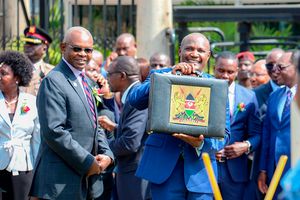
Cabinet Secretary for the National Treasury and Economic Planning John Mbadi delivers the FY 2026/27 Budget Highlights at Parliament Buildings, Nairobi, on Thursday, June 11, 2026.
Photo credit: Dennis Onsongo| Nation Media Group
Instead, CS Mbadi said Kenya has requested the East African Community bloc for a customs duty waiver on imported inputs for the local assembly of smartphones, protecting the local industry while leaving Kenyans exposed to high smartphone prices.
“To strengthen digital connectivity as part of the digital superhighway pillar for Beta (Bottom-Up Economic Transformation Agenda), the local assembly of smart devices remains a key priority,” CS Mbadi told the National Assembly Thursday.
“Expanding access to affordable smart telecommunication devices will enable more Kenyans to participate in the digital economy and benefit from emerging opportunities in business and innovation.”
Treasury had initially defended the move to raise the excise duty on mobile phones, accompanied by the reduction of all other taxes to simplify the tax payment process.
However, being part of the EAC, Kenya cannot unilaterally remove the customs duty, but can only request the bloc’s council of ministers to grant the exemption based on the country’s fiscal and economic goals.
According to CS Mbadi, the customs proposals were tabled before parliament on May 8, and forwarded to the EAC on May 15, but the request to remove the tax on imported phones was not part of them.
Without its removal, the taxes on imported mobile phones will drop only to 50 percent from the current 54.5 percent, as opposed to the 25 percent the government had promised.
Additionally, while inputs used in local assembly will be exempt from customs duty, they will be moved from VAT-exempt status to VAT zero-rating, making assemblers ineligible to claim back input taxes from the taxman.
The local manufacturers had cautioned that the move would increase their costs and subsequently raise retail prices for final consumers.
Transitioning locally assembled and manufactured phones from zero-rated to VAT-exempt status would prevent recovery of input VAT incurred on locally sourced and imported components, raw materials and spare parts, embedding irrecoverable VAT within the final device cost,” the Kenya Association of Manufacturers had said in its submission to Parliament regarding the proposals.