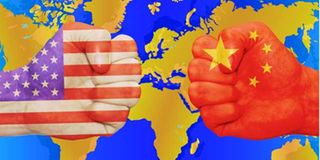
China has endeared itself to more Kenyans as a priority global economic partner in the last five years, cutting influence by the United States, findings of a new poll suggest.
The Pew Research Center, a think-tank in Washington, DC, argues that the share of Kenyans who want the government to prioritise economic relations with Beijing has increased by 10 percentage points from 2019 to 48 per cent in 2025, to tie with the US.
This marks the growing influence in Kenya of China, the world’s second largest economy.
Ratings of Washington as the most preferred economic partner have dropped to 48 from 52 per cent in the pre-pandemic period, according to the global poll.
“In several middle-income countries, the balance of opinion has shifted since 2019, when the question was last asked. In Kenya, where the US was once seen as a more important economic partner by a substantial margin, opinions are now split,” Pew researchers say in the report based on feedback from 31,938 adults in 24 countries.
“In nearly all the high-income countries surveyed, majorities continue to prioritise close economic ties with the US. In most of these places, though, the shares who say ties with China are more important has grown since 2021.”
The findings do not adequately capture impact of the sweeping global tariffs as most interviews were conducted before President Donald Trump announced the changes on April 2 “to address absence of reciprocity in our bilateral trade relationships”.
Pew – which describes itself as a non-partisan fact tank that informs the public about the issues, attitudes and trends shaping the world – said the survey was from January 8 to April 26, 2025.
China has in the last two decades exerted economic influence on Kenya through its ambitious global infrastructure development project – the Belt and Road Initiative (BRI) – that was launched in 2023.
Kenya has been a key BRI recipient, taking loans from China to finance infrastructure projects that have made the world’s second largest economy the biggest bilateral lender, with outstanding debt of $5.039 billion (Sh651.24 billion) as at end of March.
Mega infrastructure projects funded through debt from China include the standard gauge railway running from Mombasa to Suswa, the 27-kilometre tolled Nairobi Expressway, the 50-kilometre
A section of the Thika Super Highway which was constructed by a Chinese firm.
Photo credit: File | Nation
, the Nairobi Eastern and Northern Bypass of 72 kilometres, Nairobi Western Bypass, Nairobi Southern Bypass, Nairobi Inland Container Depot and several access roads.
“Across the nine middle-income nations surveyed, a median of 58 per cent say investment from China is good because it creates jobs locally. In comparison, a median of 35 per cent say such investment is bad as it gives China too much influence over their domestic affairs,” the researchers say in the report.
“Kenyans are the most positive about investment from China. Seventy one per cent see it as good for their country. Around six in 10 adults or more agree in five other countries. Conversely, people in Argentina and India are more likely to describe investment from China as bad.”
While the share of surveyed Kenyans who describe investments from China as a good thing has risen to 71 from 60 per cent in 2019, sentiment from Nigeria’s has tanked to 64 per cent from 82 – the sharpest among the countries polled.
China also remains the largest source for imports, with goods valued at Sh576.14 billion shipped into Kenya last year, largely railway wagons and vans, mobile phones as well as iron and steel products.
The trade balance is, however, heavily skewed to the East Asia’s economic powerhouse, with Kenya’s exports closing 2024 at a measly Sh26.32 billion, made up largely of titanium ore and concentrates, copper waste and scrap as well as tea.
The trade balance between Kenya and the US is not as skewed, with imports from the world’s largest economy standing at Sh155.64 billion in 2024 against Sh88.86 billion in earnings from exports.
Nairobi and Washington have for many years been keen on stitching together a bilateral trade agreement beyond the Growth and Opportunity Act (Agoa) deal, which expires September.
However, tangible negotiations over a trade and investment deal, which started in earnest in 2018, have been slowed by regime change in both countries.
Beyond trade, Kenya’s bilateral partnership with the US has for years largely revolved around security cooperation, with a focus on international peacekeeping, peace negotiations, security governance, refugee inclusion and cooperation in cybersecurity.
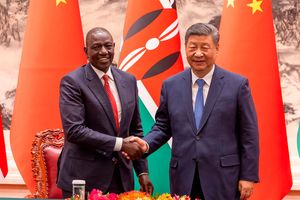
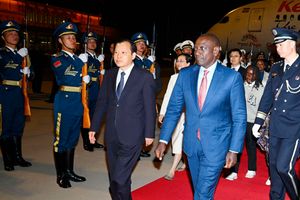
President William Ruto’s state visit to Beijing from April 22 to 26 was not received well by some congressmen in Washington who felt the Kenyan leader was warming up to China more than the US.
“President Ruto declared that Kenya, a major non-NATO ally, and China are ‘co-architects of a new world order’. That is not just alignment to China; it’s allegiance,” Republican Idaho Senator Jim Risch said on May 13.
A section of an elevated expressway in Nairobi metropolis.
Photo credit: File | Nation Media Group
“Relying on leaders who embrace Beijing so openly is an error. It is time to reassess our relationship with Kenya and others who forge tight bonds with China.”
Mr Trump’s administration initiated the negotiations with Kenya during his first stint in White House in February 2020 under a comprehensive Free Trade Agreement (FTA), but this was discontinued by the regime of Mr Joe Biden in favour of a less US-Kenya Strategic Trade and Investment Partnership (STIP), whose negotiations had not been completed by the time Mr Trump began his second term on January 20, 2025.
US Trade Representative Jamieson Greer – a Cabinet member who serves as Mr Trump’s principal adviser and negotiator on trade matters – said in April after meeting his Kenyan colleague Lee Kinyanjui that his country was keen on continuing bilateral trade talks.
“My counterpart and Trade Minister from Kenya and I sat in my office last week and we had good talk,” Mr Greer told the Congress Committee on Ways and Means amidst President Trump’s tariff wars.
“He said he wanted to engage with the US. He understands our concerns but he also understands the need to move forward. It was fruitful a conversation and I look forward to speaking with him again. He wants to work with us. They want to have some kind of agreement.”
The congressional Committee on Ways and Means is the principal agency in the House of Representatives that shapes laws on taxes, tariffs and other fiscal matters.
Mr Greer was responding to questions from the Chairman of the Trade Sub-Committee of the House Ways and Means Committee, Adrian Smith, on initiatives taken by the US Trade Representative Office to ensure deals with Kenya and America progress to conclusion.
Mr Smith accused the Biden administration of dragging its feet on concluding trade negotiations initiated by Mr Trump during his first term in White House.
“During President Trump’s first term, he teed up agreements with the United Kingdom and Kenya. I am eager for these agreements to be brought to fruition,” Mr Smith said in April.
“Over the last four years, the Biden administration trade agenda veered from slow work to complacency to non-binding framework.”
The Republican congressman added that the delay in concluding the trade agreement was concerning, given that Kenya stood to set an example for other Agoa beneficiaries which were capable of negotiating their own reciprocal agreements.
Appearing on Nation Media Group’s “Fixing the Nation” morning show on May 7, Mr Kinyanjui said Nairobi had appealed to Washington to drop the baseline 10 per cent tariff on Kenya’s exports as a priority agenda.
Mr Trump initially gave a grace period of 90 days from April 2 for the taxes on imports to the US to take effect.
But with tariff agreements struck with a handful of countries, the effective date was pushed to August 1.
“We have appealed against that 10 per cent tariff as we are not at the same level with many of those developed nations. Conversations are ongoing,” Mr Kinyanjui said during the show.
“We have had a visit to the Office of the US Trade Representative and made our appeal that Kenya – because of our geopolitical relations with the US and other areas where we cooperate – deserves better terms not just on tariff but also on market access.”
The Kenyan minister spoke at the time Prime Cabinet Secretary and Foreign Affairs CS Musalia Mudavadi had flown to Washington to meet US Secretary of State Marco Rubio and Congress Foreign Affairs Committee Chairman Brian Mast.
Mr Mudavadi’s visit marked the first formal steps between Nairobi and Washington since President Trump’s return to the White House in January, aimed at reviewing security, trade and investment commitments that the Biden regime made with Kenya.
“We discussed regional peace and security, expanded trade and investment and deepened diplomatic engagement,” Mr Mudavadi wrote on his X account on May 8.
In June this year, China offered to allow goods from African countries, except Eswatini, to access the world’s biggest market by population duty-free.
“China is ready to – through negotiating and signing the agreement of China-Africa Economic Partnership for Shared Development – expand the zero-tariff treatment for 100 per cent lines to all 53 African countries having diplomatic relations with China, or all African countries except Eswatini, to welcome quality products from Africa to the Chinese market,” read the declaration following a meeting between China and foreign ministers from Africa in Changsha, southern China.
China has no diplomatic relations with Eswatini because the southern African kingdom recognises Taiwan as an independent country.