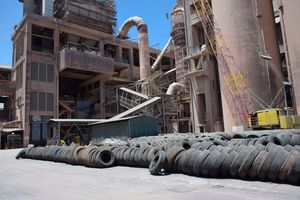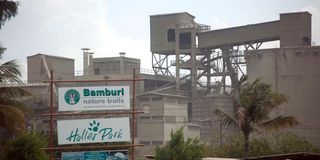
Bamburi Cement factory in Mombasa County.

Bamburi Cement has won a reprieve after the Court of Appeal suspended an order that required the company to deposit Sh3.374 billion from the sale of its shares to Tanzania’s Amsoms Group, to be held as security in an ongoing dispute with logistics firm Roy Hauliers.
The appellate judges agreed with Bamburi that forcing the company to deposit such a large sum in a joint interest-earning account—pending the outcome of arbitration—would significantly hurt its operations.
Bamburi Cement and Roy Hauliers are locked in a contractual dispute before an arbitrator, following claims by the logistics firm that Bamburi breached agreements related to transport services and access to its mining grounds in Katani, Machakos County.
In March, the High Court had ordered that the Sh3.374 billion be retained in Kenya and placed in a joint account held by lawyers representing both firms.
This came after Tanzanian tycoon Edhah Munif, through Amsons Group, completed the full acquisition of Bamburi Cement in December for Sh23.6 billion.
“The effect on Bamburi’s cash flow would not be any less onerous simply because the amount is to serve as security rather than a payout to Roy Hauliers. It is clear to us that failure to grant a stay could cause extreme hardship to Bamburi,” said the court.
The appellate court noted that the sum was nearly equivalent to Bamburi’s annual cash flow.
Sale of shares
Bamburi Cement also argued that it had no control over the proceeds from the sale of its shares and would, therefore, have to raise the deposit from its own funds—a move it said would severely strain its liquidity.
The cement manufacturer further submitted that, according to its audited financial statements for the year ending December 31, 2023, its cash and cash equivalents stood at Sh3.69 billion.
And requiring it to deposit nearly the same amount, the firm argued, would cripple its operations and undermine its ability to function as a going concern.
The public listed firm told the court that it employs 357 staff, works with 871 suppliers, and supports over 5,000 families. It maintained that its continued operations should not be jeopardised by what it termed a speculative claim.
Roy Hauliers, on its part, opposed Bamburi’s application, insisting that the deposit was necessary to safeguard its interests.
The logistics company argued that Bamburi’s sale of shares to a third party raised suspicions about its intentions and could frustrate the enforcement of an arbitral award if Roy Hauliers won the case.
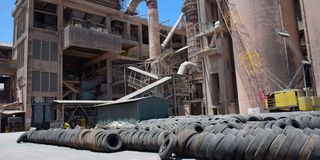
The Bamburi Cement Factory in Mombasa.
The firm claimed that Bamburi’s control was “hanging on the precipice” of a takeover that might alter the company’s management and disrupt the existing business arrangement to Roy Hauliers’ detriment.
The logistics firm added that with Bamburi’s major shareholders based abroad, enforcing a future arbitral award would be difficult without the security deposit.
However, the appellate court found that Roy Hauliers had “unwittingly conceded” that Bamburi Cement possesses sufficient assets to settle any award should it lose the arbitration.
The court further noted that there was no evidence of asset stripping or any indication that Bamburi Cement was moving its assets out of Kenya.
“Making an order for a cash deposit is therefore unnecessary and indeed oppressive to Bamburi,” the court concluded.
The court added that the shares sold in Bamburi Cement did not belong to the company itself, thus the contention that the order made by court directing the firm to deposit the money from the proceeds of the sale of shares was in vain, as it does not have control of the proceeds, may not be frivolous.
Similarly, the court said, the debate as to whether or not a company incorporated in Kenya should be treated as a foreign entity simply because its shareholders are foreigners was an arguable point.
Follow our WhatsApp channel for breaking news updates and more stories like this.