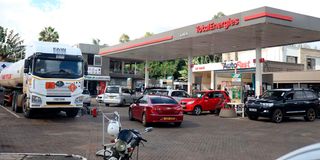
TotalEnergies Marketing Kenya now powers more than half of its fuel stations on solar, as the oil marketer gradually delinks its operations from the national grid to cut costs and ensure stable electricity supplies.
Disclosures by the company show that 154 of its stations across Kenya were powered by solar systems as at December 2025. The company had 285 stations as at May 2026. This means that 54.03 per cent of the oil marketer’s outlets are powered by solar.
Installation of the solar panels is part of a twin-approach to cut electricity bills from Kenya Power, guarantee stable supply and avoid outages tied to the national grid, as well as also reduce carbon emissions.
The French-owned company, which is the second biggest oil marketer in Kenya, is part of the many big businesses turning to alternative power sources, in what could ultimately hit Kenya Power's electricity revenues.
“As at the end of December 2025, 154 service stations across the country were powered by solar energy,” TotalEnergies said in its report for the year ended December 2025.
The oil marketer did not, however, disclose the savings that it made from the use of solar power at the 154 stations last year.
A growing number of firms have turned to solar and biomass plants for alternative electricity in an effort to cut costs besides avoiding interruptions like blackouts.
A growing list of manufacturers, including Bio Food Products, Total Energies Kenya, Maisha Mabati Mills, Simba Cement, Unilever Tea Kenya, British American Tobacco, Africa Logistics Properties, Bidco, Mabati Rolling Mills, Centum Real Estate, and Devyani Food Industries, have shifted to their own solar power generation to cut operational costs and lower emissions.
Migration of these companies to solar power could, in the long run, impact Kenya Power, given that industries and firms are the biggest source of revenue to the State-electricity distributor.
For example, in the year ended June 2025, industries and commercial firms accounted for 64 percent (Sh148.2 billion) of Kenya Power’s revenues from electricity sales.
Kenya Power has in the past said that a mass migration of industries and businesses could hit its bottom line.
TotalEnergies is the third biggest oil marketer in Kenya with a share of 14.01 percent as at December 2025, according to data from the Energy and Petroleum Regulatory Authority.
Vivo Energy is the biggest marketer with a share of 20.56 percent while Rubis Energy Kenya is third on 13.77 percent.
Coca-Cola joins a growing list of manufacturers, including Bio Food Products, Total Energies Kenya, Maisha Mabati Mills, Simba Cement, Unilever Tea Kenya, British American Tobacco, Africa Logistics Properties, Bidco, Mabati Rolling Mills, Centum Real Estate, and Devyani Food Industries, who have shifted to their own solar power generation to cut operational costs and lower emissions.