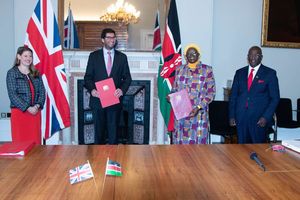
Former Cabinet Secretary for Industrialisation, Trade and Enterprise Development Betty Maina with UK's International Trade Minister Ranil Jayawardena during the signing of the new Kenya-UK trade deal in London, United Kingdom.

The High Court in Nairobi has ordered the government to strengthen the way it negotiates, ratifies and implements major international trade agreements after finding serious procedural flaws in the approval of the Kenya-United Kingdom post-Brexit trade pact.
Justice Roselyne Aburili faulted the government for rushing through the agreement without meeting constitutional standards on public participation, transparency and mandatory impact assessments, but declined to invalidate the deal because of its importance to Kenya's exports and the wider economy.
“The impugned EPA had a direct impact on small-scale farmers and local traders such as those producing green beans and flowers,” the court said, finding that the failure to provide translations of the agreement's core terms or summary sheets in Kiswahili, coupled with limited access to print and digital media among many stakeholders, severely restricted meaningful public participation.
Justice Aburili ordered fresh consultations with farmers and other affected groups, publication of overdue implementation reviews, undertaking statutory impact assessments and complying with East African Community consultation rules.
The court allowed the Kenya-United Kingdom Economic Partnership Agreement (EPA) to remain in force to protect a vital multi-billion-shilling export market for products like tea, coffee, and cut flowers. Kenya has maintained a strong bilateral trade surplus with the UK, reaching Sh110 billion by late 2025.
The orders arose from a petition filed by the Kenya Small Scale Farmers Forum and Econews Africa challenging the process used to negotiate and ratify the agreement signed on December 8, 2020, after Britain's exit from the European Union.
The agreement followed a January 2020 meeting between former President Uhuru Kenyatta and the then-UK Prime Minister Boris Johnson. The Ministry of Trade later signalled negotiations for an Economic Partnership Agreement (EPA).

Former President Uhuru Kenyatta with ex-British Prime Minister Boris Johnson outside 10 Downing Street in this picture taken on January 21, 2020
The petitioners sued in February 2021, arguing that the text and impact of the Agreement “were kept hidden from the public until the Ministry abruptly announced its signing on December 8, 2020.”
This deal officially came into force on March 22, 2021. It ensured duty-free and quota-free market access for key Kenyan agricultural exports.
The petitioners argued that small-scale farmers and rural communities were excluded from decisions affecting their livelihoods and that Parliament approved the treaty without adequate public participation.
According to government records and previous official statements, the agreement preserved duty-free and quota-free access for Kenyan exports, especially cut flowers, fresh vegetables and fruits, to the UK market after Brexit.
Government said the deal protected exports worth Sh40 billion annually and thousands of jobs in the horticulture sector.
The court found that Parliament invited public views but identified significant shortcomings in the process. It found that the public was given only eight days to study the agreement after the first notice and a further seven days after a second notice, despite the treaty running to more than 600 pages and dealing with complex trade issues.
The court said the version initially published by Parliament omitted critical annexes, including tariff schedules, customs cooperation protocols and other supporting documents, making it difficult for the public to meaningfully scrutinize the agreement before it was ratified.
"I find that the public participation was conducted but weakened by gaps highlighted above," Justice Aburili ruled.
She added that "the process fell short of the robust standards contemplated by the Constitution," although she concluded that the shortcomings were not sufficient to invalidate the agreement because there was no evidence of bad faith or irrational conduct by the respondents.
The petitioners said Parliament uploaded an incomplete version of the more than 600-page Kenya-UK trade agreement for public scrutiny. They argued that critical annexes were missing, including tariff schedules for Kenyan and British goods, customs cooperation protocols and the parties' joint statement.
They said the omissions denied the public access to essential information needed to meaningfully participate in the ratification process.
The court also criticised the government's failure to prepare and publish mandatory regulatory and economic impact assessments before ratification.
"The failure to compile and formally publish these assessments strips the ratification process of the objective transparency and accountability principles enshrined in Articles 10 and 118 of the Constitution," the court said.
Justice Aburili added: "I find that compliance with these statutory preconditions is indispensable and that their omission taints the integrity of the ratification process of the EPA."
The petitioners had argued that the agreement was negotiated largely behind closed doors before Parliament published small newspaper notices inviting public comments.
They also complained that the agreement remained available only in English and online, making it difficult for many rural farmers to understand its implications.
They said that mode of communication excluded a majority of grassroot stakeholders who speak only Kiswahili or lack internet access and digital literacy.
The court accepted that concern, saying the agreement directly affected small-scale farmers and traders.
"The court takes judicial notice that not all of them may be literate or have access to print and digital media. Thus, failing to provide translations of the core terms or summary sheets in Kiswahili severely restricted meaningful engagement,” it said.
It further found that Kenya failed to fully comply with consultation procedures under the East African Community Customs Union Protocol before concluding the bilateral agreement with Britain.
The court held that Kenya bypassed mandatory regional notification and consultation steps despite being bound by the treaty establishing the East African Community.
"There is glaring evidence that Kenya bypassed the regional mechanisms in the name of exigency and urgency as well as the timelines for Brexit," the judge said.
Despite those findings, the court declined to suspend or invalidate the agreement immediately, saying such a move could destabilize a key export sector.
"Because the petitioners provided no evidence of bad faith or irrationality and in order to avoid creating an economic crisis or causing immediate collapse to the agricultural sectors dependent on the UK market, this court will not issue an outright, immediate invalidation of the EPA treaty," the court ruled.
Instead, the court ordered the government to develop and implement a nationwide sensitization programme explaining the agreement to stakeholders and collecting their views for incorporation into future reviews.
The programme must be conducted in English, Kiswahili, indigenous languages, Kenya Sign Language, Braille and other accessible formats for persons with disabilities.
The government must also publish the first five-year implementation review, conduct future periodic reviews, prepare and publish the outstanding impact assessments and remedy procedural shortcomings through consultation under East African Community mechanisms.
“The procedural non-compliance with the EAC Customs Union Protocol shall be remedied through subsequent compliance with the notification and consultation requirements, through the relevant diplomatic channels via the relevant Ministry responsible for EAC Affairs and Trade,” said the judge.
The court retained supervisory jurisdiction over implementation of the orders and directed the respondents to report back to court within 120 days on compliance.
Follow our WhatsApp channel for breaking news updates and more stories like this.