Smallholder farmers in Kitui County are increasingly embracing crop diversification to overcome the recurrent challenges posed by drought and unreliable rainfall.
Consequently, many are turning to drought-resistant crops, specialised livestock and collective farming initiatives to bolster their livelihoods.
In the Kwamutonga area of Kitui West, retired teacher Susan Nzomo is one of the farmers championing this approach by growing high-value crops alongside traditional food staples.
She says that although maize, cowpeas and green grams (ndengu) remain the dominant crops in the entire Ukambani region because of their drought tolerance, climate change has forced many farmers to explore alternative enterprises.
“Crop diversification reduces the risk of crop failure, improves soil health, and stabilises farm income throughout the year,” she adds.
She says that growing different crops helps farmers to cope with harsh weather conditions, pests, and fluctuating market prices. Dragon fruits are one such crop.
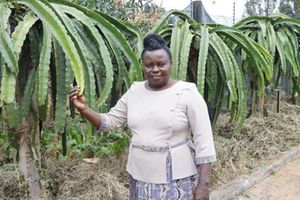
One of the crops she has introduced is the dragon fruit, a high-value climbing cactus which is still uncommon in the region compared to mangoes and papayas.
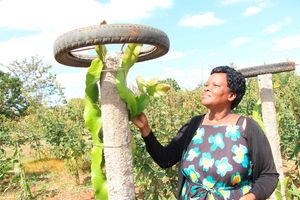
Ms Susan Nzomo, a retired teacher from Kwamutonga in Kitui West, attending to her dragon fruit farm in this photo taken on June 24, 2026.
The plant produces long, fleshy stems that require strong, vertical support structures. With proper management, it develops large, night-blooming flowers before producing its distinctive fruit.
She says that the market price for dragon fruit in Kenya ranges from Sh300 to Sh1,500 per kilogram depending on whether it is bought directly from a farm, from local online agricultural platforms or from uptown retail supermarkets.
Susan began cultivating dragon fruit around two years ago, having received clean planting materials with the support of Caritas International.
She was then taken through the process of setting up a profitable dragon fruit farm, including selecting healthy stem cuttings, setting up durable concrete trellising poles and managing fertilisation and watering schedules.
She says that successful production begins with obtaining clean, certified cuttings, which guarantee high germination rates and freedom from pests and diseases, as well as genetic purity.
Before planting, the fleshy cuttings should be left to dry for a short time to allow the cut surfaces to heal, thereby reducing the risk of rotting after planting.
She has erected six-foot vertical support structures to allow the cactus stems to climb before cascading downwards as they mature.
To ensure durability, the support mechanism must be strong enough to carry the weight of the mature plants and their fruit.
In an interview with Seeds of Gold , Susan explains that traditional food staples are vital because they deliver essential nutrients, preserve cultural identity and support local farming stability.
"These heritage foods provide dependable daily energy while protecting communities against malnutrition and imported dietary shifts," she notes.
As well as dragon fruit, Susan grows mangoes, green grams, pigeon peas, kale and a variety of other vegetables on her farm, which covers more than 10 acres.
She says that crop diversification has significantly improved the livelihoods of most families in the region because farmers are less likely to experience total crop failure, which is common when adverse weather affects a single enterprise.
Her farm has also become a demonstration centre, attracting visitors from the surrounding communities who wish to learn about modern farming practices and climate-smart agriculture.
According to Susan, working in groups enables women farmers to diversify into multiple enterprises while benefiting from capacity-building programmes and table banking initiatives that provide start-up capital.
"When women grow a variety of crops, such as vegetables, legumes, and drought-resistant grains, they can improve household food security, earn a regular income, and become more confident in making decisions about their farms," she says.
Shadrack Ikunga, a young farmer, says that chamas and table banking have become an important grassroots financial system in which members pool their savings and provide one another with quick and affordable loans.
He says that these savings and investment groups have become a reliable source of start-up capital for enterprises led by young people and women, enabling members to invest in farming and small businesses.
Members meet twice a week to discuss the group's operations, review savings and loans, and plan future investments.
With a membership of over 200 smallholder farmers, the group is now looking to expand into seed banking and multiplication to improve access to quality planting materials.
The group also plans to add value to various farm produce to increase household incomes, reduce post-harvest losses and extend the shelf life of produce.