Which cooking methods do you use for meat? Grilling, roasting, smoking, boiling, stewing, frying or braising? What cooking methods or delicacies do you use to make sure your meat is soft, tender and flavourful?
These were some of the questions answered at this year's Kenya Meat Expo, organised by Nation Media Group (NMG) PLC in partnership with the Ministry of Agriculture and Livestock Development and other key players in the livestock and meat industry.
Held from August 26 to 28 at the Kenyatta International Convention Centre in Nairobi, the fifth edition of the expo attracted farmers, processors, traders, researchers, innovators and consumers. Exhibitors demonstrated different ways of preparing and adding value to meat.
The event's theme was “Accelerating Sustainable Growth: Empowering the Next Generation in the Meat Value Chain”, showcased how innovation is extending beyond livestock production to processing, cooking, preservation, marketing and consumption.
Meat can be prepared using various cooking methods, each producing a distinct flavour, texture and aroma. Common techniques include grilling over direct heat, roasting in an oven, boiling, stewing, frying and braising. Smoking is another popular method, which involves slow cooking over indirect heat while exposing the meat to wood smoke.
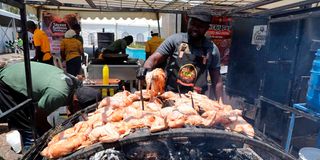
Grilled chicken prepared by Samuel Ndugu, popularly known as Pitmaster Sam of Street Anthem BBQ, during the 5th Edition of the Kenya Meat Expo 2026 at the Kenyatta International Convention Centre on August 27, 2026.
Photo credit: Dennis Onsongo | Nation Media Group
This process can take several hours, allowing the meat to become tender and absorb distinctive flavours from the wood. Other modern methods, such as sous vide cooking, pressure cooking and air frying, offer greater control over temperature, cooking time and texture.
Samuel Ndung’u, the founder of Pikmaster Sam, was one of the exhibitors at the Kenya Meat Expo. He used the event to showcase his meat-cooking skills, network with potential clients, and introduce them to his products. A specialist in smoked meat, Ndung’u has established a presence in the expanding barbecue market. During the event, he told the Seeds of Gold that smoking meat is not just about cooking; it's about creating a unique culinary experience. “What we do is smoke meat. Smoking is a slow technique, so it takes more than 12 hours,” he explained.
At the expo, Mr Ndung’u demonstrated how to prepare brisket using an offset smoker. Unlike an open grill, the fire does not come into direct contact with the meat. Instead, the firewood is placed separately, allowing the smoke and heat to circulate around the meat and cook it slowly. “This is the brisket that we started smoking two days ago, and we are serving it today while it is still juicy and tender. The idea is to preserve the flavours and enhance them with the wood we use to smoke,” he explained on the last day of the expo.
He said that this cooking method is changing how consumers perceive barbecues (BBQs) and creating opportunities for entrepreneurs in the meat industry. However, the lengthy cooking process comes at a cost. Smoking meat for over 12 hours requires more fuel and labour than conventional methods. ‘The technology definitely affects the price. We are talking about 12 hours of cooking. That uses almost three to five times the amount of firewood and fuel used in conventional cooking. There is also the cost of labour, so the price has to be high,” Ndung’u explained.
At his stall, a quarter of a chicken costs Sh400, while a kilogram of lamb is priced at Sh1,800. Brisket is priced at 2,500 shillings per kilogramme, although visitors to the expo could purchase a portion for 1,500 shillings to sample the product.
Nyama choma on display on the final day of the Kenya Meat Expo 2025 at Kenyatta International Convention Centre in Nairobi on August 8, 2025.
Photo credit: Dennis Onsongo | Nation Media Group
Mr Ndung’u founded his business in Pangani, Nairobi, in 2014, before moving to Kikuyu in Kiambu County after the country was hit by the pandemic in 2020. He now focuses on events and plans to set up a franchise selling smoked meat, as well as expanding into delivering to offices and other customers. “We particularly target events because this is a new concept, and we need to introduce it to the market and build a customer base that understands what we are offering,” he said.
The former police officer said that the expo had proved that the meat industry offered numerous opportunities for entrepreneurs, particularly young people. “I have learned that people appreciate the fact that the meat industry is a broad value chain with money-making potential. That is what I take away from it,” he said.
Ndung’u also organises family barbecue festivals where customers can sample different meat products. He revealed that his business is exploring halal options to make its products accessible to a wider market.
Visitors were able to experience the unique smoking technique, which gives the meat a distinctive outer crust and a pinkish layer known as a smoke ring. “The meat is delicious, tender, soft and juicy,” said Samuel Mwenda, who attended this year’s expo.
A few metres from Mr Ndung’u’s tent, Martin King’ori, founder of Camp David Butchery, was demonstrating a technique designed to improve the quality and flavour of meat: dry ageing.
“Dry-aged meat is meat that is stored uncovered in a carefully controlled environment of temperature, humidity and airflow for several weeks before cooking or sale,” said King’ori. During this time, moisture gradually evaporates from the meat while natural enzymes break down the muscle proteins. This tenderises the meat and intensifies its flavour, often producing a richer, nuttier and slightly earthy taste.
The outer surface develops a dry, dark crust which is trimmed away before cooking. Beef and lamb are the meats most commonly dry-aged, although the process can also be used for other meats.
Joshua Nzioka of Camp David at the exhibition stand at the Kenyatta International Convention Centre on August 28, 2026, during the 5th Edition of the Kenya Meat Expo 2026.
Photo credit: Dennis Onsongo | Nation Media Group
Mr King’ori runs several butcheries in Nairobi, including those in Kasarani and Mirema in Zimmerman, as well as one in Githiga, Githunguri, Kiambu County. He also runs a feedlot for fattening animals. He also runs a ranch in Suswa, Narok County.
While the innovations on display focused on improving the eating experience, the Cabinet Secretary for Agriculture and Livestock Development, Mutahi Kagwe, said that Kenya must view the meat industry as a complete value chain capable of creating jobs, raising farmers' incomes, and generating export earnings.
He revealed that Kenya produced approximately 613,627 tonnes of meat in 2024, with an estimated market value of Sh397 billion. This represented a 10.2 per cent increase in production volume and a 30.5 per cent increase in value compared to 2023. “Beef remained the largest contributor by both volume and value, accounting for around 260,000 tonnes valued at approximately Sh160 billion in 2024,' he said.
However, CS Kagwe stated that Kenya should not focus solely on beef, highlighting opportunities in goat meat, mutton, poultry, camel meat, pork, and emerging value chains such as rabbit meat. “This diversity is a strength that we must deliberately develop,” he said. While Kenya has a large and growing domestic market for meat, the CS said that historically, too much value in the livestock economy has been captured through the sale of live animals and informal slaughter and trade. “We must change this model. The future lies in progressively moving from selling live animals to selling carcasses and processed meat, and from there to branded products and premium brands,” he said.
According to CS Kagwe, selling live animals denies Kenya opportunities for processing, employment, and higher returns. “It's not just about selling an animal; when we send the animals abroad, we're also selling our jobs. We are exporting jobs to Europe, Dubai, and the Middle East,” he said.
Willy Laboso, Retail Manager KenMeat Limited, at the exhibition stands during the second day of the 5th Edition of the Kenya Meat Expo, at the Kenyatta International Convention Centre, Nairobi, on August 27, 2026.
Photo credit: Dennis Onsongo | Nation Media Group
He added that the government wants a greater proportion of the value created in the meat industry to remain in Kenya and reach producers.
Kenya has approximately 2,000 slaughter facilities, including around 49 large slaughterhouses, 322 medium-sized slaughterhouses, and over 1,500 slaughter slabs.
In addition to NMG and the Ministry of Agriculture and Livestock Development, the Kenya Meat Expo 2026 was supported by other strategic partners, including De-risking, Inclusion and Value Enhancement of Pastoral Economies in the Horn of Africa (DRIVE Kenya), ZEP-RE and the Kenya Development Corporation.