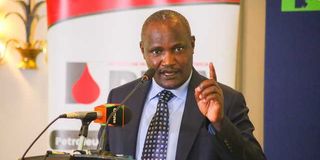
Treasury Cabinet Secretary John Mbadi has asked the High Court to dismiss a petition that is seeking to nullify the proposed privatisation of the Kenya Pipeline Company (KPC).
He says the process followed the requisite legal procedures and the plan is intended to unlock billions of shillings in investment, enhance Kenya's regional competitiveness, and economic growth.
"As the financial needs of the government continue to outpace available public resources, private sector participation has become a critical tool in addressing infrastructure gaps, enhancing service delivery, and promoting sustainable development," says Mr Mbadi in court papers defending the government's intention to offset part of its stake at KPC.
Together with the Privatisation Authority, Mr Mbadi says the application that led to issuance of a conservatory order stopping the planned sale of KPC was anchored on a non-existent law.
The application was filed by the Consumer Federation of Kenya (COFEK) alleging lack of transparency in the privatisation of the KPC and breach of various provisions of the Privatisation Act, 2023.
Cofek had also alleged lack of genuine public participation in the manner contemplated by the Constitution, adding there was no disclosure of the terms, valuations, strategic assessments, or long-term impact of the proposed transaction.
But in his replying affidavit, Mr Mbadi says the petition is premised on the Privatization Act, 2023, which was declared unconstitutional, unlawful, and null and void by the High Court on September 24, 2024.
He says the effect of the declaration of unconstitutionality of the 2023 Act was restoration of the previous status, which was the 2005 Act.
"Therefore, the Privatisation Act, 2005, is the applicable legislation with regard to the instant matter, the same having been restored upon invalidation of the Privatization Act, 2023. It is evident that the Petition in its entirety lacks a legal leg to stand on as the same is premised on a misapprehension and mis-articulation of the applicable law, which has resulted in the Petitioner's inaccurate assumptions, flawed conclusions, and ultimately, a flawed foundation for the instant suit," says Mr Mbadi.
Court papers show that the National Treasury expects to raise approximately Sh100 billion from the transaction.
The documents further disclose that the transaction advisors in the Initial Public Offer (IPO) will be compensated through a combination of fixed fees, payable for due diligence and structuring, and success fees linked to the successful completion of the offering.
"The fixed fees and public participation costs will be approximately Sh100 million. All the other fees will be paid from the proceeds of the IPO, which will be paid net of these costs," the documents show.
With regard to the petitioner's request for an order compelling disclosure of information related to the proposed sale, such as valuation reports, Mr Mbadi says that part of the information is in public domain while others are yet to be crystallized by virtue of the stage of the proposed transaction.
He also argues that the request amounts to an abuse of the court process as the Petitioner bypassed the statutory procedure specified under the Access to Information Act.
"Under part IV any complaint regarding access to information shall first be lodged and determined by the Commission on Administrative Justice established by section 3 of the Commission on Administrative Justice Act," he says.
"The Petitioner's failure to invoke this alternative procedure but instead opting to file the dispute with this Honourable Court is not only bad in law but an abuse of the court process".
The company is wholly owned by the Government of Kenya, with 99.9 percent shareholding held by the National Treasury and about 0.1 percent by the Ministry of Energy and Petroleum.
Mr Mbadi says that though strategic infrastructure investments have enhanced KPC's regional capacity, increased competition from neighboring transit routes and shifting regional policies are reshaping its dominance.
"Accordingly, sustaining its regional role requires greater efficiency, innovation, and strategic partnerships aligned with East African integration goals," he explains.
This is compounded by realignment of regional interests, culminating in the Ugandan government's decision to develop a crude oil pipeline through Tanga in Tanzania, and slow implementation of bilateral projects such as Liquified Natural Gas (LNG) and Kenya-Uganda pipeline, says Mr Mbadi.
"Further, by the shifting market dynamics and changing opportunities as a result of the discovery of crude oil in the region and commercialisation plans such as the inland refinery in Uganda necessitating review of planned regional pipeline extensions," he adds.
The CS further explains that since privatisation is a key tool to address three major economic balances like government debt, public expenditure and revenue raising, the proposed sale of KPC shares through public initial offer at the Nairobi Security Exchange (NSE) is in compliance with the values and principles of public participation, transparency, accountability and value for money.
"The mechanism also provides an equal opportunity for all investors and safeguards can be put in place to give preferential treatment of Kenyans during the Initial Public Offer, strengthening public confidence in the privatization process. That in itself, a public offer is the most transparent and fair process of privatisation as it provides equal opportunities for all citizens and non-citizens from all walks of life to participate," he states.
Mr Mbadi says the proposed sale was an innovative mechanism of raising money for the government budget.
"Considering that our economy is in a critical turning point and to sustain the economic achievements realised thus far, both from a macro and fiscal (inflation, interest rates, currency stabilization, GDP growth) perspectives, the government is obliged to turn to innovative financing mechanisms to fund infrastructure and public service projects," he states.
It is his position that the listing of KPC may provide the company lots of flexibility outside the Government fiscal framework to pursue its core objectives and key benefits include diversification of risks.
Related to involvement of Kenyans in the plan, the CS says that during the 2025/2026 budget-making process the Treasury disclosed that revenue-raising measures would include privatisation to a tune of Sh149 billion.
"Public Hearings for the Financial Year 2025/26 Budget were held, including through physical, virtual and social media platforms," he says in response to the petitioners' claim that there was no meaningful public participation.
The document was further shared with the various stakeholders such as the Commission on Revenue Allocation, county governments, Controller of Budget, Parliamentary Service Commission and the Judicial Service Commission, Macro Working Groups, Cabinet Secretaries, among others.
In regard to the valuation of KPC, Mr Mbadi explains that "the valuation is carried out at the implementation stage once the proposal is approved by the National Assembly".
"Upon approval of the privatisation proposal, the Initial Public Offer shall be undertaken in accordance with the provisions of the Capital Markets Act. It is evident that the process so far has been undertaken with due regard to public participation, transparency, accountability and being mindful of the value for money principle," he maintains while pleading with the court to dismiss the case.
The matter is scheduled for hearing on September 5, 2025, at the High Court in Milimani Nairobi.