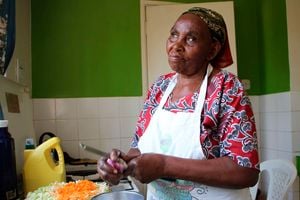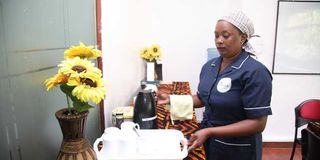
Regina Wanjiru is trained on how to properly set and serve a table during a hospitality session at Maids of Honour-Africa facility in Lavington, Nairobi on April 30, 2026.

In 2011, from her home in Kilimani, Nairobi, a mother of three found herself confronting a challenge common to many households in Kenya. That of finding trustworthy, skilled and reliable domestic help.
After repeated attempts to secure a housekeeper and nanny capable of balancing childcare, cooking and managing the household, Evelyne Kihia turned the experience into a business idea that would later become significant to efforts to formalise Kenya’s domestic work sector.
This is how Maids of Honour Africa, a training and placement agency serving households, corporates and institutions, came about. The business began as a small home-based training initiative intended to address gaps in Kenya’s domestic work environment, a sector that has long remained informal, fragmented and largely undervalued despite its importance to millions of households.

Maids of Honour-Africa Founder and CEO Shiko Kihikia during an interview at their facility in Lavington, Nairobi, on April 30, 2026.
In its early days, Evelyne, better known as Madam Shiko, trained domestic workers in cookery and housekeeping, while introducing basic workplace discipline and professional standards. Within a short period, the venture was serving close to 40 clients a month.
By 2012, rising demand had outgrown the initial set-up, prompting a move to larger premises. Training expanded to additional modules in healthy cooking, mentoring and advanced housekeeping.
Evelyne says the focus is on setting standards for training and placement while addressing the trust gap that has long defined the market.
Over time, the operation developed from one-off placements into a subscription-based arrangement that gives households ongoing access to trained and vetted domestic workers, with support continuing after placement.
It is organised into tiered offerings, such as specialised service divisions which cover functions such as recruitment, training, performance management and replacement arrangements.
“The subscription arrangement allows us to move away from one-off hiring to more structured household support systems. It is intended to improve consistency and accountability for both families and workers,” she says.
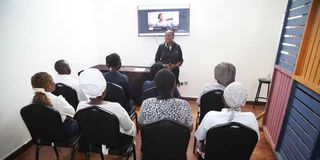
Maids of Honour-Africa Founder and CEO Shiko Kihikia trains housekeepers on how to properly perform household duties at the facility in Lavington, Nairobi, on April 30, 2026.
She adds that the longer-term plan is to integrate technology and skills development into the organisation of domestic work, an area that has largely remained informal, and also influence how the sector is structured and managed.
“We have developed an AI-based vetting and rating system that allows families to assess service providers with greater confidence, while also giving workers a portable record of reliability and performance,” she says.
Service providers undergo continuous assessment, supported by digital training platforms covering housekeeping, nutrition, childcare, eldercare and household management.
The firm has also expanded into corporate and institutional services, supplying staff to offices, schools and those in the hospitality business. Apart from nannies, they also provide caregivers, cooks, drivers and personal assistants. “We also offer access to Sacco schemes, financial literacy training and health coverage. This extends financial services, including insurance, savings and access to credit,” she says.
These measures are intended to provide more stable income pathways and access to basic social protections for domestic workers, a segment that has historically operated with limited safeguards.
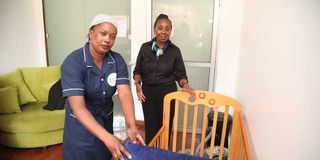
Maids of Honour-Africa Founder and CEO Shiko Kihikia (right) trains Regina Wanjiru on how to perfect house chores at their facility in Lavington, Nairobi, on April 30, 2026.
Domestic work in Kenya, as in much of the continent, has largely relied on informal hiring channels, often through referrals or brokers, with limited standardisation.
This has exposed families to inconsistent skill levels, high turnover and limited accountability, while domestic staff continue to bear the consequences of an unregulated system.
In the absence of formal contracts, statutory contributions and structured training, many earn below the minimum wage and remain vulnerable to job insecurity, which limits their ability to plan for the long term. “Most households regard domestic workers as temporary help rather than skilled professionals. In reality, they are entrusted with raising children, caring for the elderly and managing the running of homes,” she explains.
This lack of recognition has created persistent challenges for both sides.
For households, trust and reliability remain central concerns, while those providing domestic services face low pay, limited motivation and restricted access to professional development, reinforcing a cycle of attrition that serves neither party.
Within this context, the company operates as an intermediary between households and service providers. It uses a structured process that includes identifying household needs, interviewing candidates and placing selected individuals.
It also provides post-placement management, including follow-up with households and exit interviews with those who leave assignments. To date, it has vetted and trained more than 1,500 candidates and matched over 1,000 households with domestic staff across roles such as childcare, eldercare, cooking and household management.

A housekeeper is trained on how to properly set and serve a table during a hospitality session at Maids of Honour-Africa facility in Lavington, Nairobi on April 30, 2026.
Evelyne notes that training and financial inclusion initiatives are intended to improve access to more structured employment opportunities, alongside clearer contractual protections and progression pathways.
“We bring together households in need of domestic support and those seeking formal ised employment opportunities, with the intention of building a network of trained service providers within domestic work,” she says.
Kenya’s domestic service market is extensive, with hundreds of thousands of households relying on such arrangements, although most remain informal.
Maids of Honour operates in a labour market where one of the most persistent challenges is the absence of reliable worker histories, making it difficult to independently verify experience, consistency or performance over time.
This is compounded by high mobility among domestic staff, many of whom move frequently between households in search of better pay or working conditions, which in turn disrupts continuity for both clients and the agency.
At the same time, the company must navigate varying household expectations that are often informal and unstandardised, ranging from differing definitions of duties to inconsistent views on pay and working hours, all within a space where enforcement of labour norms remains weak.
“We continue to invest in human touchpoints alongside our operational systems. This blending of digital efficiency and personal engagement is what we believe allows us to continue scaling without losing our foundational approach,” she says.
The implications of this approach extend to both households and workers. For households, it is intended to improve access to structured domestic support, including childcare and eldercare, while strengthening trust in hiring arrangements.
Follow our WhatsApp channel for breaking news updates and more stories like this.