Off the busy thoroughfares of Ngong Road at the Jamhuri Showground in Nairobi, the rhythmic thud of a counterbalance loom cuts through the workshop noise. Hand to shuttle, foot to treadle, the motion is precise and deliberately slow.
Founded in Kibera before scaling up to its current location, Mukabwa Handmade Studio relies on a craft-led framework that diverges from conventional commercial textile manufacturing. While much of Kenya's apparel sector pivots toward automation, digital printing, and high-capital machinery to compete with imported volume, founder Hillary Mukabwa is betting on low-volume, manual craftsmanship.
The enterprise specialises in custom fabrics, tailored garments, hand-stitched bags, and bespoke upholstery produced entirely on wooden looms.
Handmade fabric tote bags displayed at Mukabwa Handmade Studio in Nairobi on August 27, 2026.
Photo credit: Bonface Bogita | Nation Media Group
“It is a deliberate move to capture premium market share—catering to consumers disaffected by mass-market uniformity in favour of lineage, material integrity, and ethical supply chains,” he says.
Two dominant structural forces drive the overarching narrative of Kenya’s apparel sector. On one end sit capital-heavy, export-focused manufacturers anchored in Special Economic Zones (SEZs), while the market floor is defined by a massive inflow of secondhand imports (mitumba). Caught between these extremes are boutique domestic labels, squeezed in the middle and struggling to achieve the economies of scale needed to source custom-milled fabrics affordably. Mukabwa, who holds academic credentials in both finance and design, targeted this supply gap as a commercial opportunity.
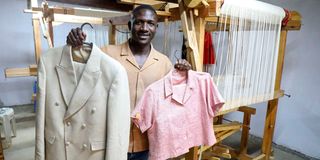
Mukabwa Handmade Studio founder and lead designer Hillary Mukabwa operates a traditional wooden handloom at the studio’s workstation at Jamhuri Showgrounds in Nairobi on August 27, 2026.
Photo credit: Bonface Bogita | Nation Media Group
Backed by Sh1.6 million in seed capital, he established an in-house production setup staffed by two weavers, two tailors, a quality assurance analyst, and an accountant. Turning raw domestic yarn into finished fabric on hand looms, he notes, insulates the business from supply-chain delays that typically hamper early-stage African fashion brands.
“We focus exclusively on handmade textiles, operating machinery powered entirely by hand and foot controls," he explains, his hands maintaining an uninterrupted cadence across the warp and weft of a developing tote bag fabric.
"It functions on a counterbalance mechanism that lifts opposing harnesses to open the shed between thread layers, allowing the shuttle to pass through to construct the weave. To me, mastering this process is just as critical as the final aesthetic design,” he says.
"It produces a fabric with greater structural integrity and longevity than mass-manufactured synthetic alternatives," he says.
New Content Item (2)
Photo credit: Bonface Bogita | Nation Media Group
According to him, the decision to forego automation functions as a margin-preservation strategy. In the high-end textile market, pricing power relies heavily on scarcity, labour-intensive production, and provenance. Treating hand-woven fabrics as artisanal items rather than mass-market commodities allows the enterprise to leverage spatial constraints and low-volume output to establish commercial exclusivity. The handloom weaving tradition, once an integral pillar of regional craft economies across sub-Saharan Africa, has faced near-extinction under the weight of synthetic imports and modern industrial looms.
The barrier to entry for younger players remains twofold, combining prohibitive capital outlay for automated machinery with widespread scepticism toward manual craft.
“I came to realise that there was a severe structural gap in our local market. Creatives and young entrepreneurs in my demographic were either unfamiliar with handloom mechanics or actively shied away from the discipline,” he says.
The discipline, he adds, is widely dismissed as a demanding, low-margin legacy process.
“My objective was to dismantle that misconception by demonstrating that handloom weaving, when backed by contemporary brand positioning and disciplined capital management, can serve as a high-value manufacturing engine.”
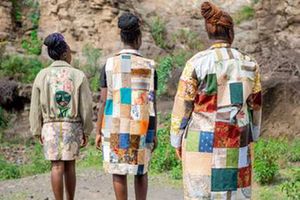
Sourcing 100 per cent local Kenyan cotton provides the studio with a backward integration strategy to mitigate exposure to foreign exchange volatility and international shipping disruptions. The raw materials feed into a product line spanning home accessories and custom apparel—including upholstery, throw blankets, pillowcases, Kikois, tote bags, and tailored garments—with retail prices ranging from Sh3,000 to Sh20,000.
For the B2B segment, the enterprise supplies customised handwoven bags, souvenirs, and corporate gifts for institutional events, annual general meetings, and brand activations. This aims to capture demand from corporate clients seeking locally produced alternatives to imported or mass-manufactured promotional merchandise.
Mukabwa Handmade Studio founder and lead designer Hillary Mukabwa operates a traditional wooden handloom at the studio’s workstation in Nairobi on August 27, 2026.
Photo credit: Bonface Bogita | Nation Media Group
For emerging luxury enterprises, capital efficiency is paramount.
“Holding high volumes of finished inventory represents a significant liquidity risk, particularly when catering to a niche, high-value demographic,” he notes.
His studio mitigates this balance-sheet risk through a strict build-to-order execution model, primarily delivered via digital direct-to-consumer (D2C) channels. Rather than producing seasonal collections on speculation, Mukabwa operates an interactive, co-creation sales pipeline. Clients engage directly with him to define colour profiles, geometric patterns, weight, and garment silhouettes before a single thread is wound onto the shuttle. At this stage, the studio operates primarily on a pre-order and custom commission model.
“The high-net-worth individuals and creative professionals who reach out to us are looking for hyper-personalised garments. They come to the studio, and together we select the thread specifications, define the weave structure, and establish the overall design. The client becomes an active stakeholder in the manufacturing process,” he says.
Mukabwa Handmade Studio founder and lead designer Hillary Mukabwa operates a traditional wooden weaving frame at the studio’s workstation in Nairobi on August 27, 2026.
Photo credit: Bonface Bogita | Nation Media Group
This demand-driven structure minimises inventory wastage, optimises working capital, and commands high gross margins while capitalising on growing global demand for bespoke, traceable luxury items.
Looking ahead, the enterprise plans to open a flagship retail store and showroom in Nairobi, alongside launching a structured weaving training initiative in Kibera.
"Growth is incomplete if it remains isolated within the balance sheet of this studio," he says. "The vision is to expand our operational footprint and build a sustainable platform for community transformation in Kibera, where I was raised, by training young men, women, and mothers who lacked access to formal tertiary education."
He adds that equipping trainees with technical skills in handloom mechanics, textile design, and inventory management is intended to build long-term capability rather than provide short-term labour. “It is about providing dignity and economic empowerment through craft," he says.
"We want to show that high-value economic growth in Africa’s creative sector does not always require capital-intensive, high-volume industrialisation. There is a viable commercial path in low-volume, high-margin craftsmanship,” he says.
Ultimately, the primary operational hurdle for heritage-based micro-enterprises lies in managing volume growth without eroding the product scarcity that supports premium margins.
As boutique producers move from informal direct-to-consumer pipelines into commercial retail spaces, institutionalising technical quality standards across an expanding workforce will determine their long-term competitiveness in the regional manufacturing market.