Plans to establish a national Camel Centre of Excellence have gained momentum following a study commissioned after the Fourth Pastoralist Leadership Summit in Wajir in December 2024, as Kenya seeks to expand milk production and commercialise its growing camel sector.
The proposed centre is expected to strengthen research, animal health, breeding, processing and marketing of camel products, amid President William Ruto’s call to explore alternative milk sources, including camel and buffalo milk, to meet the country’s growing demand.
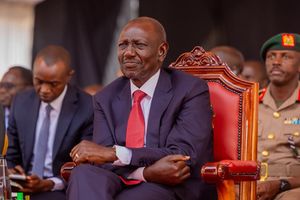
The President made the call on October 8 during the Agriculture and Food Systems Transformation Summit 2026 at Jamhuri Park, ASK Showground, Nairobi. The three-day summit, held from October 7 to 9, was themed “Agriculture and Food Systems Transformation — Advancing Food Sovereignty, Job Creation, and Shared Prosperity under BETA.”
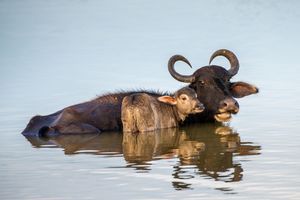
“I had told the Livestock PS to bring in good breeds of camels and buffaloes. I hear buffaloes also produce a lot of milk. If others are milking them, why can’t we do the same? What is wrong with that? We need to diversify our sources of milk,” Dr Ruto said.
The Head of State also highlighted the commercial potential of camel milk, saying a litre sold in urban markets could fetch between Sh180 and Sh200, nearly three times the price of cow’s milk. The President linked the need to diversify milk sources to supply pressures caused by drought and asked Principal Secretary for Livestock Development Jonathan Mueke to explore improved camel breeds and buffalo production.
The summit’s focus on food sovereignty and agricultural commercialisation has added urgency to the proposed centre, which stakeholders say could help pastoralists move from largely informal trade to organised production, processing and marketing.
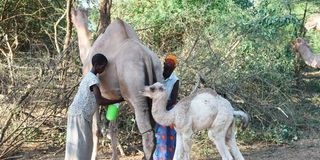
Borana herders community milk a camel on June 9, 2011.
Photo credit: File | Nation Media Group
Presenting the study findings at a consultative workshop in Nairobi this week, Dr Piers Simpkin, founder and CEO of Spiers Consultants, said consultations with more than 200 pastoralists and over 33 key informants across northern Kenya identified animal health and disease surveillance as the top priorities, followed by market access and value addition. “Animal health came out as the first priority, followed by market access and value addition,” Dr Simpkin said. The study recommends a coordinated institution connecting research, training, veterinary services, breeding programmes and market development while building on existing institutions instead of duplicating their work. It also identifies rangeland management, animal nutrition, genetic characterisation and knowledge sharing as priorities for improving productivity and strengthening pastoralists’ livelihoods.
The design study was commissioned in April 2026 and conducted by Spiers Consultants. It was supported by Prosper Global, formerly Mercy Corps, through the 12-year Regional Livestock Programme, funded by the Swiss Agency for Development and Cooperation (SDC) and the French Development Agency (AFD). The programme seeks to improve livestock markets for climate-resilient, inclusive and sustainable livelihoods.
Dr Simpkin, in an exclusive interview with Seeds of Gold , said pastoralists wanted stronger disease surveillance, better veterinary services and community-based mechanisms for reporting suspected outbreaks early. “The proposed centre would support access to quality breeding animals and improve understanding of camel productivity and adaptation to changing environmental conditions,” shared the expert who is also a camel farmer.
Kenya has an estimated 4.7 million camels, making it the fourth-largest camel-owning country globally, according to figures cited by government representatives during the workshop. Camels are suited to arid and semi-arid lands (ASALs), where they provide milk, meat, transport and income in environments that challenge other livestock species.
Jane Meriwas milks a camel at her home at Kipsing village in Isiolo County on May 23, 2024.
Photo credit: File | Nation Media Group
Despite this potential, Dr Simpkin said the camel industry remains underserved by research and development. Through the report, he cited limited diagnostic and genetic research capacity and constraints affecting existing institutions. The study also found that about 94 per cent of camel trade takes place informally, limiting traceability, market information and producers’ ability to capture more value.
A national centre could help formalise the industry, improve standards and support markets for camel milk, meat, breeding stock, hides and skins. It could also connect pastoralists with processors and buyers, helping them secure better returns while improving product quality and consumer confidence.
Dr Simpkin said the study considered several institutional options, including a fully-fledged physical centre, a network model connecting existing institutions and a smaller secretariat coordinating research, training and services. A fully fledged centre could require about $17.3 million (approximately Sh2.2 billion) in capital investment and $5 million to $6 million (Sh645 million to Sh774 million) annually to operate.
Smaller models were estimated to cost between $3.1 million and $11 million (about Sh400 million to Sh1.42 billion) to establish, with annual running costs of between $600,000 and $1.6 million (about Sh77 million to Sh206 million). These are indicative estimates, with final costs depending on the model, facilities and services selected. “The centre should not be viewed simply as a building. Its success will depend on coordination, community ownership and sustainable financing,” Dr Simpkin explained, stressing the need to link universities, research organisations, national and county governments, private businesses and pastoralist groups.
Value addition is another proposed focus. Stakeholders said the centre could help improve hygiene, handling, processing and marketing while supporting the development of pasteurised camel milk, yoghurt, flavoured milk and ice cream. Better quality control and certification could help producers access higher-value markets.
Prof Joshua Arimi of Meru University of Science and Technology said the institution had developed camel yoghurt, showing the potential to diversify products beyond fresh milk. Other stakeholders called for improved standards for camel milk products, including smoked camel milk. They raised questions about the type of smoke used and its implications for product quality and safety, saying the proposed centre should link research with standards development, practical training and commercial production.
Dr Paul Muraya, from the Office of Caroline Karugu, Principal Secretary for the State Department for ASALs and Regional Development, said the Government supported the centre following the resolution adopted at the 2024 pastoralist summit. “Camels are increasingly important as pastoralists adapt to changing climatic conditions and seek livestock that could survive in dry environments,” he stated. Data shows camel milk production increased from 61,157 tonnes in 2020 to 71,490 tonnes in 2024, representing growth of 16.9 per cent.
Dr Muraya said poor hygiene, handling practices, inadequate equipment and limited collection and processing infrastructure contribute to milk losses. “About half of camel milk could be wasted, denying producers income and limiting the quantity reaching consumers,” he estimated.
Improving collection systems, cooling, processing and transport would be critical to reducing losses and making camel milk more readily available in urban markets. Therefore, the proposed centre should strengthen research, innovation, capacity development, market access and knowledge management, with pastoral communities involved in its ownership and operations. Women and young people should also benefit from opportunities in milk collection, processing, transport and marketing.
Prof Abdi Guliye, Advisor for Livestock and Rangeland Management in the Executive Office of the President, called for a clear legal framework to guide the centre’s establishment and long-term operations. He urged the task force to consider a standalone Act of Parliament defining its mandate, governance, financing and relationship with existing livestock institutions. “The legal framework must be clear, and the centre must have a defined mandate, sustainable financing and strong links with the communities it is meant to serve,” the former Electoral and Boundaries Commission (IEBC) commissioner advised.
He said the study should recommend a location using clear criteria and proposed starting on a manageable scale, with offices and one or two laboratories, before expanding as demand and resources grow. Prof Guliye, however, cautioned against overreliance on donor projects and political cycles, saying the centre would need sustainable financing to maintain its core services.
Kenya’s camel sector shares challenges and opportunities with neighbouring countries in the Horn of Africa, where camels are central to pastoral economies. In Somalia and Ethiopia, camel milk is consumed and traded through domestic and cross-border markets. India, with its established camel-rearing communities and substantial buffalo dairy sector, could offer lessons in breeding, animal health and product development.