A sea of maize stretches as far as the eye can see, its lush green canopy merging with the distant horizon.
This is the breathtaking sight that welcomes us to Mama Fresh Organic Farm in Tuigoin, Trans Nzoia County, where farming is more than just a means of producing food.
It is a carefully designed system in which every resource has a purpose and waste is turned into wealth.
The farm has become a learning ground for local farmers seeking practical ways to improve productivity, embrace smart agriculture and conserve the environment.
At Mama Fresh Organic Farm, the principles of a circular economy underpin daily operations. Rather than treating waste as an unwanted by-product, the enterprise converts it into valuable resources that support crop production, livestock feeding and energy generation.
On just one acre, farm owner Violet Rotich manages more than 3,000 poultry birds alongside dairy cows, sheep, pigs and guinea fowl. She also grows a variety of vegetables, including African nightshade, amaranth, capsicum, collard greens and spinach.
Rotich tells Seeds of Gold that her decision to embrace organic farming was driven by a desire to explore sustainable production methods and reduce reliance on synthetic farm inputs, which she considers expensive.
She inherited her interest in farming from her parents, who practised traditional agriculture. However, she wanted to go a step further by researching smart farming techniques that would enable her to maximise production while making better use of available resources.
Initially, Rotich relied on casual jobs that paid her about Sh6,000 a month. Rather than spend all her earnings, she reinvested part of the money into poultry farming.
She started with just six indigenous chickens. Over time, the small venture grew into a diversified farming enterprise that now integrates poultry, livestock, crop production and renewable energy.
Violet Rotich in her flourishing capsicum farm during an interview with the Seeds of Gold on July 16,2026.
Photo credit: Richard Maosi | Nation Media Group
For Rotich, the journey has demonstrated that farmers do not necessarily need large tracts of land to establish productive agricultural enterprises. What matters is how effectively they utilise the resources available to them.
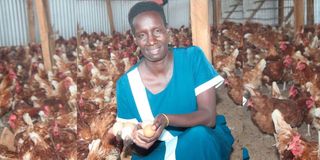
One of the practices she has adopted is the deep-litter system of poultry management, particularly for her commercial layers.
“Under this system, poultry are kept on a floor covered with bedding material such as wood shavings, rice husks or other suitable absorbent materials. The litter accumulates over time and is managed through regular maintenance rather than being completely removed every day,” she adds.
Rotich says the system is relatively affordable for farmers starting out in commercial poultry production, as it can reduce the initial investment required compared with certain cage-based housing systems.
She encourages aspiring poultry farmers to assess their resources and begin with a manageable flock before expanding their operations.
Her commercial layers produce eggs for sale, providing the farm with an additional source of income.
According to Rotich, a flock of 1,000 layers produces about 33 trays of eggs. However, production levels depend on factors such as the birds' age, breed, feeding programme and general health.
Beyond egg production, the deep-litter system provides manure that supports the farm's circular economy model.
Rather than allowing the waste to accumulate without a clear purpose, Rotich collects it for use in other farm enterprises, including black soldier fly production.
At Mama Fresh Organic Farm, poultry manure is among the resources used to support the production of black soldier fly larvae.
Violet Rotich displays an instrument that is used to detect the appropriate temperatures for rearing the Black soldier fly.
Photo credit: Richard Maosi | Nation Media Group
The manure and other suitable organic materials provide an environment that attracts the flies, which lay eggs that hatch into larvae.
“When properly reared and processed, the larvae provide a protein-rich ingredient that can be incorporated into animal feed, including diets for pigs and poultry,” she alludes.
This approach helps the farm recover nutrients from organic waste while exploring alternatives to conventional feed ingredients.
However, Rotich notes that feed prepared from these resources must be properly processed and balanced to meet the nutritional requirements of the animals.
For farmers seeking to replicate the model, appropriate hygiene, substrate management and feed-safety practices are essential to ensure that the resulting products are suitable for livestock consumption.
Rotich has installed a biogas system that uses livestock and poultry waste to generate energy for some of the farm's daily operations.
The waste is fed into a biogas digester, where microorganisms break down organic matter in the absence of oxygen, producing gas that can be used as fuel.
At Mama Fresh, the biogas supports activities such as chick brooding, helping reduce reliance on electricity for heating.
For Rotich, the system offers an opportunity to reduce energy costs while putting farm waste to productive use.
She says the digester is fed daily, while routine cleaning and maintenance are undertaken to keep it functioning effectively.
Once the digestion process is complete, the resulting slurry is directed towards crop production, where it can be used as an organic fertiliser, subject to appropriate handling and application.
The slurry helps return nutrients to the soil, supporting the cultivation of crops and animal fodder.
In this way, waste from livestock contributes to energy generation, while the by-product of that process supports crop production.
The system creates a cycle in which different farm enterprises complement one another rather than operating independently.
Away from the livestock units, Rotich has devoted part of her farm to growing organic vegetables, including capsicum.
She says even a relatively small growing area can generate meaningful returns when crops are properly managed and marketed.
According to her, a plot measuring about one square metre can produce capsicum worth approximately Sh10,000, although returns depend on production levels, prevailing market prices and other costs.
To manage pests and diseases, she uses a mixture of pepper, neem oil and garlic as part of her crop protection approach.
She says this allows her to explore alternatives to conventional chemical pesticides while maintaining the quality of her produce.
Violet Rotich from at her farm in Tuigoin in Trans-Nzoia County on July 16, 2026.
Photo credit: Richard Maosi | Nation Media Group
However, she acknowledges that successful organic production requires close monitoring of crops, proper soil management and timely intervention when pests or diseases appear.
Rotich believes that farmers can improve their earnings by diversifying their enterprises instead of relying on a single source of income.
At Mama Fresh, poultry provides eggs and manure, livestock supplies additional manure, black soldier fly larvae offer a potential feed ingredient, and biogas provides energy.
Meanwhile, the vegetable section contributes to food production and household income.
Despite the opportunities in poultry farming, Rotich warns that disease outbreaks can cause significant losses if farmers fail to observe proper biosecurity measures.
The highly contagious viral disease can cause respiratory problems, digestive disturbances, nervous signs and high mortality in susceptible flocks.
Rotich says prevention requires regular cleaning and disinfection of poultry houses, restricting unnecessary movement of people into poultry units and limiting contact between chickens and other birds.
She also emphasises the importance of proper feeding, vaccination and close observation of the flock.
Vaccination programmes should be developed with guidance from a qualified animal-health professional to ensure that birds receive the appropriate vaccines at the right time.
Rotich also rears and sells young chicks, with a one-month-old chick going for about Sh300, depending on the market and other prevailing factors.
She says proper vaccination, feeding and general management are essential before birds are sold to customers.
Violet Rotich from at her farm in Tuigoin in Trans-Nzoia County on July 16, 2026.
Photo credit: Richard Maosi | Nation Media Group
For her, maintaining healthy livestock is just as important as expanding production because disease outbreaks can quickly undermine the gains made through farming.
Despite operating on a small piece of land, Rotich has set her sights on expanding the poultry enterprise.
Her vision is to increase the flock to more than 20,000 chicks in the coming months, building on the experience and systems she has developed over time.
She believes that organic farming and resource-efficient agriculture offer opportunities for farmers seeking to improve productivity while managing production costs.
Her approach, however, is not limited to producing more food. It also involves making better use of what the farm already generates.
From poultry manure to biogas slurry, each by-product is viewed as a resource that can support another activity within the enterprise.
Rotich says she wants more farmers to appreciate the value of integrating different agricultural enterprises, particularly where land and capital are limited.
For her, the future of farming lies in systems that combine productivity, environmental conservation and efficient resource use.
At Mama Fresh Organic Farm, the guiding principle is simple: one enterprise's waste can become another's resource, helping farmers reduce costs, diversify their income and get more value from every acre.