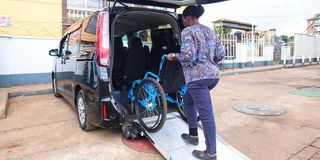
Betty Ndegwa, a driver at Ace Mobility, loads a wheelchair into a vehicle using a retractable metal ramp at Uthiru, Nairobi, on March 28, 2026.

Access to reliable and accessible transport remains a major challenge for people with reduced mobility in Kenya, limiting their participation in work, healthcare, and social life.
Nairobi-based social enterprise Ace Mobility, founded in 2020, is addressing this gap through a specialised ride-hailing service for persons with reduced mobility (PRMs) across Africa. The company’s co-founder and chief executive, Daniel Gatura, was inspired to set up the business after witnessing the challenges faced by his father following a spinal cord injury.
When Gatura was five years old, his father suffered a life-altering accident that left him wheelchair-bound. Despite being a mechanical engineer, he was dismissed from his job due to a lack of suitable commuting options.
“The country’s infrastructure simply does not accommodate persons with diverse disabilities, and public transport presents countless barriers. That experience shaped my childhood,” he says.
He grew up determined to develop a solution for his father and for the estimated 200 million Africans, including five million Kenyans, living with similar challenges. The company also provides last-mile transport for people with disabilities, the elderly, the sick, pregnant women, as well as others requiring additional support when commuting.
Currently operating in Nairobi, it runs a fleet of 20 vehicles equipped with ramps and adjustable swivel seats that can rotate up to 90 degrees outside the vehicle, lower, and, in some cases, allow full passenger transfer for safe boarding and alighting.
Bookings can be made through the company’s website or via the Ace Mobility app, available on the Play Store and App Store. Both platforms allow users to arrange transport independently.
Once a pickup location and destination are entered, the app connects the passenger to a driver trained to provide support throughout the journey.
“We charge for our services, but revenue from B2B clients is often used to provide discounts for B2C customers, effectively cross-subsidising individual users,” he explains.
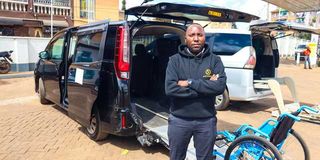
Ace Mobility founder Daniel Gatura Kamau stands next one of his vehicles which is equipped with features to accommodate wheelchairs and other mobility aids at Uthiru, Nairobi on March 28, 2026.
Globally, modern ride-hailing services are integrating accessibility features to better support passengers with disabilities. AI-powered in-vehicle assistants, for instance, enhance communication for those with sensory impairments.
In Africa, starting with Kenya, Ace Mobility is implementing these technologies while also advocating for hybrid and electric vehicles.
Relying on voice
Text-based platforms enable communication without relying on voice, while voice-to-text tools convert spoken instructions into real-time on-screen text. Additional features such as vibration feedback, visual alerts, and dashboard signals provide important updates, including incoming calls, emergency notifications, and turn signals.
Accessibility filters also allow users to customise their ride, such as requesting drivers proficient in sign language or selecting chat-only communication modes.
These innovations, alongside AI-driven navigation and predictive routing, are helping create a more inclusive transport system.
“Technology can remove barriers that have existed for decades. Combining smart apps with specially equipped vehicles allows passengers to travel safely and independently, increasing autonomy and social inclusion,” he says, adding that accessible transport is not merely a convenience but a right.
He explains that scaling has been challenging, largely because the sector remains niche. With a team of six office-based employees and 20 trained drivers, growth has been steady but gradual with increasing awareness and rising demand for the rides. Since its inception, the company has served over 6,000 clients. He cites funding as the biggest constraint, noting that the business has largely been bootstrapped with minimal external capital.
Access to capital remains a key challenge, with the high cost of acquiring and maintaining specialised vehicles limiting growth. Financial institutions often lack tailored products for enterprises serving niche markets, restricting access to credit and forcing many operators to rely on internal financing and incremental expansion. Establishing a pricing structure that balances affordability with operational costs remains a challenge, while fleet expansion is further limited by high vehicle costs and the lack of government subsidies or tax incentives.
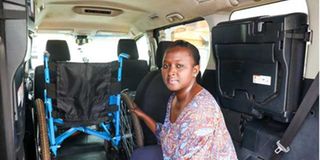
Betty Ndegwa, a driver at Ace Mobility, inside a vehicle equipped with inclusive features to accommodate wheelchairs and other mobility aids.
Infrastructure limitations also remain a significant barrier. Many buildings across the country are not designed to accommodate people with reduced mobility, affecting how they navigate urban spaces.
The development of accessible transport in Kenya is also shaped by the broader regulatory environment governing mobility and urban planning. While disability rights are recognised in principle, implementation within transport systems has often lagged, with enforcement remaining inconsistent across operators.
Gatura says clearer standards and stronger enforcement could support wider adoption of inclusive transport solutions.
Uniform guidelines
“In the absence of uniform guidelines, many operators continue to rely on voluntary compliance, resulting in uneven levels of accessibility across regions and service providers, limiting access to education, healthcare and economic opportunities,” he notes.
The role of public institutions is also central to discussions around inclusive transport, with collaboration between private operators and government agencies seen as key to scaling services.
Such collaboration may include infrastructure development, incentives for accessible vehicle importation, or integration with broader urban transport systems.
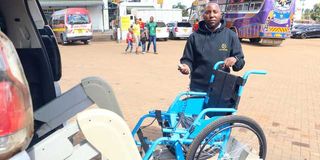
Ace Mobility founder Daniel Gatura Kamau operates a wheelchair lift machine at the back of a vehicle equipped with inclusive features to accommodate wheelchairs and other mobility aids.
To address these gaps, the businessman suggests policies mandating accessible public transport, alongside training for operators, to improve commuting for affected users.
He adds that tax incentives or subsidies for vehicle importation could further enhance affordability for those who need these services most. Inclusive transport looks promising, with innovations ranging from haptic steering wheels to real-time sign language avatars pointing to a more inclusive future.
“However, achieving this will require a collective effort—from developers and designers to policymakers and passengers—to ensure these technologies become standard rather than exceptional,” he notes.
Through impact investors, the enterprise has raised USD 75,000 to date and is currently seeking an additional USD 750,000. The funding, he says, will support the expansion of its fleet to 100 vehicles and the transition to a fully on-demand service, alongside plans to enhance accessibility across Africa as operations scale.
The company is also involved in efforts to influence societal attitudes towards people with mobility challenges.
Gatura adds that in future, drivers and service staff with mobility challenges will be employed, creating opportunities for participation in work and professional roles, with access to training, employment and pathways into driving and related services.
“Such opportunities would allow individuals to support their communities while gaining economic independence and practical skills,” he says, adding that this would also support the expansion of service capacity.
Gatura notes that efforts are underway to explore local customisation of vehicles to improve affordability and accessibility, alongside supporting users in sourcing and adapting vehicles for personal use.
Follow our WhatsApp channel for breaking news updates and more stories like this.