A sharp rise in the cost of tomatoes and beef pushed Kenya’s inflation back to 4.4 percent in March, reversing the slight easing recorded in February and signalling renewed pressure on household budgets.
Latest official data shows annual inflation ticked up from 4.3 percent in February, driven largely by increases in food prices, which remain the most volatile and influential component of the consumer basket.
The rebound brings inflation back to levels last seen in January, underlining how quickly gains in price stability can be eroded by shifts in food supply and market conditions.
Month-on-month, prices of food and non-alcoholic beverages rose by 1.1 percent between February and March, reflecting fresh pressures on key staples.
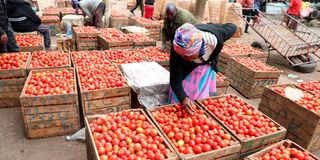
Tomatoes recorded the sharpest increase, rising 13.3 percent in a single month, while beef with bones edged up by 1.8 percent over the same period.
Titus Mwangi, 26, sells tomatoes on Wednesday, June 28, 2023.
The spike in tomato prices highlights the continued sensitivity of vegetable costs to supply disruptions, even as seasonal rains begin to stabilise output.
While vegetables often respond quickly to weather patterns, price corrections are not always immediate particularly where distribution and market inefficiencies persist.
Monthly inflation in the housing and utilities category rose 0.4 percent between February and March, driven largely by higher electricity tariffs.
“Electricity price increased by 2.5 percent and 2.2 percent for 50 kWh and 200 kWh, respectively between February 2026 and March 2026,” wrote the Kenya National Bureau of Statistics (KNBS).
A worker at Kayole Slaughter House prepares beef for sale.
Photo credit: BILLY MUTAI|NATION
Some food items such as sugar and loose maize grain offered partial relief as their prices declined 1.3 percent and 2.4 percent respectively. Others that registered price declines were cabbages and spinach.
“The price of one kilogramme of cabbages decreased from Sh74.33 to Sh71.52, while one kilo of loose maize grain dropped from Sh72.19 to Sh70.44. Similarly, spinach (one kilo) recorded a marginal drop from Sh113.11 to Sh111.58,” said KNBS.
The food and non-alcoholic beverages basket recorded an annual inflation rate of 7.7 percent, remaining the biggest driver of overall price movements.
Fresh tomatoes for sale at Githurai Market, Nairobi, in 2023. More than a billion Africans cannot afford a healthy diet.
Photo credit: File | Nation Media Group
Transport costs also contributed to the inflationary pressure, rising by 3.8 percent over the year, while the housing, water, electricity, gas and other fuels division registered a two percent annual increase.
The three categories together account for more than 57 percent of the total consumer basket, making them central to the country’s inflation trajectory.
Non-core inflation, which includes volatile food and energy items, stood at 10.8 percent in March, significantly higher than core inflation of 2.1 percent during the same period.
The divergence between core and non-core inflation underscores the outsized influence of food and energy costs on overall inflation.