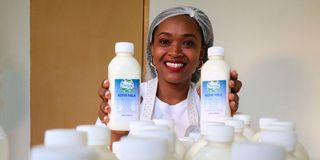
Juliet Koikai, displays some of her products at her small firm in Pipeline, Nakuru County on May 30, 2026. She is the proprietor of Kefir milk, a probiotic product with anti-Hpylori effect.

Juliet Silantoi had spent a year working in Kenya’s banking sector before she began to question the permanence of the career she had once considered secure.
The long hours, performance targets and procedural routine that define much of corporate banking had provided financial stability. Still, they had also distanced her from the kind of work she increasingly found meaningful.
In 2019, she left the industry, unsure of what path to pursue. She ventured into the dairy sector and later identified an opportunity in kefir production, a niche area in Kenya’s dairy market that is not widely developed on a commercial scale.
From a small processing facility in Nakuru County, she runs Dapfarm, a kefir production business supplying supermarkets, cafés, wellness outlets and individual consumers with fermented dairy products marketed as probiotics.
The business operates around a product that remains relatively unfamiliar within Kenya’s mainstream dairy market and requires constant refrigeration, precise fermentation and sustained consumer education.

Juliet Koikai, inspects milk boiling in an electric boiler at her firm in Pipeline, Nakuru County on May 30, 2026. She makes a probiotic product with anti-Hpylori effect.
The transition from banking to dairy fermentation was neither immediate nor particularly calculated.
Her introduction to kefir began through personal experimentation after researching fermented foods linked to digestive health, following the loss of her father due to a perforated stomach caused by an ulcer.
“I was not thinking about business in the beginning. I was trying to understand the product first—how it behaves, how fermentation works, what affects taste and consistency,” she says.
Kefir, originally associated with Eastern Europe and parts of Central Asia, is produced by fermenting milk using kefir grains — clusters of bacteria and yeast cultures that convert lactose into lactic acid.
Unlike yoghurt, which relies predominantly on bacterial fermentation, kefir undergoes mixed fermentation involving both bacteria and yeast, producing a drink with a tangy taste and slight effervescence.
For months, she experimented in her kitchen, refining fermentation times and storage conditions while testing different milk sources.
Friends and family who sampled the product began regularly requesting bottles, prompting her to consider whether there was room in Kenya’s growing consumer market for a specialised fermented dairy business.
“The challenge was that most people had never heard of kefir. Even now, many customers still confuse it with yoghurt or mala,” she says.
She invested about Sh50,000 from her savings to start the business in Nakuru. She later put in an additional Sh200,000 to purchase machinery, selecting the location for its proximity to dairy farmers and lower operating costs.
The startup capital was used to acquire essential equipment and cover packaging, licensing, food safety certification and the conversion of a rented space into a compliant small-scale processing unit.
Juliet Koikai, displays some of her products at her small firm in Pipeline, Nakuru County on May 30, 2026. She is the proprietor of Kefir milk, a probiotic product with anti-Hpylori effect.
What initially seemed manageable became operationally complex due to the strict consistency required in dairy fermentation. Variations in milk quality, temperature sensitivity during fermentation, and seasonal changes all affect production.
While home producers can adjust with simpler methods, commercial production requires precise temperature control, and equipment failures such as refrigeration breakdowns can lead to the loss of entire batches.
“People think you just add culture to milk and bottle it. But fermentation is extremely sensitive. Small inconsistencies affect flavour and texture,” she explains.
The production process begins before dawn several days each week when fresh milk deliveries arrive from dairy farmers within Nakuru County. Each batch undergoes preliminary quality checks before pasteurisation begins.
The milk is heated to temperatures high enough to eliminate harmful micro-organisms, then cooled gradually to fermentation range before kefir culture is introduced into sterilised containers.
The mixture remains under controlled fermentation for between 18 and 24 hours, with systems used to maintain a consistent temperature throughout the process.
“Careful monitoring of acidity is essential, as over-fermentation can significantly alter the product’s taste. Once complete, the product is immediately chilled to halt the process before bottling,” she adds.
Dapfarm currently produces plain organic kefir alongside flavoured variants blended with fruit purées, with no additives.

Juliet Koikai, arranges her packed Kefir milk in a freezer before after processing it in her firm in Pipeline, Nakuru County on May 30, 2026.
Maintaining short ingredient lists has become increasingly important as consumers become more attentive to food labelling and product composition.
The business produces between 100 and 200 bottles weekly, depending on seasonal demand. Retail prices range from Sh130 to Sh300, with products packaged in 500ml and 1-litre bottles.
Small-scale dairy processors in Kenya typically factor in refrigeration, packaging and transport costs when setting prices, given the perishability of fermented milk products.
Electricity instability remains one of the company’s largest operational risks. Because kefir contains live cultures and requires continuous refrigeration after production, prolonged outages can compromise entire batches.
“Milk is expensive, production takes time, and once the cold chain is interrupted, you cannot risk selling compromised product,” she says, adding that she has invested in backup power systems, though rising fuel costs have introduced additional financial pressure.
Like many small-scale food processors in Kenya, Silantoi has also struggled to access affordable financing despite her background in banking, a challenge she describes as ironic.
She understood exactly how lending systems work, but notes that becoming an entrepreneur seeking financing revealed how difficult it is to secure expansion capital.
Most formal lenders required substantial collateral or extended trading histories difficult for emerging food businesses to provide. As a result, expansion has relied primarily on reinvesting profits back into operations.
Consumer education has been demanding. While awareness of probiotics and gut health has grown in urban
Kenya, kefir remains relatively unfamiliar, often requiring explanation during early customer interactions.
Rather than pursuing aggressive advertising, the business grew gradually through sampling events, expos, referrals, and partnerships with fitness centres and wellness-oriented cafés in Nakuru and Nairobi.
Social media also contributed to visibility, particularly among younger consumers interested in nutrition trends. Kefir is described as a functional food with probiotic properties that support digestive and feminine health.
“Regular consumption of kefir may help support digestive health by improving gut microbiome balance. It is also increasingly recognised for its potential role in supporting feminine health by helping maintain a healthy bacterial environment,” she says.
Despite the business being fairly sustainable and able to maintain its operations, the bigger challenge remains visibility.
“Limited awareness of her products and services means she is not reaching enough customers, which in turn restricts her ability to meet demand fully. As a result, even when there is potential for higher sales, the lack of exposure continues to slow her growth,” she says.
Small-scale food manufacturers in Kenya often cite exposure to inflationary pressure, logistical disruptions and inconsistent purchasing patterns.
There are months where sales are strong and months where everything slows down, requiring constant adjustment.
Dapfarm employs four workers handling production, packaging, deliveries and customer service, although Silantoi still supervises most fermentation processes herself.
Consistency, she adds, is critical to retaining customers, noting that with fermented products, customers notice even small changes immediately and may lose confidence if texture, acidity or flavour shifts too much.
Although the business has expanded beyond its earliest stages, Silantoi has resisted rapid scaling. She explains that industrialising too quickly often compromises quality control in food businesses dependent on live cultures and cold-chain management.
Instead, the focus remains incremental—from increasing refrigeration capacity and strengthening supplier relationships with dairy farmers to cautiously expanding distribution into additional retail outlets.
The goal is not rapid growth but operational durability, she says, noting that many businesses collapse because they expand faster than their systems can support, and that she would rather grow slowly and maintain consistency.
Her work bears little resemblance to the structured predictability of banking. The pressures are different now, less corporate, more immediate and physical.
She describes the uncertainty of entrepreneurship less as liberation and more as responsibility, noting that people often romanticise leaving corporate jobs.
“But running a manufacturing business means constantly thinking about operations, quality control, staffing, refrigeration and cash flow. The pressure does not disappear, but it simply changes form.”
Still, the transition has altered her understanding of work itself.
“In banking, most of what I handled existed on paper or screens. Here, every day ends with something tangible. You can see the production, the process and the outcome directly,” she says.
Follow our WhatsApp channel for breaking news updates and more stories like this.