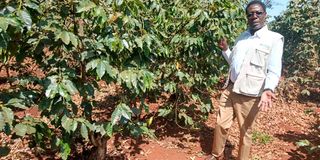
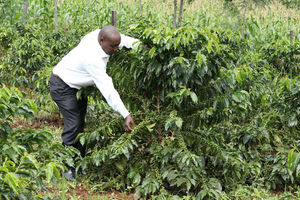
Rows of coffee bushes stretch across the 65-hectare Kiganda Farm Estate in Gatanga, Murang’a County.
They stand under a canopy of trees, surrounded by vegetation.
Pruned branches are left on the ground as mulch, and organic manure is spread across the farm. Ring basins around coffee trees help conserve water.
The estate also employs soil testing, biological pest control and nitrogen-fixing shade trees as part of a system that has earned it recognition across the continent.
Leased by the Coffee Management Services (CMS), Kiganda recently became the first farm in Africa to get certification under the Rainforest Alliance Regenerative Agriculture Standard.
CMS General Manager, Martin Ngare, says the estate produces 110 to 120 tonnes of green coffee a year, with most of it destined for Europe and America.
“This recognition comes when climate change is putting pressure on coffee production through rising temperatures, changing rainfall patterns and an increase in pests and diseases,” he says.
Ngare says regenerative agriculture makes the farm resilient while maintaining production and quality.
“It is about improving soil health, managing and conserving water, increasing biodiversity and ensuring good conditions for employees and locals,” he says.
At Kiganda, it all begins with the soil. Soil testing is carried out to determine nutrient deficiencies before fertiliser is applied. Organic manure has become an important part of the programme, with around 85 lorry loads applied in 2025.
“This is designed to increase the amount of organic matter in the soil and improve its ability to support healthy coffee trees,” he tells Seeds of Gold.
The farm leaves pruned branches on the ground to decompose and return nutrients to the soil. Mr Ngare explains that shade trees, including Albizia, fix nitrogen, improve organic matter and help bring nutrients from deep in the soil to the surface.
Water conservation is an important component. In the past, the farm relied heavily on overhead irrigation, resulting in considerable water loss through evaporation and evapotranspiration when temperatures hit 33 to 35 degrees Celsius.
“Ring basins around coffee trees now help channel water closer to the plants, improving its utilisation,” he says.
Martin Ngure (right), General Manager of Coffee Management Services, which manages Kiganda Farm Estate in Gatanga, Murang’a County, with the farm manager, Paul Kabubi, displays the Rainforest Alliance certificate on August 27, 2026.
Photo credit: Sammy Waweru | Nation Media Group
The estate has also adopted new ways of controlling pests. Rather than blanket spraying, a team monitors the coffee trees to identify pests.
Cultural control methods, including pruning and opening up the trees, help create conditions that reduce pest pressure.
Biological control methods are employed against certain pests, and natural predators like wasps and ladybirds are encouraged.
Mechanical methods are used to control stem borers, while insecticides are only applied to affected trees.
These changes are also intended to address the biennial nature of coffee production. Before the adoption of the regenerative approach, a heavy crop could exhaust the trees, resulting in production falling by almost half the following year.
The aim is to flatten the production curve and maintain more consistent volumes from one year to the next.
“Consistency is important. When, for instance, a customer orders six containers, we need to be able to supply them,” he says.
Stable volumes can help strengthen relationships with international buyers, while improved quality can open opportunities in premium markets.
Julius Ng’ang’a, the Rainforest Alliance’s Senior Director for Impact Programmes in East and Southern Africa, says Kiganda’s certification is a milestone for Kenya and the coffee sector on the continent.
The Rainforest Alliance is a global organisation that works at the intersection of agriculture, business and forests. It focuses on responsible production, environmental protection and livelihoods improvement.
“The climate is changing and farms have to change too,” he says.
According to Ng’ang’a, a baseline study at Kiganda found that the regenerative approach involves improving soil health, enhancing irrigation, maintaining coffee shade and adopting drought- and pest-resistant crops and coffee varieties.
The certification has enabled the estate to engage buyers looking for coffee produced with strong environmental and social safeguards.
Ng’ang’a says certified coffee attracts better prices and premiums locally and abroad, which helps farmers recover the costs of adopting regenerative practices.
“Buyers need to support the farms so they can recoup their investment,” he says.
Regenerative agriculture can boost productivity while improving coffee quality and creating opportunities in speciality markets.
Kenya Coffee Platform Chairman, Karugu Macharia, says regenerative agriculture should not be viewed as complicated or new.
He says many of the practices are similar to those used by past generations, including intercropping, maintaining ground cover and using natural methods to manage pests.
Macharia says this approach could also be used by smallholder farmers with 50, 100 or 200 coffee trees.
“When you add manure in the soil, you increase the amount of organic matter and bring the soil to life,” he says, adding that healthy soil supports organisms like earthworms, frogs and snails.
Macharia says this approach fosters a relationship between nature and people, which is important as farmers adapt to changing weather conditions.
Dr Tony Maritim, Deputy Director of the Coffee Research Institute at the Kenya Agricultural and Livestock Research Organisation, says that climate-resilient varieties play a key role in regenerative agriculture.
Kenya has five main Arabica varieties – SL28, SL34, K7, Ruiru 11 and Batian.
“Researchers are also developing and evaluating varieties that can perform in emerging coffee-growing areas,” Dr Maritim says.