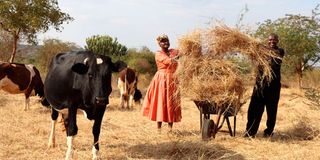
Visitors to Michael Ndangili’s homestead in Mathea village on the outskirts of Masumba township in Makueni County are greeted with by a giant rack with bales of hay.
The teacher is at the forefront of an agrarian revolution in one of the county’s driest regions.
Ndangili is among the smallholders who have embraced dairy farming in an area known for maize production. A quick survey reveals there are no granaries in the neighbourhood, signalling the phase-out of maize. Almost every homestead in Mathea has a hay rack.
“After making losses on maize farming due to unreliable rainfall, we turned to growing grass and dairy farming,” Ndangili tells the visiting Seeds of Gold team.
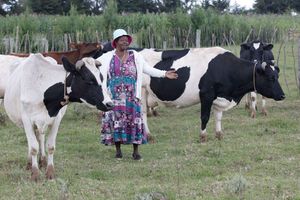
Three calves follow six cows as they roam a section of Ndangili’s farm. They are a source of pride for the Itulu Comprehensive School teacher and his wife Christine Mueni, who teaches at neighbouring Mwalili School.
The couple’s day begins at 3am. While Mueni attends to household chores, her husband assists the farmhand with milking. He then delivers the milk to a depot in Masumba before leaving for school.
“Milking six cows is overwhelming for one person. An overworked farmhand can easily compromise the quality of the milk and expose the animals to mastitis, which thrives when the teats are not properly drained,” he says, justifying his decision to milk the cows himself.
Ndangili and Mueni started their dairy farm six years ago. They started the enterprise by debunking the misconception that dairy cows could not thrive in arid regions.
“Dairy cows require sufficient feed and water to thrive,” Mueni says.
The enterprise was triggered by Covid-19. While the pandemic slowed down economic activities and threatened livelihoods worldwide, the couple did not rest easy.
The situation was made worse by a long school holiday imposed by the government in an attempt to slow the spread of the illness. The long holiday was a reality check for teachers.
“What if the pandemic ultimately renders us jobless?” Ndangili recalled asking Mueni at the height of the pandemic.
“Will you walk around the village offering laundry services while I look for opportunities to set up terraces and build latrines?”
Ndangili and Mueni bought a Holstein Friesian heifer from a well-known farmer in the area. The farmer insisted that they first get enough fodder before selling them the cow.
“The most important thing before setting up a dairy venture is having sufficient feed,” says Bernard Korir, manager of the Kenya Agriculture and Livestock Research Organisation’s arid and rangelands research station, Kiboko.
Ndangili has converted his farmland into a pasture teeming with African foxtail grass, Masai love grass and bush rye grass. He also grows Napier grass for silage.
The two were not prepared for the amount of milk produced. They gave their neighbours most of the produce.
“Using artificial insemination and ensuring right timing, we ensure at least three of our cows are producing milk at their peak. We get 15 to 20 litres per cow per day. Our target is 100 litres daily,” Mueni says.
“The July to November dry spell is the most appropriate time for cows to produce milk at their peak. Milk fetches the highest price then.”
Joining Nguu/Masumba Dairy Farmers Cooperative Society was a turning point for the couple. With 220 members, it is one of the most vibrant co-ops in the county.
“We are no longer concerned about losing our jobs,” Ndangili says.
The Co-op society has partnered with the Kenya Animal Genetic Resources Centre to distribute sexed semen.
“It is the best option for farmers looking for heifers. Calves born from sexed semen are in high demand. We supply sexed semen at Sh2,500 to our members and Sh3,500 to non-members,” Nguu/Masumba Dairy Farmers Cooperative Society chairman Julius Kimilu says.