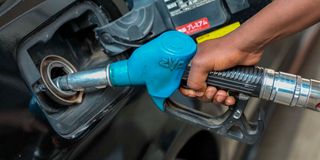
The widening gap in the cost of diesel and kerosene has raised fresh fears of product adulteration that could affect cars, farm machinery and the environment.
Petrol currently retails at Sh214.25 in Nairobi, while diesel and kerosene sell at Sh242.92 and Sh152.78 respectively.
This has widened the price gap between diesel and kerosene to Sh90.14, as the state has offered significant subsidies on the product to support those who rely on it for cooking and lighting.
However, the price difference has led some traders to mix kerosene with diesel and petrol in order to enjoy higher margins in a market where the price of fuel products is controlled by the energy regulator.
David Gikaria, the chairman of the National Assembly Energy Committee and MP for Nakuru Town East, warned that the recent fuel price reviews contradict the 2018 EPRA study, which recommended setting kerosene prices at the same level as diesel to prevent adulteration.
“When I chaired this committee in 2018, we introduced policy measures that significantly reduced the problem of fuel adulteration, which was previously widespread and caused significant damage to diesel engines,” said Mr Gikaria.
“We will not sit back and see the progress undone, returning us to the days of selling adulterated diesel to unsuspecting Kenyans, most of whom are peasant farmers,” he said.
National Assembly Departmental Committee on Energy chairman David Gikaria (centre) and members Geoffrey Mulanya and Elisha Ochieng Odhiambo, address the media in Nairobi on April 8, 2026 on the ongoing fuel crisis in the country.
Photo credit: Dennis Onsongo | Nation Media Group
Without the subsidies offered in the April and May cycles, diesel would have traded at Sh279.58 per litre, while petrol would have retailed at Sh218.59 per litre, up from Sh214.25.
The ERC report notes that illegal profiteering from mixing kerosene leads to the high maintenance costs of diesel engines in cars, buses, matatus, farm machinery and trucks due to frequent breakdowns.
Fuel prices make a big contribution to inflation in Kenya as it relies heavily on diesel for transport, power generation and agriculture, while kerosene is used in many households for cooking and lighting.
Inflation rose to 5.6 per cent year-on-year in April from 4.4 per cent a month earlier, data from the statistics office showed, making it the fastest rise in seven years.
Geoffrey Mulanya, the Nambale MP and a member of the Energy Committee, challenged the government to ensure that anti-adulteration policies are not rescinded.
“The price difference between kerosene and diesel creates an opportunity for dishonest traders to sell Kenyans poor-quality diesel. Unless this changes, the government will continue to incur losses while dishonest oil traders pocket billions in profits,” he said. The EPRA report presented to the committee was produced following a benchmarking mission in Tanzania in 2018.
It recommended increasing kerosene taxation to the same level as diesel. This was intended to curb the practice of mixing kerosene and diesel.
The EPRA report noted that increasing the tax on kerosene would not only prevent adulteration but also generate at least Sh29 billion in additional direct tax revenues for the government each year.
“It is therefore recommended that the kerosene tax be raised to the same level as diesel. The expected annual revenues could be invested back into the energy sector,” says the EPRA report.
The proceeds from the increased kerosene taxation were to be invested in the sector through LPG subsidies to boost consumption and reduce biomass use.
EPRA also pushed for increased access to clean energy in the form of electricity through the Rural Electricity Authority (REA), which was later succeeded by the Rural Electrification and Renewable Energy Corporation (REREC).
In September 2019, the government introduced an anti-adulteration levy of Sh18 per litre of kerosene in an attempt to stop the practice.
Towards the end of 2019 and into early 2020, kerosene prices were higher than diesel prices, as adulteration appeared to have been contained. However, there was a subsequent drop in kerosene prices in mid-2020.
In 2018, EPRA confirmed that around 5 million of the 33 million litres of kerosene consumed monthly was actually used for lighting and cooking, while the rest was used to adulterate diesel.
Adulteration, which involves mixing lower-grade products with a higher grade for financial gain, has negative effects, including tax leakages, engine damage, adverse health effects on the population, loss of Kenya’s competitive advantage as the preferred route, and unfair competition.
Documents in Parliament also show that the Petroleum Institute of East Africa (PIEA) lobbied for the price of a litre of kerosene to exceed that of a litre of diesel in order to stop the illegal practice.
“Adulteration of fuel has reached alarming levels in Kenya,” said the PIEA.