National carrier Kenya Airways (KQ) is staring at more disruptions this year as difficulties in sourcing aircraft engines and other parts persist, leaving at least five of its planes grounded.
The airline, which swung back to loss-making in 2025, has three Embraer jets grounded alongside two Boeing 787 ‘Dreamliners’.
The grounded aircraft are estimated to represent about 18 percent of KQ’s available seats, cutting nearly one-fifth of the airline’s passenger capacity.
“We have three Embraer jets on the ground waiting for engines and landing gears, and we have two Boeing 787s waiting for engines, and one requiring heavy checks,” said George Kamal, the Acting Group Managing Director and Chief Executive Officer for KQ.
“We have an engine coming from the shop on June 19 and a second engine coming on July 15. This is due to supply chain issues, which is not something localized for Kenya Airways. It’s something impacting most airlines globally.”
KQ, which has attributed the grounding of aircraft to external supply chain disruptions, hopes it can put most of the jets back in operation by next month, while restoring its entire fleet by the end of this year.
The airline is hoping to offset the lost capacity in part by re-introducing its Boeing 777-300ER next month, which had been leased out to Turkish Airlines.
The return of the 400-seater craft is expected to trim grounded capacity to between six and eight percent, raising KQ’s available seats.
KQ’s operations were materially impacted by the temporary grounding of three Boeing 787-8 Dreamliner aircraft due to global supply chain constraints last year, and limited engine availability, resulting in reduced capacity across key routes.
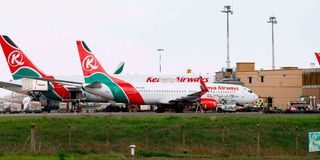
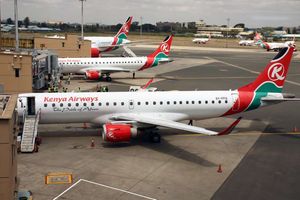
Kenya Airways planes are parked at the Jomo Kenyatta International Airport (JKIA) in Nairobi on March 5, 2026.
Photo credit: Reuters
The national carrier made a net loss of Sh17.1 billion in the year ended December 2025, reversing a net profit of Sh5.4 billion the year before as revenue plunged from the partial grounding of aircraft.
The airline’s revenue fell by Sh27 billion or by 14 percent, driven by a 13 percent drop in passenger numbers following an 18 percent reduction in capacity.
Capacity measured in available seat kilometres (ASKs) declined by 18 percent to 13,349 million, underscoring the direct impact of fleet constraints on performance.
KQ plans to improve its capacity over the medium-term by adding more aircraft even as the prevailing geopolitical environment slows down the acquisition outlook.
“We took the decision in February to slow down and move our plan to acquire Boeing 737-Max jets forward to 2027. However, our end goal, say in 2030, we are looking at 60 aircraft and 100 in 2035. Not all of them will be owned aircraft; some will be owned, and others leased,” Kamal added.
In 2025, the airline acquired one Boeing 738 and two Bombardier Dash 8 passenger aircraft.
The airline makes upfront deposits to manufacturers like Boeing for the right to lease and own aircraft down the line.
As of December 31, 2025, KQ operated 37 owned/leased aircraft comprising seven Boeing 787 wide-body jets, nine Boeing 737 narrow-body jets, seven Embraer regional jets, four Boeing 737 freighters and 10 Bombardier Dash 8-400.
Beyond the grounding of aircraft, KQ has been impacted by the ongoing US-Israel war on Iran, which has resulted in the fluctuation of fuel prices.
KQ has noted that fuel prices as a share of total flight costs on the continent have gone up from an average of 40 percent to a high of up to 52 percent.
The airline has chosen not to deploy its established fuel hedging programme, highlighting the risks posed by volatility in the prices.
The national carrier says it is constantly reviewing its operations and network to ensure optimisation in line with demand as a cost management strategy.
“Sometimes you have to reshuffle your network and relook where you go. For unprofitable routes, you have to join them up with other destinations or hubs, including profitable points. The last thing you do is to temporarily hold flights and operate more viable destinations,” said George Kamal.