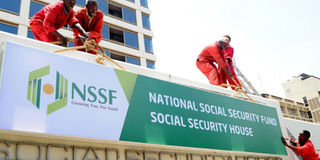
The battle over enhanced National Social Security Fund (NSSF) contributions deepened on Wednesday after the Law Society of Kenya declared there is no legal basis for continued enforcement of the disputed deductions.
The intervention by the lawyers' body opens a new front in the long-running dispute over the Sh715 billion pension fund and raises the stakes for employers, workers and regulators as courts grapple with the future of the NSSF Act, 2013.
In a statement signed by LSK president Charles Kanjama, the society said the Employment and Labour Relations Court (ELRC) judgment that declared the NSSF Act unconstitutional remains operative because the Court of Appeal recently declined to suspend it pending determination of a substantive appeal.
"The ELRC judgment declaring the NSSF Act, 2013 unconstitutional remains operative," the society said, adding that there is presently "no judicial basis supporting the continued enforcement of the enhanced contribution framework."
The statement came as Busia Senator Okiya Omtatah moved to the Labour Relations court seeking to join the long-running constitutional case and launch contempt proceedings against senior NSSF officials over continued implementation of the law.
The senator wants the court to halt enhanced deductions and compel the fund to revert to the previous contribution regime under the repealed NSSF framework, where workers and employers each contributed Sh200 monthly.
At the centre of the dispute is the NSSF Act, 2013, which replaced the flat-rate contribution model with a phased earnings-based system.
Under the new framework, monthly contributions have risen from Sh200 to as much as Sh6,480 for workers, matched by employers.
Employers are expected to match the workers’ NSSF contribution, raising the maximum total payment to the fund to Sh12,960
Under the new NSSF rates, an employee earning a gross salary of Sh100,000 contributes Sh6,000 while those with a gross salary of Sh200,000 and above contribute Sh6,480.
An employee earning Sh25,000 contributes Sh1,500 and those earning between Sh35,000 and Sh50,000 pay Sh2,100. Those earning from Sh50,000 to Sh75,000 contributes Sh3,000 while those earning between Sh75,000 and Sh100,000 contributes Sh4,500.
The law was declared unconstitutional by the Employment and Labour Relations Court in September 2022 following a challenge by employers and other stakeholders.
The Court of Appeal later overturned that decision on jurisdictional grounds in February 2023, effectively allowing implementation of the enhanced rates.
However, the Supreme Court overturned the appellate decision in February 2024 and sent the case back to the Court of Appeal for determination on the substantive issues.
According to LSK, the consequence was that the ELRC judgment regained legal force pending the hearing of the appeal.
The society further argues that the Court of Appeal's decision on May 29 this year refusing to grant a stay means there is currently no order suspending the judgment that invalidated the law.
Mr Omtatah argues that despite those developments, NSSF has continued implementing the contested law and collecting enhanced deductions from millions of workers.
He points to the publication of NSSF's Year Four contribution rates earlier this year and subsequent directives instructing employers to continue remitting contributions under the 2013 Act.
The senator wants the court to declare the continued deductions unlawful and hold senior NSSF officials personally liable for alleged disobedience of court orders.
The legal battle is also playing out in a separate case filed by the Consumers Federation of Kenya (COFEK), which has challenged NSSF's June 5 directive instructing employers and workers to continue remitting enhanced contributions despite the Court of Appeal ruling.
The directive followed a May 29 Court of Appeal ruling dismissing NSSF's application seeking to suspend a 2022 Labour Court judgment that had declared the NSSF Act, 2013 unconstitutional.
That ruling triggered widespread confusion because NSSF and the Central Organization of Trade Unions (COTU) subsequently argued that the appellate judges had determined an application that was no longer before the court.
In a letter to the Court of Appeal Registrar, Senior Counsel Fred Ngatia, acting for NSSF, described the decision as a "monumental error".
"We write to express our client's profound disbelief and bewilderment arising from the monumental error therein and which has caused confusion in the pension sector," Mr Ngatia wrote.
He argued that the matter argued before judges in January 2025 concerned an application by a union seeking joinder as an interested party, not the 2022 stay application.
"In plain terms, the Court purported to determine a motion which was neither before them nor was a live issue at all," Ngatia wrote. "A monumental error by any account."
COTU secretary-general Francis Atwoli backed that position. "The application for stay of execution filed in October 2022 was conclusively overtaken by events upon delivery of that judgment and was no longer a live controversy capable of determination," Atwoli said.
However, LSK's position escalates pressure on employers by warning that employers that continue deducting contributions under the disputed framework may expose themselves to legal liability should the ELRC judgment ultimately be upheld.
The society said affected employees could pursue claims for refunds or restitution of unlawfully deducted contributions.
It further warned that it may pursue contempt proceedings against individuals found to be deliberately disobeying court orders. Penalties could include fines, sequestration of assets and imprisonment.
NSSF has maintained that the enhanced contribution regime remains lawful and has advised employers and workers to continue complying with the current framework.