A storm has erupted around the Sh715 billion National Social Security Fund (NSSF) after a recent Court of Appeal ruling triggered fresh confusion over the future of enhanced pension contributions.
The appellate court is facing scrutiny after NSSF and the Central Organization of Trade Unions (COTU) accused it of issuing a ruling on an application that was not before the judges.
The fund has asked the court to recall the decision, describing the alleged mix-up as a "monumental error" that has unsettled employers, workers, labour movement and the wider pension sector.
For its part, COTU says the ruling "seems to have been intended to cause confusion within the pension sector by seemingly contradicting an earlier judgment of the same court delivered on February 23, 2023."
According to NSSF and COTU, the appellate judges having ruled on the dispute in February 2023 before the Supreme Court ordered them to do a fresh hearing, the application for stay of the Labour Court ruling was conclusively overtaken by events.
The controversy stems from a ruling delivered on May 29, 2026 by a three-judge Court of Appeal bench that dismissed NSSF's bid to suspend a September 2022 Labour Court judgment declaring the NSSF Act, 2013, unconstitutional.
In a letter to the Court of Appeal Registrar dated June 2, 2026, Senior Counsel Fred Ngatia, acting for NSSF, said the judges had determined the wrong application, triggering confusion in the pension sector.
"We write to express our client's profound disbelief and bewilderment arising from the monumental error therein and which has caused confusion in the pension sector," Mr Ngatia wrote.
Senior Counsel Fred Ngatia at his office in Upper Hill, Nairobi, on December 17, 2024.
Photo credit: Wilfred Nyangaresi | Nation Media Group
According to the letter, the court proceeded on the basis that it was determining NSSF's October 2022 application seeking to stay the Employment and Labour Relations Court judgment pending appeal.
Mr Ngatia says that the application had long been dealt with and was no longer a live issue before the appellate court because the judges had also already delivered a judgment in 2023 before the Supreme Court asked them to do a fresh hearing.
Instead, he says, the matter argued before the appellate judges on January 23, 2025 was an application by the Kenya Export Floriculture, Horticulture and Allied Workers Union seeking to be joined in the case as an interested party.
"A perusal of the proceedings held on January 23, 2025 will show that the application before the Court was a motion filed by Kenya Export Floriculture, Horticulture and Allied Workers Union seeking joinder as an interested party," he said.
He told the court that parties had spent more than a year and four months waiting for a ruling on the joinder application so that they could proceed to the fresh hearing of the appeal.
"In plain terms, the Court purported to determine a motion which was neither before them nor was a live issue at all. A monumental error by any account," Mr Ngatia wrote.
He urged the court to act on its own motion, recall the contested ruling, expunge it from the record and issue a public announcement on its withdrawal.
The dispute centres on the NSSF Act, 2013, which introduced a new contribution regime designed to increase retirement savings.
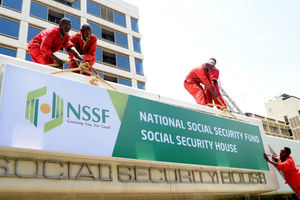
Workers erecting a sign at NSSF's Social Security House offices in Nairobi.
Photo credit: File | Nation Media Group
The law replaced the long-standing flat rate of Sh200 monthly contribution with a phased earnings-based system under which workers now contribute up to Sh4,320 a month, matched by an equal contribution from employers
The enhanced rates were rolled out in phases and took effect from February 2023 following a Court of Appeal decision that cleared their implementation.
The latest controversy emerged after the appellate court dismissed NSSF's application for a stay of a judgment that declared the NSSF Act, 2013 unconstitutional, finding that the law had been enacted without Senate involvement and contained provisions that breached constitutional and competition principles.
In that contested ruling, the judges found that although the intended appeal raised arguable issues, the fund had failed to demonstrate that it would suffer irreparable harm if stay orders were not granted.
The court held that NSSF had not provided evidence to support its claims that invalidating the 2013 law would destabilise the fund's operations.
The judges also noted arguments by employers and other parties that the previous NSSF law remained available to fill any legal gap.
The underlying case was filed by employers and other stakeholders challenging the constitutionality of the NSSF Act, 2013.
They argued that the law created an unfair advantage for NSSF, restricted choice for workers already covered by private pension schemes and was passed without the involvement of the Senate.
In September 2022, the Employment and Labour Relations Court agreed with several of those arguments and declared the law unconstitutional.
NSSF appealed, arguing that the judgment threatened retirement savings and could undermine efforts to expand pension coverage.
In February 2023, the Court of Appeal set aside the Labour Court's ruling and effectively revived the NSSF Act, 2013. The dispute later went to the Supreme Court, which in February 2024 ordered a fresh hearing at the Court of Appeal.
The Supreme Court did not determine whether the NSSF Act itself was constitutional or unconstitutional, leaving the enforcement of the increased rates to continue.
Mr Ngatia says that because the Court of Appeal had already delivered its substantive judgment in February 2023 and the dispute had subsequently reached the Supreme Court, the May 2026 ruling could not logically have been determining the 2022 stay application.
"The application for stay of execution filed in October 2022 was conclusively overtaken by events upon delivery of that judgment and was no longer a live controversy capable of determination," said COTU secretary-general Francis Atwoli.
In a public statement issued after the latest ruling, the NSSF insisted that the NSSF Act remains in force and that contribution rates remain unchanged.
NSSF advised employers, employees and stakeholders to "disregard the misleading opinions alluding to reverting contributions to Sh200" and continue complying with the current contribution framework.
The fund said issues still pending before the Court of Appeal "do not affect the enhanced contribution rates."