More than 362,000 formal sector workers will stop paying income tax under Treasury proposals that raise the untaxed monthly income threshold to Sh32,333, but employees earning above Sh50,000 will pay more to plug the revenue gap.
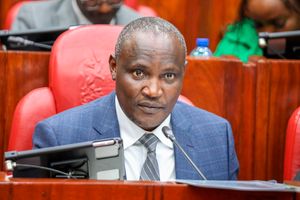
Treasury Cabinet Secretary John Mbadi said on Thursday that the Sh2,400 monthly relief, available to all workers, will be scrapped as the threshold rises from the current Sh24,000.
“We want to do away with this thing called the relief and set the PAYE rate at zero for earnings up to Sh32,333,” Mr Mbadi said. “We may not at this point change the other tax bands, but going forward, that’s a conversation to have.”
Treasury estimates show the number of formal sector workers exempt from income tax will rise to 1.69 million from the current 1.32 million. Those obliged to pay payroll taxes will fall from 2.14 million to 1.77 million, or 51 per cent of the 3,468,997 formal sector workforce, meaning nearly half will pay no income tax.
National Treasury Cabinet Secretary John Mbadi during a press briefing at Sarova Imperial Hotel in Kisumu on September 16, 2026.
Photo credit: Alex Odhiambo | Nation Media Group
Employees earning between Sh32,334 and Sh50,000 will see their income tax fall by up to Sh596, the estimates show. Those on Sh60,000 will pay an extra Sh473, while workers earning Sh100,000 and Sh200,000 will pay an additional Sh892 and Sh3,867, respectively.
The easing comes as the State seeks to placate the electorate with only months to the General Election in August next year. President Ruto’s administration has introduced a raft of new taxes and raised existing ones since he was elected in August 2022.
The measures have proved unpopular, with many Kenyans believing he has betrayed his campaign pledge to champion the interests of “hustlers”, those who struggle financially.
The Kenya Bankers Association (KBA) estimates workers’ purchasing power has declined by up to 12 per cent over the past five years because of rising taxes, multiple statutory deductions and the high cost of living.
The government has also proposed scrapping stamp duty on land and property transactions valued at below Sh1 million to boost the affordable housing ownership programme, and removing the 25 per cent import duty on mobile phones to lower digital access costs.
Economists argue the current tax brackets weigh heavily on lower-income earners. The bottom bracket taxes monthly income of up to Sh24,000 at 10 per cent, but this is returned to workers through the Sh2,400 relief.
Income between Sh24,001 and Sh32,333 is taxed at 25 per cent, followed by 30 per cent on additional income up to Sh500,000. The top rates of 32.5 per cent apply to earnings of between Sh500,000 and Sh800,000, and 35 per cent to all earnings above that. The Finance Act 2023 introduced the 32.5 and 35 per cent top rates but left the lower brackets unchanged.
Data from the Kenya National Bureau of Statistics (KNBS) statistical abstract shows 1.36 million Kenyans earned below Sh50,000 in 2024, or 42.2 per cent of the 3.21 million formal sector employees.
The largest group, earning between Sh50,000 and Sh99,000, numbered 1.46 million, followed by the Sh30,000-Sh49,999 segment at 1.04 million workers.
Some 104,206 workers earned between Sh20,000 and Sh29,999, while 36,955 earned up to Sh19,999.
Those taking home more than Sh100,000 stood at 397,541 by the end of 2024, or 12 per cent of the workforce.
Last year, the World Bank proposed that Kenya raise its top rate to 38 per cent for those earning above Sh800,000 a month and ease the burden on lower-income earners by adding a band to eliminate the 30 per cent segment.
Under that plan, the Sh24,000 tax-free threshold would remain, but the rate for pay between Sh24,001 and Sh32,333 would fall to 15 per cent from 25 per cent. Pay between Sh32,334 and Sh166,667 would attract 25 per cent, Sh166,668 to Sh500,000 would attract 32.5 per cent, and Sh500,001 to Sh800,000 35 per cent.