Three weeks into a nationwide strike by public university lecturers and non-academic staff, students are threatening to join the industrial action, accusing the government of allowing a labour dispute to derail their education and impose additional financial costs.
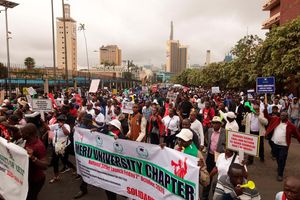
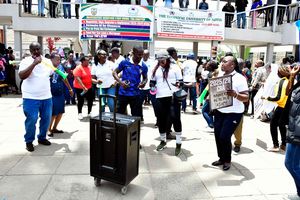
Students at the University of Nairobi demonstrated on Wednesday, signalling an escalation of the standoff as lecture halls remain deserted and academic programmes face uncertainty.
The students have warned of further protests unless the government intervenes to resolve the dispute over the 2025–2029 collective bargaining agreement (CBA), whose negotiations have stalled over the cost of union demands.
At the University of Nairobi, students say prolonged disruption is threatening their academic plans, straining their finances and exposing them to pressure from families eager to see them graduate.
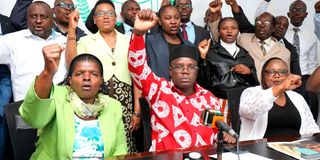
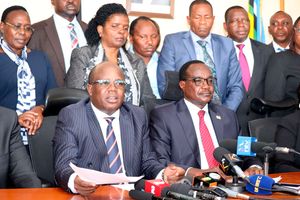
University Academic Staff Union’s Secretary General for the University of Eldoret Chapter, Dr Nyaberi Mogaka accompanied by Kenya University Staff Union officials at the university, other officials and members, during the launch of the nationwide lecturers' strike on October 02, 2026.
Photo credit: Jared Nyataya | Nation
“We are frustrated. We fear that the prolonged standoff could further derail our academic plans, leaving us uncertain about when normal learning will resume. We have been in school for so many years, and we want to graduate,” said Ahmed Rashid, president of the University of Nairobi Students Association.
Mr Rashid said some students were struggling financially, while others faced mounting expectations from their families. He also cited distress among students, saying some had died by suicide.
“We are facing financial difficulties and pressure from our families. Many of our comrades have also been working within the university, but everything has stopped. Nothing is running,” he said.
Ian Ochieng, a University of Nairobi student, said recurring strikes had become a familiar disruption.
“This is the third year in a row that we have faced this situation. We keep repeating the same script,” he said, warning that students would join the lecturers if the government failed to act.
Beyond missed lectures, students say the strike is depleting money set aside for accommodation, food and other living expenses, even as the eventual resumption of classes remains uncertain.
Remmy Osoti, a fourth-year student at Multimedia University of Kenya, said repeated travel between campus and home could add to the financial burden.
“For me to travel upcountry, I spend about Sh2,500. When the strike is called off, I have to spend another Sh2,500 to return. That is already Sh5,000, money I could have used for other things,” he said.
Students must also decide whether to remain in their hostels and continue spending or return home and incur further travel costs when teaching resumes.
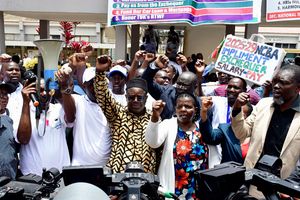
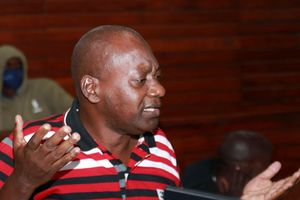
Universities Academic Staff Union (UASU) lecturers and staff participating in a demonstration in Nairobi streets on October 15, 2026, protesting the failure of the Government to implement the 2025–2029 Collective Bargaining Agreement (CBA).
Photo credit: Evans Habil | Nation
The uncertainty threatens both first-year students, whose transition to university has been interrupted, and finalists facing possible delays to coursework, examinations and graduation. Universities may also have to adjust their academic calendars to recover lost teaching time.
Education Cabinet Secretary Julius Ogamba said the government was consulting the National Treasury to improve its Sh9.7 billion offer after unions rejected it.
He said the unions’ demands had been estimated to cost about Sh100 billion, an amount the government considered unaffordable and unsustainable.
“The technical team said it would cost about Sh100 billion, which is unaffordable and unsustainable,” Mr Ogamba said.
The ministry is assessing how much more the government can offer, taking into account the economic outlook over the next three years. “We are discussing with the Treasury to enhance the Sh9.7 billion and see how far up we can go. Once we have a working figure, we’ll call them, then we’ll discuss,” he said.
Education Cabinet Secretary Julius Migos Ogamba at New Mitihani House in Nairobi on October 5, 2026, during the launch of the 2026 national examination and assessment season.
Photo credit: Evans Habil | Nation Media Group
Mr Ogamba appealed to students to remain calm, saying the government wanted the dispute resolved quickly to allow learning to resume. Vice-Chancellors Committee of Public Universities chairman Daniel Mugendi warned that some programmes could struggle to recover lost learning time, even after the strike ends.
“When students lose learning time, they have to try to catch up when they return. However, there are programmes like Medicine where it may not be possible to recover the lost time because they run back-to-back,” Prof Mugendi said. He urged the government and unions to reach a compromise and resolve future CBA negotiations before new agreements take effect, preventing labour disputes from disrupting academic calendars.