The national government spending outside the authority of parliament surged to a four-year high, hitting Sh209 billion during the fiscal year 2025/26, according to the latest data from the Office of the Controller of Budget (CoB).
This comes as Controller of Budget Dr Margaret Nyakang’o singled out fiscal indiscipline by officials at the National Treasury as the key driver of the upsurge in the use of Article 223 of the Constitution, with some of the approvals flagged as routine day-to-day operations.
The data shows that of the Sh281.5 billion that National Treasury Cabinet Secretary John Mbadi had approved as additional expenditures by government ministries pending the post-facto approval by the National Assembly, Dr Nyakang’o sanctioned withdrawals of Sh209.37 billion.
National Treasury Cabinet Secretary John Mbadi during a press briefing at Sarova Imperial Hotel in Kisumu on September 16, 2026.
Photo credit: Alex Odhiambo | Nation Media Group
The approved withdrawals from the national exchequer are about five percent of the gross estimates and comprise Sh187.9 billion for recurrent expenditure and Sh21.47 billion for development expenditure.
“To address reliance on Article 223 of the Constitution to access the exchequer, there is a need to adhere to public finance management laws and regulations governing the criteria for funding under Article 223 of the Constitution,” says Dr Nyakang’o, adding, “this will enhance budget credibility.”
This, Dr Nyakang’o says, includes adopting planning, budget practices and sound expenditure management that involve prioritizing all essential services and aligning them with operational realities during budget formulation and implementation.
During the fiscal year 2024/25, the government spent Sh66.54 billion on top of the national budget approved by the National Assembly, additional Sh19.12 billion in the 2023/24 period and Sh69.2 billion extra during the 2022/23 financial year.
The OCoB is established under Article 228 of the Constitution, as an independent watchdog, to ensure that public funds are spent prudently and strictly in accordance with the law.
The office does so by overseeing the implementation of the budgets of both the national and county governments by authorizing withdrawals from public funds.
Article 223 of the Constitution allows the national government to access additional funding during the budget implementation by spending money that has not been appropriated by the National Assembly.
However, this only applies if the amount appropriated by the National Assembly for any purpose, is insufficient or a need for unbudgeted expenditure arises for which no amount has been appropriated, or money has been withdrawn from the Contingencies Fund.
The Article states that the post-facto approval of the National Assembly under “this Article shall be sought within two months after the first withdrawal of the money.”
Dr Nyakang’o specifically questioned CS Mbadi’s blatant abuse of the Constitution and the law by approving additional funding to various government agencies for expenses that are not of an emergency nature.
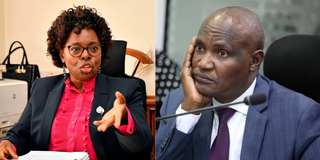
Controller of Budget Margaret Nyakang’o and Treasury CS John Mbadi.
Photo credit: NMG
She noted that State expenditures must be planned for during the budget cycle “rather than being sneakily” funded through “the emergency consolidated fund back door.”
According to the COB, allocating additional funds to expenses that are not unforeseen and can therefore be delayed highlights weaknesses in budget planning, fiscal indiscipline and the overall reliability of the national government's budget formulation and implementation.
In a stinging critique of the National Treasury’s financial management, Dr Nyakang’o warned that the upsurge in government expenditures that bypass parliamentary oversight is illegal and unconstitutional.
“Article 223 of the Constitution should be strictly reserved for expenditure that is genuinely unforeseen at the time of budget formulation, urgent and unavoidable, in accordance with the constitutional requirements,” says Dr Nyakang’o.
The CoB noted that Article 223 of the Constitution should not be used by the National Treasury as a fallback plan for "bad" budgeting that seeks to sidestep parliament’s check on public spending.
Section 16 of the Public Finance Management (PFM) Act provides that the national government may, with the approval of parliament, deviate from the financial objectives in a Budget Policy Statement (BPS) on a temporary basis “where such deviation is necessitated by a major natural disaster or other significant unforeseen event.”
Section 21 of the Act adds that the CS National Treasury shall only approve additional expenditures upon satisfaction that an urgent and unforeseen need for expenditure has arisen for which there is no specific legislative authority.
In doing so, the law says, the CS shall be guided by regulations and relevant laws upon establishing that the payment was not budgeted for because it was unforeseen and cannot be delayed until a later financial year.
“This reliance on Article 223 to finance foreseeable expenditures contravenes the PFM (National Government) Regulations 2015, highlighting weaknesses in budget planning and the overall reliability of budgeting,” says Dr Nyakang’o.
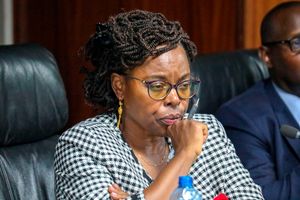
The Controller of Budget Dr Margaret Nyakang'o when she appeared before the National Assembly Committee on Finance and National Planning at Bunge Tower Nairobi on May 14, 2025.
Photo credit: Dennis Onsongo| Nation Media Group
Regulation 40 (3) of the Public Finance Management (National Government) Regulations 2015 stipulates that the purpose for which approval is sought for a supplementary budget shall be “unforeseen and unavoidable,” in circumstances where no budget provision was made.
The regulations also specify that the purpose for which approval under Article 223 is sought shall be unavoidable, in circumstances where there is an existing budgetary provision, “which is, however, inadequate.”
This includes expenditure that, although known when finalizing the estimates for the original budget, “could not be accommodated within allocations, tariff adjustments and price increases.”