The National Treasury irregularly withdrew Sh7.3 billion from the fuel levy to compensate a consortium of French firms whose contract to build the Nairobi-Nakuru-Mau Summit Road was terminated illegally, an Auditor-General’s report has revealed.
The payment to the consortium—comprising Vinci Highways SAS, Meridian Infrastructure Africa Fund and Vinci Concessions SAS—was made under an emergency vote and required belated approval from Parliament through a supplementary budget.
In the report on KeNHA for the financial year ended June 2025, the Auditor-General fingers the Kenya National Highways Authority (KeNHA) for irregularly drawing cash from the securitised Road Maintenance Levy Fund (RMLF) to pay the contractors, an act that amounted to diversion of funds.
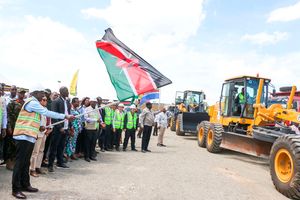
President William Ruto launches the dualling of 175km Rironi-Mau Summit road at Mau Summit in Nakuru County on November 28, 2025.
Photo credit: Boniface Mwangi | Nation Media Group
The auditor reckons that the payout for terminating the deal did not qualify as part of pending bills that were to be paid from part of the fuel levy, which was set aside as security for a bank loan to clear road contractors’ dues.
“The amounts were paid through the securitisation of fuel levy, which was meant to reduce the pending bills and pave way for a return to-work formula,” states the report.
“No explanation was given on why the amount was charged on the securitisation fund, while it did not constitute pending bills that were earmarked for discharge through the securitisation facility. In the circumstances, there was no value for money for the payment of Sh7.31 billion,” it adds.
Treasury had not disclosed the source of the funds the State used in compensating the French firms after cancelling the Sh159.27 billion contract for the construction of the highway under a public-private partnership arrangement.
The French consortium had been awarded the contract on September 30, 2020 under President Uhuru Kenyatta’s regime. It had hammered the deal during Mr Kenyatta’s visit to Paris in the same year.
However, the deal was cancelled by President William Ruto’s administration even before the contractor commenced works, ushering in Chinese contractors. The entry of the Chinese contractors came after the president visited Beijing in April last year.
The fuel levy securitisation programme was primarily intended to clear verified pending bills owed to contractors and facilitate resumption of work on stalled road projects across the country.
KenHA said pending bills dropped to Sh72.8 billion from Sh87.9 billion due to “targeted settlements” enabled by the securitisation of the fund.
Motorists pay Sh25 into the RMLF for every litre of petrol or diesel bought, out of which the government apportions Sh12 for securitisation.
The Nakuru highway project has since been divided into two sections and awarded to a consortium of China Road and Bridge Corporation Kenya (CRBC) and National Social Security Fund (NSSF), and Shandong Hi-Speed Road & Bridge International Engineering Co. Ltd (SDRBI) at a combined cost of Sh192.6 billion.
Initially, there was a push to have Chinese contractors settle the Sh7.31 billion compensation bill and inherit the works done by the French contractors, like the feasibility fees. However, this was dropped during President Ruto’s visit to China, leaving the bill in the hands of Kenyan taxpayers.
The use of the securitised funds in settling the compensation bill highlights the pressure the State found itself in after cancelling the multi-billion shillings deal.
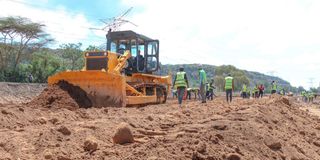
Kenya National Highways Authority (Kenha) officials, led by Corridor B Director Kibet Terigin, Presidential Protocol team, together with CRBC and Shandong road contractors inspect project launching sites for the dualling of the Rironi - Mau Summit (A8) road on November 26, 2025, ahead of the official launch by President William Ruto on Friday.
Photo credit: Boniface Mwangi | Nation Media Group
Treasury said earlier it pursued an out-of-court settlement to avoid a costly and protracted suit at the London Court of International Arbitration. Kenya was also fretful that without the payment, the French would block attempts to take away the contract—a move that would have marred the president’s Beijing tour.
Kenya terminated the highway expansion deal with the French consortium, citing, among other things, high toll fees. The highway construction deal was one of the projects that Dr Ruto sought to close on his first visit to China as President.
Motorists were going to pay $6 (Sh774.61) to drive 175 kilometres in a small car and close to $50 (Sh6,455) for a truck to go the same distance under the French deal.
President Ruto’s foreign policy has shown a strategic pivot towards China, driven by economic necessity and challenges in securing funding from Western partners. While initially focusing on the US and Europe upon taking office, his administration has increasingly engaged with Beijing to secure infrastructure deals and investment.
The early termination triggered compensation costs amounting to Sh7.31 billion, an expense the Auditor-General says could have been avoided had proper feasibility studies and planning been undertaken before the award of the contract.
The audit findings point to possible gaps in due diligence for one of Kenya’s most ambitious road projects. The highway is a key transport corridor linking the capital to western Kenya and the East African region.
KeNHA management furnished auditors with documents, including a report on compensation following termination, a deed of termination and payment vouchers. However, the report says the main contract document was not provided for audit, thereby limiting the auditors’ ability to fully assess the terms and obligations in the agreement.
Under the split project scope, CRBC-NSSF will develop Rironi-Naivasha-Gilgil and Rironi-Mai Mahiu-Naivasha (A8) road section covering 139 kilometres, while SDRBI will handle Gilgil-Nakuru-Mau Summit section covering 94 kilometres.
SDRBI had lost the contract to the CRBC-NSSF consortium, but the government brought it back to avoid scrutiny and lengthy approval from the Chinese government due to the large size of the contract.
Beijing usually demands approval for overseas projects exceeding $1 billion (Sh129 billion) that are handled by State-owned Chinese firms. This rule would have likely subjected the project to a delay of more than a year, hence the decision to split it into two sections.
President Ruto is keen to see the project completed before the next General Election in 2027, viewing it as a key selling point to residents of the Rift Valley, Western Kenya and Nyanza, where motorists often endure long traffic snarl-ups, especially during the festive season. The project was launched on November 28, 2025.
It forms a critical part of both the Northern Corridor and the Trans-African Highway, serving as a vital transport artery that links East and Central African countries to the Port of Mombasa. The highway plays a key role in supporting the movement of goods and services across the region, carrying a substantial volume of heavy commercial traffic.