The government faces a legal challenge over a new requirement making health insurance mandatory for all foreign visitors entering Kenya, deepening concerns from the tourism sector that the policy could increase travel costs and undermine the country’s competitiveness as a destination.
The Consumers Federation of Kenya (Cofek) has moved to court seeking to suspend implementation of the directive, arguing that the government introduced the requirement without demonstrating compliance with constitutional provisions on public participation, transparency and fair administrative action.
The consumer lobby wants the court to stop authorities from enforcing the mandatory insurance requirement, accrediting insurers or allowing collection of premiums until the legality of the policy is determined.
The petition challenges Gazette Notice No. 11492 published on July 30, 2026, and signed by Health Cabinet Secretary Aden Duale, which requires all inbound travellers to obtain a travel health insurance policy with a minimum cumulative benefit limit of $50,000 (about Sh6.5 million) before entering Kenya.
Under the directive, the insurance cover provides up to Sh2.58 million for medical expenses, Sh3.22 million for emergency medical evacuation, Sh38,700 for prescribed medicines, Sh129,000 for mental health treatment and Sh645,000 for repatriation of mortal remains.
The government says the requirement is intended to ensure visitors can access healthcare services during emergencies and reduce pressure on public health facilities.
However, Cofek argues that the policy effectively creates a compulsory insurance regime affecting travellers, insurers and businesses without adequate public consultation or clarity on implementation.
Cofek secretary-general Stephen Mutoro said the organisation does not oppose travel health insurance as a policy objective but is challenging the process through which the requirement was introduced.
Consumer Federation of Kenya (Cofek) Secretary-General Stephen Mutoro.
Photo credit: Lucy Wanjiru | Nation Media Group
“The petitioner’s concern arises from the way the statutory framework has been established and the apparent absence of demonstrable compliance with constitutional safeguards governing delegated legislative and administrative authority,” Mr Mutoro said in court documents.
The lobby says the Gazette Notice does not provide sufficient details on how insurers will be accredited, how premiums will be determined, who will manage the funds collected or what accountability measures will be put in place.
“The gravamen of this petition is therefore not opposition to travel health insurance as a public policy objective, but whether the Executive may establish a compulsory statutory insurance regime without demonstrable compliance with the Constitution,” the petition states.
The Cabinet Secretary for Health, the Insurance Regulatory Authority and the Attorney General have been named as respondents, while the Public Procurement Regulatory Authority and the Digital Health Agency are listed as interested parties.
The court challenge comes amid growing opposition from tourism stakeholders, who argue that the new requirement could make Kenya a more expensive destination at a time when the country is competing for international visitors.
Hoteliers, tour operators and travel agents say the directive sends mixed signals to the global tourism market, coming months after Kenya eased entry requirements for most foreign visitors in an effort to increase arrivals.
Kenya Association of Hotelkeepers and Caterers (KAHC) chief executive officer Dr Sam Ikwaye said the industry was opposed to the policy, questioning its timing and the wider environment facing the tourism sector.
“As an industry, we oppose this move. It is the wrong direction. The challenge is the timing and the current state of the tourism sector,” said Dr Ikwaye.
He said the government had focused on introducing measures that increase revenue but had overlooked long-standing concerns from the industry, including the need to improve air connectivity.
“What we have consistently advocated for is opening the skies and liberalising air access to allow more international visitors to fly directly to the Coast,” he said.
Dr Ikwaye said requiring tourists to connect through Nairobi before reaching coastal destinations increases travel costs and could influence visitors to choose competing destinations.
“Tourists do not save money to come and pay multiple taxes and levies. They save to enjoy holidays and experiences,” he said.
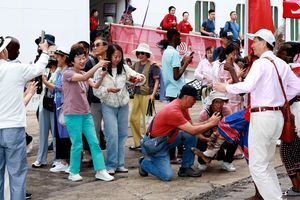
Tourists at Fort Jesus Monument in Old town, Mombasa on April 1, 2025.
Photo credit: Kevin Odit | Nation Media Group
He argued that Kenya could generate more revenue by creating a business-friendly environment that attracts more investors and visitors, allowing the government to collect more taxes through increased economic activity.
Dr Ikwaye warned that achieving the Kenya Tourism Board target of attracting 5.5 million visitors annually could become difficult if government agencies continue introducing measures that increase the cost of travelling to Kenya.
“Investors and tourists need a predictable environment where they can plan. The government should engage stakeholders, listen to industry concerns and incorporate their views before implementing policies that affect the sector,” he said.
Tourism players say visitors already face several charges, including the Electronic Travel Authorisation (ETA) processing fee and increased park entry fees.
They fear that adding mandatory insurance could make Kenya less attractive compared with destinations such as Tanzania, Rwanda and South Africa.
Tourism consultant Tony Kirimi questioned why visitors should be required to purchase a Kenyan insurance policy when many already arrive with comprehensive travel insurance from their home countries.
“Every day I cry for my country. We accepted the gateway fee. Park fees have continued to rise, making Kenya increasingly difficult to market. Now we want to introduce mandatory health insurance that is even more expensive than what some travellers pay in Europe,” he said.
Mr Kirimi questioned the rationale behind removing visa requirements for many countries while introducing another compulsory payment.
“What was the point of removing visa requirements only to introduce another expensive requirement?” he asked.
He argued that Kenya is still building its reputation as a global tourism destination and should avoid policies that increase the cost of visiting the country.
“Most travellers already have travel insurance purchased in their home countries. Why should they be forced to buy another cover?” he posed.
Hotelier Mohamed Hersi also criticised the requirement, saying tourists should not be subjected to duplicate insurance costs.
“A tourist pays for insurance before travelling to Kenya and is then expected to buy another one. Imagine if every country adopted the same approach. The issue is not whether it costs ten dollars or one hundred dollars. If the charge is unnecessary, it is still wrong,” he said.
Industry players are demanding clarity on whether existing international insurance policies will be recognised, how much the new cover will cost and which companies will be authorised to provide the service.
They have also accused the government of failing to adequately consult stakeholders before introducing the policy.
Kenya Wildlife Service (KWS) data indicates that national parks and reserves have recorded more than 3.5 million visits this year, up from about two million previously.
Domestic tourism has been a major driver of growth, accounting for about 60 per cent of visitors to parks and reserves.
KWS Director-General Prof Erustus Kanga attributed the increase to improved marketing, better management and political stability.
He said KWS revenue had grown from Sh2.9 billion in December 2022 to Sh5.3 billion, Sh7.6 billion in 2024, Sh7.98 billion in 2025 and Sh10.5 billion this year.
Tourism operators fear that additional costs imposed on international travellers could slow this momentum and make it harder for Kenya to achieve its visitor targets.
They are calling for further engagement between government agencies and the private sector before the directive is implemented.