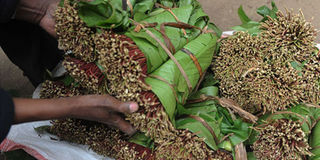
Kenya’s miraa exports to Somalia fell in the first quarter of the year as Ethiopian suppliers tightened their grip on the country’s biggest export market, cutting earnings by nearly Sh470 million and piling pressure on one of Kenya’s most valuable cash crops.
New data from the Agriculture and Food Authority (AFA) shows export volumes dropped by 13 per cent to 692,000 kilogrammes between January and March, down from 795,668 kilogrammes in the corresponding period last year.
The decline pushed export earnings down to Sh3.09 billion from Sh3.56 billion over the same period, representing a revenue loss of about Sh470 million.
The figures underscore Kenya’s growing vulnerability after relying almost exclusively on the Somali market, where Ethiopian exporters continue to gain market share through geographical and logistical advantages.
“Kenya’s miraa is consumed locally and exported, with Somalia serving as the primary destination and a key source of foreign exchange. However, Kenyan miraa exports to Somalia face growing competition from Ethiopian imports, largely due to Ethiopia’s closer geographical proximity to the Somali market,” AFA said.
The regulator added that, “During the quarter under review, Kenya exported a total of 692,000 kg of miraa, valued at Sh3.09 billion. This was a drop in volume and value compared to the same quarter in 2025, attributed to competitive pressures in the Somali market, underscoring the need for market diversification and improved trade logistics.”
The latest decline extends a trend that has persisted since Ethiopia secured preferential access to the Somali market in 2023.
That year, Somalia granted Ethiopian exporters exclusive access to its miraa market for 10 days every month, prompting protests from Kenyan farmers, who argued that the arrangement distorted competition by giving Ethiopian traders a guaranteed marketing window instead of allowing both countries to compete on equal terms.
Ethiopia defended the arrangement, saying Kenyan miraa had dominated the Somali market for years and that its producers needed protection to establish themselves.
Somalia remains Kenya’s leading export destination for miraa, accounting for virtually all official overseas shipments.
Photo credit: Bonface Mwangi | Nation Media Group
Ethiopia’s competitive edge has also been strengthened by its proximity to Somalia, enabling traders to deliver fresher produce more quickly and at lower transport costs. Miraa is highly perishable and depends on rapid transportation to preserve its freshness and market value.
Kenya resumed miraa exports to Somalia in 2022 after President Hassan Sheikh Mohamud lifted a two-year import ban imposed during a diplomatic fallout with Nairobi.
The reopening initially raised optimism among farmers after Somalia restored daily import quotas, starting at 19 tonnes before increasing them to 50 tonnes.
However, that recovery has gradually weakened as Ethiopian exports expanded under favourable trading arrangements.
Somalia remains Kenya’s leading export destination for miraa, accounting for virtually all official overseas shipments. The heavy reliance on a single market has increasingly exposed growers to policy shifts and rising competition.
AFA warned that the industry’s long-term sustainability will depend on reducing reliance on the Somali market.
“To sustain competitiveness, stakeholders are advised to diversify export markets, improve post-harvest handling, enhance trade logistics, and pursue bilateral trade agreements to reduce overreliance on Somalia and stabilize export volumes,” the agency said.
Kenya has in recent years intensified efforts to secure alternative export destinations across the Horn of Africa and the Middle East. Last year, Kenyan exporters gained access to the Djibouti market following trade negotiations between the two countries.
Despite legal restrictions in several international markets, miraa remains one of Kenya’s most valuable commercial crops, supporting thousands of farmers, transporters, traders and exporters, particularly in Meru, Embu and Tharaka Nithi counties.
The crop occupies 55,281 acres nationwide, with Meru and Embu accounting for 88.4 per cent of the total acreage. Other major producing counties include Kirinyaga, Tharaka Nithi and Marsabit.