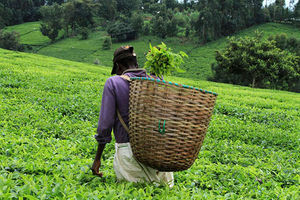
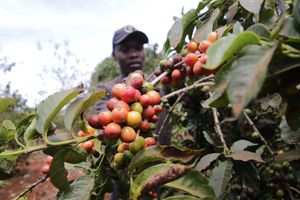
A farmer tends to her coffee in Nyeri town on October 25, 2022.
The United States Department of Agriculture (USDA) projects a 13.3 per cent growth in Kenya’s coffee production to 850,000 bags in the next marketing period (2025/2026) that begins in October, up from 750,000 bags in the current 2024/2025 period.
The agency, through its foreign agriculture service division, says the expected rebound is informed by the higher coffee prices, the government’s ongoing coffee reform programme, and the slowdown by farmers in converting their coffee plantations into real estate business.
This is expected to mark a turnaround from a 6.3 percent production decline to 750,000 bags currently, largely due to stagnation of harvested area and a drop in yields.
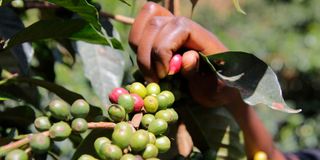
A farmer tends to a coffee bush in Nyeri town on May 10, 2023.
The agency, in a report dated May 15, says the substitution of coffee plantations with housing that was widespread in recent years has declined due to the stagnation of real estate development, and this is helping to stabilise the area under coffee cultivation.
“Following a year of high prices, farmers will be able to increase fertiliser application and improve disease and pest control. In addition, coffee plantations will be at the peak of the biennial production cycle that is characteristic of Arabica coffee,” the agency says.
Average coffee prices at the Nairobi Coffee Exchange (NCE) surged in the first half of the current marketing period due to a tight global supply associated with a production drop in key coffee exporting countries, the previous year, such as Vietnam, Indonesia and Brazil.
In February 2025, the average coffee price on the NCE rallied to a record high of $363 (Sh46915) per 50-kilogramme bag, up from $254 (Sh32828) in October 2024 and at the last trading session in April 2025, the price was $329 (Sh42521).
However, a price correction is anticipated in the second half of the current period because of the projected supply increase.
In the last five years (2020-2024), the acreage under coffee plantation has declined by 6.25 percent to 105,000 hectares (HA) from 112,000 hectares, demonstrating the farmers’ determination to convert their parcels of land to relatively higher income-generating activities compared to coffee production.
“The substitution trend was rampant in peri-urban areas of Nairobi, Thika, Kiambu, and Nyeri. Between 2020 and 2024, the area planted dropped from 112,000 to 105,000 hectares (HA),” the agency says.
“Area planted is also expected to increase marginally, as the government rolls out its coffee expansion programme targeting both traditional and new growing regions. The transition of land from coffee plantations to housing near Kenya's largest cities has slowed, stabilising the area planted."
Domestic coffee consumption, but tea is still Kenya's main beverage.
The agency expects a 6.9 percent increase in Kenya’s domestic coffee consumption to 62,000 bags in the next marketing year (2025/2026) from 58,000 in the current period (2024/2025) driven by the expansion of coffee service outlets in Nairobi and other urban areas and anticipated growth in Kenya’s tourism sector.
Kenya’s coffee exports are expected to increase by 10 percent to 840,000 bags from 763,000 bags during the period under review due to increased local production, with green bean exports continuing to dominate Kenya’s coffee exports.
Since February 2023, the government has undertaken several reforms in the coffee sector including placing NCE under the Capital Markets Authority (CMA), and the licensing of brokers to take over roles previously undertaken by marketing agents.