When Lucy Wanjiru began working at a flower farm in Ruiru in 2017, she saw it as a ticket to stability. The job paid modestly but reliably, and with her earnings, she could pay rent, buy food, and send her two children to school.
But in early 2020, as the Covid-19 pandemic upended global trade and travel, Wanjiru’s job, like that of tens of thousands of other flower workers across Kenya, suddenly vanished.
“I was told not to report to work indefinitely. At first, I thought it was temporary. Then weeks turned into months. I was never called back,” she recalls.
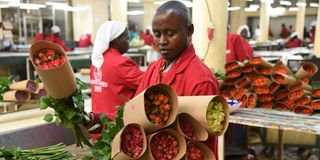
Flower scouter Ms Anastasia Mutheu inspects flowers in a greenhouse at Preesman, a flower breeding farm at Njoro in Nakuru.
Wanjiru’s story is not unique. Since 2020, Kenya’s once-thriving floriculture industry—renowned globally for its premium roses and cut flowers—has faced a dramatic downturn. A perfect storm of pandemic disruptions, surging production costs, shrinking European demand and shifting regulations has forced multiple flower companies to either scale back operations, lay off workers, or exit Kenya altogether.
Before the pandemic, Kenya was the world’s fourth-largest exporter of cut flowers, with the industry contributing over Sh100 billion annually to the economy while employing more than 200,000 people directly, and up to 500,000 indirectly. Export markets—particularly in Europe—accounted for 70 percent of Kenya’s flower sales.
But when Covid-19 hit, global demand for luxury goods like flowers plummeted. Weddings, events, and retail orders were cancelled. Cargo flights were grounded. Thousands of tons of unsold blooms were discarded, and farms were left with no option but to slash labour costs.
In March 2020 alone, an estimated 30,000 casual flower workers were sent home, and another 40,000 permanent staff faced indefinite leave. Some farms projected their entire workforce would be halved if conditions didn’t improve.
“We lost years of progress in just a few months,” says Peter Kamau, a union representative in Naivasha.
Though the flower sector rebounded slightly in 2021 and 2022, the recovery has been uneven—and for many workers, the layoffs became permanent.
The crisis deepened as global and local factors made flower farming increasingly unsustainable. The cost of inputs—fertilisers, pesticides, fuel, and packaging—skyrocketed, while air freight charges remained stubbornly high due to reduced cargo capacity. Domestically, farms grappled with delays in VAT refunds, increasing water tariffs, and what some industry players describe as a “punitive tax regime”.
In this pressure cooker environment, several notable firms decided to pull out of Kenya altogether.
James Finlay Kenya, a major player in Kericho’s highlands, announced its exit from the flower business in 2021, shuttering its Chemirei and Tarakwet farms and selling off Lemotit Flower Farm. The exit resulted in more than 910 workers losing their jobs.
Former UK High Commissioner to Kenya Jane Marriott smells a rose flower at Ibis farm in Meru county on February 3, 2021. They had led a high powered delegation in the area to celebrate the UK-Kenya Free Trade Agreement and trade between the two countries worth Sh200 billion.
Photo credit: Joseph Kanyi | Nation Media Group
In Naivasha, Oserian Development Company, one of Kenya’s oldest and largest flower farms, laid off 800 employees in September 2025, citing high costs and shrinking margins. The remaining 400 workers were placed on contracts with 50 percent pay cuts.
Other farms, including Karuturi, Magana, and Harvest, have also either shut down, downsized, or changed ownership.
While corporate statements often frame such moves as “strategic realignments,” the human toll is stark.
“I worked there for 12 years. They gave us two weeks’ notice and no severance. I haven’t found stable work since," says David Njoroge, who lost his job when a farm in Kajiado closed operations in 2022.
The true number of job losses is difficult to verify. Industry-wide data on layoffs, especially involving seasonal or contract workers, remains fragmented. However, analysts and union leaders estimate that over 70,000 direct jobs have been affected since 2020, with the total economic impact, including suppliers, transporters, and local businesses, much higher.
“Every flower worker supports at least three or four others,” says Rose Mboya, who runs a food kiosk near a flower estate in Ruiru. “When they lose their jobs, we all feel it.”
The majority of Kenya’s flower farm workers are women—many of them single mothers or sole breadwinners.
Fairtrade Africa has warned that the economic insecurity caused by widespread layoffs has led to increased vulnerability among female workers, including higher rates of domestic violence, reduced access to healthcare, and the withdrawal of girls from school.
One emerging trend that has further eroded job security is the rise of contract-based employment. Rather than hiring workers directly, many flower farms now outsource labor through agencies. While this allows companies to cut costs and avoid long-term obligations, workers complain of reduced wages, unstable schedules, and limited recourse for unfair treatment.
The Kenya Plantation and Agricultural Workers Union (KPAWU) has raised alarms over what it calls a “systematic dismantling” of labor protections in the flower industry. “We are seeing a deliberate shift toward short-term contracts and outsourced labor, which is exploitative,” said Cotu boss Francis Atwoli and KPAWU Secretary-General, at the height of layoffs in the industry.
In some cases, unionised workers have been replaced entirely with contracted staff, undermining collective bargaining efforts.
Central Organization of Trade Unions (Cotu-K) Secretary-General Francis Atwoli at a past event.
Photo credit: Bonface Bogita | Nation Media Group
Despite the bleak outlook, not all is lost. Some companies have chosen to stay and adapt.
In 2023, the Dutch investor Marginpar acquired several struggling flower farms, preserving hundreds of jobs in areas like Nyandarua. Other firms have diversified into higher-value varieties or invested in automation and sustainability measures to stay competitive.
Kenya Flower Council (KFC) has lobbied for more supportive policies, including subsidies for fertiliser, increased cargo space for fresh produce, and faster VAT refunds.
“There must be a long-term plan to make Kenyan flowers globally competitive again. We are not just losing jobs—we’re losing an entire ecosystem,” KFC boss Clement Tulezi, said while lobbying for incentives.
In April 2025, Mr Tulezi, warned that threats to Kenya's flower industry, including high freight costs and capacity shortfalls, are diminishing the country's competitive edge.
This year, the government extended a 2 percent Standards Levy, which was originally meant for manufacturers, to include flower exporters, a move industry leaders say will inflate costs, shrink margins, and weaken Kenya’s position in the global market.
Mr Tulezi, termed the levy unfair to flower exporters. This approach, he said in a statement, is “misguided, disproportionate and economically damaging as the industry was already one of the most heavily regulated in Kenya.
Flower farms must comply with inspections by the Kenya Plant Health Inspectorate Service (Kephis), regulations from the Pest Control Products Board (PCPB), requirements from the Horticultural Crops Directorate, and VAT rules enforced by the Kenya Revenue Authority.
“To add yet another levy without consultation, clarity, or regard for sector-specific realities is to further burden an industry already carrying more than its fair share,” Tulezi said. He also highlighted concerns over stringent EU regulations, rising production costs due to taxes and input as challenges threatening the sector’s sustainability.
Although Global demand is recovering, so are competitors. Ethiopia, Colombia, and Ecuador have all increased their market share in recent years, buoyed by lower costs and friendlier business climates
At the same time, climate change is introducing new variables. Erratic rainfall patterns, rising temperatures, and water scarcity are already affecting some flower-growing zones.
Workers at a flower farm in Oserian, Naivasha. Kenya’s flower industry meets stringent market conditions set by the European market. Photo/FILE
“Everything is more expensive now—labor, water, transport. And the weather is less predictable,” says John Karanja, a farm manager in Ruiru. “It’s like farming on a knife’s edge.”
Industry insiders and worker advocates agree: Kenya’s floriculture sector still holds promise but only if it is safeguarded.
They are proposed reforms including tax and duty waivers on essential inputs and equipment, better regulation of labor outsourcing, protection of worker’s rights, enhanced cargo infrastructure, including dedicated flower freight at airports,
Without urgent action, KFC says Kenya risks losing a vital part of its export economy in floriculture.
It has been over seven years since Wanjiru was last formally employed. She now does odd jobs like cleaning, washing clothes, and occasionally selling vegetables. Her children dropped out of school for a year when she couldn't afford fees.
“I still hope things will get better,” she says. “But it’s hard to believe when you’ve seen so many friends lose everything.”
As flower farms continue to wither under pressure, so too do the dreams of thousands of Kenyans who once found dignity in their petals.