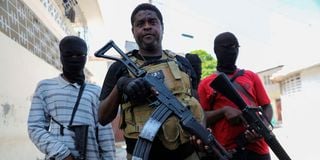
In Port-au-Prince, the capital city of Haiti, neighbourhoods are under the grip of gangs that operate like shadow governments — taxing truck drivers at roadblocks, holding hostages for ransom, and siphoning fuel supplies.
Now far from home, Kenya is leading a United Nations (UN) backed Multinational Security Support (MSS) mission in the Caribbean nation in an effort aimed at reversing that grim equation. But the challenge is staggering; dismantling a criminal economy that has become as entrenched as the gangs themselves.
Efforts to uproot the underground economy that has characterised Haiti since assassination of President Jovenel Moise in 2021, come with life threatening operations.
Kenya first sent its officers to Haiti in June 2024 in the mission that offers both risks and rewards. On risks, so far three police officers attached to the National Police Service (NPS) have died following attacks by gangs.
Success in the mission could bolster Kenya’s image as a peacekeeping leader and failure on the other end could sap resources, cost lives, and tarnish its standing.
A protestor adds a tire to a burning barricade during a demonstration to protest the killings of six police officers by armed gangs, in Port-au-Prince, Haiti, January 26, 2023.
Photo credit: AFP
Already, Kenyan forces have won small victories. In some districts, residents have returned to markets after patrols reopened blocked roads. Fuel deliveries have resumed in areas once starved by gang control.
But sustaining those gains will demand more than patrols. Analysts stress the need for parallel reforms: rebuilding Haiti’s police, strengthening courts, tackling corruption, and injecting jobs and schools into communities where gangs recruit.
“Security deployments can suppress violence temporarily,” said Pius Masai, a UN security advisor. “But unless people see hope, gangs will always have fresh recruits and new revenue streams.”
1. Participation in illicit markets (drugs, arms, contraband)
Haiti is used as a transit point for cocaine and other contraband. Gangs facilitate and tax shipments, store goods, and provide armed protection — earning margins from international trafficking networks. This week, Kash Patel, the Federal Bureau of Investigations (FBI) Director told the United States Senate that Haiti is a major hub for cocaine trafficking from Venezuela.
He blamed the alleged complicity of Haitian gangs, amid institutional fragility, a lack of territorial control, and the expansion of transnational criminal networks.
Patel also stressed that although operations to intercept vessels in the Caribbean fall under the Department of Defence, he is confident that the United States acts firmly against those who try to bring drugs into its territory.
"The end-state delivery, which is the United States of America — and we will hunt down every single one of those narco-traffickers with the authority we have," he said.
On July 13, 2025, Haitian National Police (HNP) seized more than a tonne of cocaine off the coast of Tortuga Island. The Caribbean based nation has been playing a long-standing role as a transit point for Mexican, Venezuelan and Colombian cartels.
In the past, drug cargoes have been intercepted in the North (Cap-Haitien, Port-de-Paix), the Centre (Hinche, Mirebalais), the West (Bon-Repos, Plaisance) and especially in the South, notably in Les Cayes, Ile-a-Vache, Bale des Flamands, and Plaisance-du-sud, which are considered entry points of cocaine and marijuana.
A demonstrator holds up a Haitian flag during a protest against Prime Minister Ariel Henry's government and insecurity, in Port-au-Prince, Haiti March 1, 2024.
Photo credit: REUTERS/Ralph Tedy Erol/File Photo
On firearms, in April 2024, officers attached to HNP, announced that they had seized the two boxes containing 12 assault rifles, 14 pistols and 999 ammunition cartridges.
The shipment had traversed nearly 1,200 kilometres from Fort Lauderdale in Florida to Cap-Haitien in northern Haiti, on the Rainer D cargo ship.
2. Weak state capacity and corruption amplify gains
As police, courts and customs weaken or are co-opted, gangs face less risk of arrest and can expand economic activities.
Corruption and collusion with some political actors can further shield or legitimise their operations.
Two weeks ago, Jimmy Cherizier alias Barbecue , who is the most dreaded gang leader in Haiti, claimed that they are being paid well to cause more mayhem in the Caribbean based nation.
Barbecue, who is the leader of Viv Ansanm gang, which translates from Haitian Creole to “living together’— an alliance comprising former rivals G9 Family, allies and G-Pèp — said that top officials in Haiti make payments to ensure that the country remains unstable.
“We enjoy good friendship with a section of top leaders here in Haiti and they have paid us well so that we can destabilise the country,” he claimed, adding that the strategy was for them to remain in power.
Deadly firearms recovered from Haiti Gangs.
Photo credit: Multinational Security Support (MSS)
He named a section of leaders, who were sponsoring their operations within Haiti. Barbecue said his fellow leaders have been paying visits to a top official in Haiti where they discuss progress of their operations.
If the financial muscle being claimed by the gangs is anything to go by, then that gives an explanation why in the recent past, the United Nations Office on Drugs and Crime warned Kenya to be wary, that weapons of Haitian gangs are far more powerful than those of the Caribbean country’s police force.
Kidnapping has been a major revenue source; large numbers of kidnap-for-ransom cases (including mass kidnappings) have generated big pay-outs from families, companies and sometimes diaspora networks. This also funds weapons, pays fighters, and logistics.
In August 2025, Gena Heraty, an Irish missionary and a three-year-old child were among nine people who were kidnapped in Haiti from an orphanage near Port-au-Prince.
The victims were seized from the Sainte-Hélène orphanage in the commune of Kenscoff, about 10 kilometres south-east of the capital by gang members who were demanding ransom.
Heraty used to oversee the orphanage which is operated by the humanitarian organisation Nos Petits Frères et Sœurs (“Our Little Brothers and Sisters”).
According to the United Nations Integrated Office in Haiti (BINUH) a total of 1,494 people were kidnapped in 2024. The kidnappings were conducted by members of various gangs.
4. Direct cash extraction: extortion and “taxes”
Gangs set up checkpoints, demand “passage” fees from truckers and businesses, run protection rackets for shops and markets, and levy regular payments on local businesses and informal markets. These steady flows are a primary income source.
In May, Finance minister Alfred Metellus estimated that gangs were making between Sh7.7 billion to Sh9 billion every year just from extortions for the movement of cargo containers The money from fuel truck drivers is in addition to that.
A BINUH report seen by the Nation states that between January and March 2024, gangs continued to extort common transport vehicles and trucks transporting goods passing through the illegal checkpoints set up on the capital’s main roads.
“According to local sources, trucks transporting food products or fuel from the capital to the southern departments of the country were forced to pay “passage fees” of up to 3,000,000 HTG (around 22,600 USD) for each journey,” the report reads.
It says other gangs such as the Delmas 6 gang, stepped up their extortion of businesses operating in territories they control in recent months, using violent means (including physical assaults and destruction of premises) to enforce payment.
In March, members of the Delmas 6 and Tokyo gangs attacked and vandalised at least seven businesses in the Bas-Delmas area.
These businesses were raided despite some of them giving large sums of money to the gangs for years, in order to be able to continue operating.
Since the end of February, the “self-defense” group Caravane, whose modus operandi is now similar to that of the gangs, collected illegal fees from people passing along Route des Rails road (Carrefour commune).
5. Control of territory for political and economic leverage
When gangs control neighbourhoods or whole districts they become gatekeepers of social and economic life — issuing “rules,” collecting fees, supplying (or denying) basic services, and selling protection.
That territorial control lets them bargain with local elites, politicians, or international actors — sometimes gaining impunity, jobs, or contracts.
The Caribbean nation is currently grappling with extraordinary violence as gangs have tightened their stranglehold over large portions of the country.
It is worth noting that since the MSS mission started more people have been killed compared to other years.
In 2024, at least 5,601 people had been killed which is 1,000 more than in 2023 leading to criticism of the Kenyan police force.