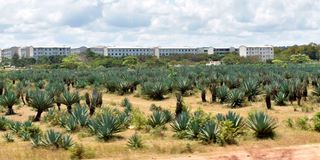
Once the heartbeat of Kenya’s sisal industry, Vipingo is now undergoing a dramatic transformation, driven by falling sisal export earnings and rising demand for land for industrial and real estate development.
The sprawling sisal plantations that defined the Coast’s agricultural economy for decades are slowly giving way to luxury homes, gated estates, golf resorts, and short-stay apartments.
From Taita-Taveta to Kilifi, where there have been large sisal plantations, owners are now shifting to real estate since natural fibres and their products have a relatively low commodity value compared to other commodities.
A sisal plantation in Vipingo, Kilifi County in this photo taken on October 6, 2025. The plantations are slowly giving way to luxury homes, gated estates, golf resorts, and short-stay apartments.
Photo credit: Wachira Mwangi | Nation
The recent launch of the Vipingo Special Economic Zone (SEZ) at the larger Rea Vipingo, according to industry insiders, suggests that the once-thriving fibre enterprise may be taking its final bow as investors pivot towards high-value real estate and manufacturing.
According to the Agriculture and Food Authority (AFA), sisal production has declined from 14,806 tonnes in 2022 to 11,432 tonnes in 2023. Data further shows that exports dropped to 1,979 tonnes as of April 2025, down from 2,116 tonnes during the same period in 2024.
“The demand for land is high and we cannot be farming sisal, which has little value compared to land demand. Many are uprooting the crop and subdividing the land into plots,” said Juma Karissa, a small-scale sisal farmer in Kilifi.
The global price for a kilo of sisal fell by 1.2 percent to Sh218 ($1.7) during the year ended 2024, with freight rates to Europe and Asia rising to their peak.
According to the Rea Vipingo 2024 Annual Report, the company has ceded several acres of sisal plantation to Centum Investment Company Limited after the two companies entered into an agreement in 2015.
Despite high total fibre production in 2024, management says production is expected to continue declining due to below-average rainfall and reduced acreage of mature sisal.
“In 2024, production was unusually high at 4,172 tonnes (2023: 3,631 tonnes), a level that will not be achieved going forward. This is because the amount of rainfall since the start of the new financial year has been below average for the period,” read the report.
A sisal plantation in Vipingo, Kilifi County in this photo taken on October 6, 2025.
Photo credit: Wachira Mwangi | Nation
From the largest sisal farm in the Coast region to a regional industrial hub, the Vipingo Sisal Estate is transforming into a high-end real estate and luxury golf enclave, and now into one of the region’s largest Special Economic Zones.
Mr Martin Kariuki, the general manager of Centum Vipingo, said that more than 10,254 acres that were once part of the sisal estate are being turned into prime plots offering a diverse range of investment opportunities.
Mr Kariuki said the Vipingo development aims to shape a new phase of urban growth along the Coast. He noted that the project provides opportunities for homeowners and investors alike, including serviced plots and residential options designed to support the region’s expanding urban landscape.
“We have residential homes, fully serviced residential and industrial plots, as well as enticing prospects in commercial, hospitality, and institutional sectors. The development features key urban infrastructure, including a three million-litre-per-day seawater desalination plant and an on-site power substation,” said Mr Kariuki.
A sign post for the Vipingo Special Economic Zone in Kilifi County in this photo taken on October 6, 2025.
Photo credit: Wachira Mwangi | Nation
The groundbreaking of the Vipingo Special Economic Zone is expected to enable the establishment of numerous enterprises, creating an estimated 50,000 direct and indirect jobs over the next decade. It is designed to host over 200 industries across sectors such as agro-processing, manufacturing, IT, logistics, green energy, and pharmaceuticals.
President William Ruto said the Vipingo SEZ will help create jobs and that Centum in Kilifi County has demonstrated the power of devolution to deliver real, tangible, and transformative outcomes.
Kilifi Governor Gideon Mung'aro said increased investment in Vipingo has added value to land around Kilifi, with several companies already moving to the site to begin construction.
“The value of land has increased since speculation began about 10 years ago. With the dualling of the Mombasa-Kilifi highway, many corporates have been attracted to the area,” he said.
Centum has over the years carved a niche as an investment channel providing investors with access to a portfolio of quality, diversified investments that were previously inaccessible.
Centum Re is one of the biggest real estate investors, and in the Coast region, it has made an edge in Kilifi County through the Vipingo residential and commercial development project.
A sign post for the development of Vipingo in Kilifi County in this photo taken on October 6, 2025.
Photo credit: Wachira Mwangi | Nation
Mombasa Cement has also moved in to expand its cement production capacity due to the projected demand for the commodity over the next 13 years before the completion date of a number of companies in the Vipingo SEZ.
In Taita-Taveta County, Teita Sisal Estate Limited, one of the area's largest sisal estates, has announced plans to subdivide and sell its 3,000 acres to individuals and companies looking to set up businesses or residential homes.
This decision came about due to low demand for sisal and reduced production caused by inadequate rainfall.