Kenya's growing urban centres must rethink non-motorised transport

Delegates follow proceedings during the 2nd Smart Cities Forum on October 29, 2026 at Iconic Plaza Hotel in Nairobi.

Every new road should make a town easier to navigate. That was the rallying call by experts who spoke at the second Smart Cities Conference held on Thursday ( yesterday). Discussions on regenerating African cities exposed the challenges of planning urban spaces, enforcing development standards and ensuring that investments respond to the needs of residents.
Engineers and urban planners are concerned about pedestrians, cyclists, motorcyclists and motorists who are left competing for the same limited space, while footpaths are considered after the road has already been built.
Engineer Muguru Wairimu, a sustainable mobility consultant and chairperson of an engineering chapter at the Architectural Association of Kenya (AAK), said road development had historically prioritised covering as many kilometres as possible, often leaving pedestrian infrastructure out of the initial design.



From left: Technopolis Development Authority-Kenya Chief Executive Officer John Paul Okwiri, Board Chair of Cities and Municipalities Forum, Kenya Wanyonyi Buteyo, Nation Media Group Chief Commercial Officer James Sogoti and The president of The Architects Alliance Senator Sylvia Kasanga during the 2nd edition of the smart cities forum held on October 29, 2026 at the Iconic Plaza Hotel in Nairobi.
“There are times when people need to speak in some areas,” she said, “or they need to go to a town rather than a town that is very remote.”
However, she said planners needed to rethink their approach and give greater priority to non-motorised transport, including walking and cycling.
“When we design and construct roads, we rely on manuals that guide us on how to design the specifications,” Ms Wairimu noted.
The experts explained that separating pedestrians and cyclists from motorised traffic was essential to improving road safety.
“Design is one of the guarantees of road safety,” Ms Wairimu said.

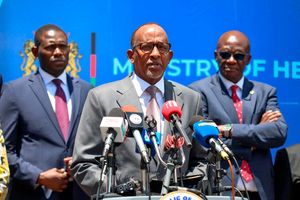
KRA Board chairperson Ndiritu Muriithi
Ndiritu Muriithi, the chairperson of the Kenya Revenue Authority board, challenged professionals to take responsibility for the decisions that shape towns and cities, arguing that those who understand planning rules should not facilitate violations.
“Professionals need to uphold their ethical obligations,” he said, “and refuse to participate in decisions that did not comply with the rules.”
Mairura Omwenga, the chairperson of the Town and County Planners Association of Kenya, said urban professionals must take responsibility for the challenges facing cities.
“If cities are thriving or collapsing, professionals should not shift the blame to others,” he explained, “we must take responsibility for our role in shaping them.
Cyrus Mbisi, the vice-chairperson of the Physical Planners Registration Board, estimated that about 50 per cent of Kenya's population was urban, with the country approaching the point at which more than half of its population would live in urban areas.
“Kenya must strengthen its urban planning institutions,” he said, “to keep pace with the growing demand for infrastructure and essential services as cities expand.”
He further added that much of the growth was driven by people moving from rural areas to towns and cities, increasing demand for housing, water supply, information and communication technology infrastructure and other essential services.
However, he raised concerns about whether urban development was being adequately guided by plans and qualified professionals.
“We need to get serious,” he warned, “assigning planning roles to unqualified people undermines professional practice and weakens urban development institutions.”
Stakeholders pointed to the importance of integrating special economic zones into broader urban plans.
According to David Kombo, Director of land and infrastructure at the Special Economic Zones Authority, the Industrial areas need reliable transport links, housing and other essential services to function effectively within cities.
“Planning must put communities first and support economic growth,” he said, “through investment, skilled people and essential infrastructure.”
He identified transport corridors, housing, water recycling, renewable energy and waste management as elements that should be considered when developing more integrated urban and industrial systems.
The transition to electric vehicles presents another example of why technology alone cannot deliver a functional city.
Achieng Anami, director of sales and marketing at Moja EV Africa, said Kenya had about 35 electric-vehicle charging stations, reflecting growing investment in the infrastructure needed to support electric mobility.
However, integrating charging facilities into residential developments remains a challenge.
“Systems in developed cities have allowed developers to incorporate charging facilities into houses and apartments,” she explained.
Mr Muriithi said planning should involve citizens in deciding what their towns need, including green spaces, sports facilities, waste management, water infrastructure and digital connectivity.
“Health, water and sewerage services,” he said, “Need to be organised around what communities required rather than developed as disconnected interventions.”

Nation Media Group Managing Director and Chief Executive Officer Geoffrey Odundo deliver his remarks during a panel discussion at the Trust Summit in Nairobi on October 23, 2026.
Geoffrey Odundo, Nation Media Group's Chief Executive Officer and Managing Director, said the success of urban regeneration should be measured by how it changes people's everyday lives.
“We must ensure access to reliable water, safe housing and shorter commutes,” he said, “while creating opportunities for young people to access services and build businesses.”
The Ministry of Investment, Trade and Industry also highlighted the need to attract private capital into urban infrastructure and technology.’
Elsama Ndegwa, the Administration Secretary, State Department for Investment Promotion, Ministry of Investments, Trade and Industry, said Konza City was being positioned as an entry point into the knowledge economy, with a target of creating more than 200,000 high-skilled jobs in information and communication technology and business process outsourcing.
“The government is targeting digital-skills training for more than 120,000 citizens across counties,”
According to the Ministry, the government is seeking to attract investment in smart cities through reforms to special economic zones, green infrastructure and public-private partnerships.
“Regenerating our cities is not just about creating new glass towers," he said, “it is about retrofitting existing urban spaces with utilities, affordable housing and resilient infrastructure.”
Follow our WhatsApp channel for breaking news updates and more stories like this.