After two weeks in China, it would be easy to return home and declare that Beijing has figured out everything while Nairobi has figured out very little. That would be both unfair and, frankly, lazy.
Nairobi has warm people, wonderful food and a character that is second to none in the world.
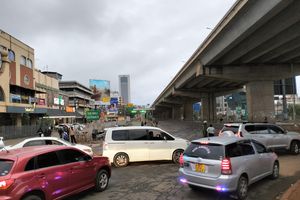
But moving around Beijing, Ningbo and Jiaxing cities in China made me think about what Nairobi could learn from the former, a capital city that has spent decades trying to keep millions of people moving without allowing traffic to consume the city.
For the China trip, I was joined by my Nation Media Group colleagues Justus Wanga, Acting Lead Editor for Weekend Editions; Aggrey Mutambo, Africa Editor at The EastAfrican; and Grace Kerongo, weekend homepage editor at Nation.Africa, alongside editors from other Kenyan media houses.
From left: The writer Kenfrey Kiberenge, alongside Justus Wanga (Acting Lead Editor for Weekend Editions), Grace Kerongo (Weekend Homepage Editor at Nation.Africa) and Aggrey Mutambo, (Africa Editor at The EastAfrican) pose with their certificates after completing the seminar for mid- and senior-level media managers and editors from Kenya.
Beijing still has a traffic problem. By the end of 2025, it had 8.1 million motor vehicles, including 6.6 million private cars. Yet the city has built a transport system in which owning a car is not the only practical way of getting around.
Part of the story goes back to the 2008 Olympics, as narrated to us during our eventful ride to the Great Wall of China.
Beijing experimented with a strict odd-even number-plate system during the Games, keeping roughly half the vehicles off the road on any given day.
The restrictions were temporary, but they showed that traffic could be managed by controlling when cars moved, rather than simply building more roads.
In October that year, Beijing introduced weekday restrictions based on the last digits of number plates, which eventually became a permanent feature.
The system has since become more sophisticated. The numbers now rotate every few months, with two final digits restricted each weekday. In the current cycle, running from September 28 to December 27, plates ending in 5 and 0 stay off restricted roads on Monday, 1 and 6 on Tuesday, 2 and 7 on Wednesday, 3 and 8 on Thursday, and 4 and 9 on Friday.
The restrictions apply from 7am to 8pm, while fully electric passenger cars are exempt. But Beijing went further than telling motorists which days they could drive.
From 2011, it began limiting the number of new passenger-car plates available each year and allocating them through a lottery. That means getting permission to put another private car on Beijing’s roads can be harder than buying the car itself.
Nairobi has another option, which Beijing has embraced on a large scale: make alternatives to cars cheaper, convenient and easy to use.
At the end of 2025, Beijing had 848,000 shared bicycles, while its rail network had grown to 30 lines covering 909 kilometres and carrying 3.57 billion passengers that year.
Its buses operated 1,252 routes.
The technology is almost invisible because it works so naturally. You find a bicycle on your phone, unlock it, ride it and pay electronically, while operators use data to manage the bikes.
Hawkers selling their merchandise to motorists stuck in a traffic jam on Thika Road in Nairobi on September 30, 2025.
Photo credit: Bonface Bogita | Nation Media Group
For Nairobi, the point is not to copy Beijing’s bicycles or subway map. It is to make the alternative to driving so reliable that Nairobians choose it willingly.
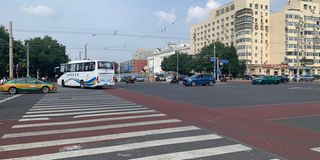
During my stay, I noticed sidewalks that were clearly separated from the main road, paths for people with visual impairments, functioning traffic lights and lane markings that actually seemed to mean something.
U-turns are not illegal. They are permitted at designated points, yet they do not produce the kind of improvisation we know too well in Nairobi because the lanes, signals and turning arrangements tell motorists what is expected.
Even the relationship between taxis and traffic officers felt different. A driver waiting for a passenger did not appear to be permanently looking over his shoulder for Kanjo.
In Nairobi, taxi drivers can sometimes be chased or harassed even when they are legitimately picking up or dropping off passengers.
In Beijing, my impression was of officers who were more inclined to regulate and explain than confront.
None of this is cheap, and that matters. Beijing is considerably wealthier than Nairobi, so it would be unrealistic to suggest that the two cities can simply exchange blueprints. Nairobi therefore has to adapt the ideas to its own economic reality, rather than copy the infrastructure.
Still, it is good to dream. My journey took me from Beijing’s Lize Financial Business District to Ningbo’s Zhoushan Port and Tengtou Village, before we travelled to Jiaxing and the Nanhu Revolutionary Memorial Hall.
Beijing has dramatically increased its urban greenery, parks, roadsides, and courtyards feature ancient trees.
Photo credit: Aggrey Mutambo | Nation
Nanhu was particularly memorable because history there has been turned into a living tourist attraction.
Some 105 years ago, in 1921, Mao Zedong and 12 other delegates to the First National Congress of the Communist Party of China moved their meeting from Shanghai to a boat on Nanhu Lake after their gathering was disrupted by authorities.
The boat, now remembered as the Red Boat, has become an important symbol and part of the memorial complex.
Then came the Great Wall, where it is difficult not to think about the sheer scale of what previous generations built and left behind.
Much of the Beijing section dates from the Ming dynasty, although the wider wall system contains structures from different periods. It became a Unesco World Heritage Site in 1987.
After a filling lunch at Big Pizza restaurant on what happened to be my birthday on September 18, we also crossed the magnificent 36-kilometre Hangzhou Bay Bridge, opened in 2008 to connect Ningbo and Jiaxing.
Our guide informed us that the bridge cut the road distance between Ningbo and Shanghai by about 120 kilometres and roughly halved the journey time.
These experiences left me thinking less about copying Beijing and more about changing Nairobi’s habits.
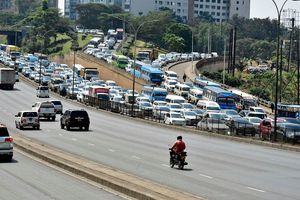
Vehicles in a traffic jam on Muranga Road in Nairobi on January 30, 2025.
Photo credit: Francis Nderitu | Nation Media Group
A city becomes easier to live in when its pavements work, public transport is dependable, roads are properly marked and rules are applied consistently.
Residents, too, have a role: drivers must stay in their lanes, pedestrians need to use designated spaces and enforcement should be firm without becoming a daily confrontation.
There was one area, however, where Nairobi easily won: food. Some Chinese aromas can take getting used to, although the chefs slowly learnt to accommodate our palates. Nairobi’s international hotels are particularly good at feeding people from almost anywhere.
I also noticed how comfortable people appeared walking at night. Young women livestreamed from streets, sometimes leaving phones beside them briefly while taking breaks. That does not mean Beijing has no crime, but it was striking to see such confidence in public spaces.
Perhaps Nairobi does not need a Beijing-sized subway tomorrow. What it needs first is the determination to make ordinary urban life work better, and then to keep building from there.
That may sound less dramatic than a mega bridge or a 909-kilometre rail network. But cities are transformed by thousands of such decisions, made consistently over many years.
Beijing offers Nairobi something more useful than a model to copy: proof that urban behaviour can change when the city gives people systems they can trust.