Kenyan manufacturers have petitioned the Common Market for Eastern and Southern Africa (Comesa) to resolve long-running disputes with Zambia over milk and edible oils trade.
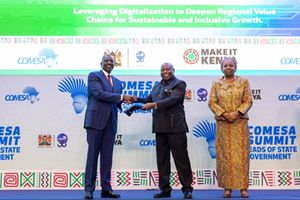
The Kenya Association of Manufacturers (KAM) presented the petition during the just concluded 24th Comesa Heads of State Summit held in Nairobi and in which President William Ruto assumed chairmanship of the 21-member regional bloc.
Zambia continues to block Kenyan milk (from Brookside Milk Ltd) and edible oil primarily to protect its domestic industries from perceived unfair competition, citing lower safety standards for milk, due to higher bacteria counts, and issues with the "rules of origin" for palm oil-based products.
But KAM opposes Zambia’s decision. The association argues that unresolved Non-Tariff Barriers (NTBs) are hurting intra-regional trade, specifically in milk and edible oils.
Zambia continues to block Kenyan milk and edible oil primarily to protect its domestic industries.
Photo credit: File | Nation Media Group
“We are increasingly seeing new barriers to trade through the introduction of domestic taxes and levies, particularly excise duties on intermediary and raw materials. In some cases, these taxes are even being applied to imports from within our own Comesa region,” said Hitesh Mediratta, KAM vice-chairman.
While many NTBs have been resolved, these two products remain key issues, with Kenyan manufacturers facing unfair barriers and protectionist tendencies from other member states, as exemplified by past disputes with Zambia over milk.
According to KAM, Comesa has failed to resolve trade disputes spanning over 10 years due to undue protection, wondering how intra-trade can prosper under such an environment.
“Even though Comesa has a small number of NTBs, the existing ones, such as those touching on edible oils and dairy, have taken over 10 years to resolve. This is an important emerging issue,” said Hitesh.
The Comesa Secretary-General, Ms Chileshe Mpundu Kapwepwe, promised to escalate the dispute to the summit, which met in a closed-door session.
“Just listening to the representative of the KAM, a number of pertinent issues have already been raised that should be part of that declaration (the Nairobi declaration) to bring to the attention of the Heads of State the number of challenges and bottlenecks experienced by the private sector and which should be addressed at that level,” she said.
Ms Kapwepwe said the matter had been on the discussion table for far too long. “Sometimes, as we all know, it’s only political will that can remove some of these constraints. Comesa’s main objective is to enhance economic growth and improve the livelihoods of its citizens,” she added.
Ms Kapwepwe said solutions over NTBs could be found by leveraging digitisation at the border crossing points.
In 2018, the Zambian Dairy Processors Association (ZDPA) banned dairy products from Kenya, complaining that Nairobi’s standards for raw milk did not measure up to the World Trade Organization’s (WTO) health standards, a charge Nairobi vigorously opposed.
In June 2022, President Uhuru Kenyatta hosted President Hakainde Hichilema at State House, Nairobi, in a bid to resolve Brookside milk exports to Lusaka, but the matter was never fully resolved.
KAM wants Comesa, of which both Kenya and Zambia are members, to establish a common standard that is acceptable to all in order to address such NTBs.
“Even though such measures may be driven by a well-intended local policy, they distort regional markets; go against the spirit of a free trade area (FTA),” said Hitesh.
“They disrupt supply chains, raise production costs and discourage cross-border trade and investment. Ultimately, they weaken the integration we have worked so hard to achieve. If left unchecked, this protectionist act could invite retaliation and undo years of progress.”