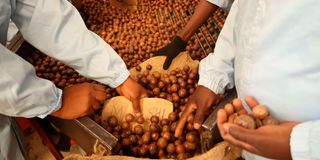
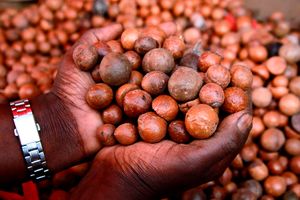
Kenya has given macadamia farmers and traders an additional six months to export raw nuts and clear mounting stocks, delaying the date for banning shipments to May 2027 from October this year.
The extension offers farmers a renewed opportunity to sell more of their harvest to international markets instead of relying entirely on domestic processors.
Farmers say local processors offer Sh50 to Sh80 per kilogramme of raw nuts, compared with offers of up to Sh200 from export buyers, giving them a stronger incentive to seek overseas markets.
The Agriculture and Food Authority (AFA) extended the export window following concerns over accumulated stocks, with more than 30,000 tonnes of macadamia nuts reportedly awaiting access to wider markets.
“AFA, in consultation with office of the Agriculture Cabinet Secretary, have granted permission to extend the controlled export window for raw (nut in shell) macadamia for a further six months,” said the Authority. “The extension was recommended to facilitate the marketing of the remaining stocks and provide additional market opportunities.”
The export restrictions are intended to discourage premature harvesting, as farmers rushing to sell raw nuts risk picking immature produce that delivers poor kernel recovery and oil content, weakening Kenya’s quality reputation in international markets.
The extension comes against the backdrop of a previous export window that closed on October 10, and in which only 700 tonnes were shipped, against an allocation of 14,000 tonnes, raising questions about the industry’s ability to turn regulatory concessions into actual sales.
The new window follows discussions at a November 5 farmers’ forum in Gatanga, Murang’a County, where growers and other industry players raised concerns over the difficulties facing producers in marketing their crop.
The restrictions on raw, in-shell exports have long been a contentious issue in Kenya’s macadamia industry, with disagreements over whether the policy protects domestic processing capacity or limits competition for farmers’ produce.
Processors have traditionally argued that exporting raw nuts deprives local factories of the supplies needed to sustain value addition, employment and investment in the industry.
But growers have faced a different reality, with limited competition for their produce weakening their bargaining power when negotiating prices with local buyers.
Kenya’s macadamia sector depends heavily on smallholder growers, particularly in the Central and Eastern regions, where the crop is an important source of income.
For these households, the price offered at the farm gate determines how much money remains after meeting production costs, including labour, harvesting, transport and farm maintenance.
Allowing more traders to access export markets could increase competition for raw nuts, potentially giving farmers alternative buyers and improving their negotiating position.
Kenya is competing in an international market where demand, processing capacity and the ability to supply consistent quality influence the prices paid for the crop.
The country, one of the world’s leading macadamia exporters, has in recent years grappled with fluctuating quality and volatile prices blamed on early picking and unregulated trading by middlemen.
Processors have repeatedly warned that immature nuts result in low kernel recovery, reduced oil content and poor shelf life, undermining competitiveness in export markets that demand strict quality specifications.
Section 43 of the Agriculture and Food Authority Act, 2013, prohibits the export of raw macadamia except with written approval from the Agriculture Cabinet secretary.
Kenya’s macadamia industry remains a key foreign exchange earner, with exports destined for markets in the United States, Europe, and Asia, where buyers place a premium on consistency and traceability.