The value of macadamia produced in Kenya jumped 73 percent to Sh8.6 billion in 2025, driven by a strong price run, especially towards the end of the year.
Fresh data from the Agriculture and Food Authority (AFA) show that farmers produced 53,968.16 tonnes of the crop valued at Sh8.6 billion in 2025, compared with 49,183 tonnes worth Sh4.95 billion the previous year.
“During the year 2025, farm gate prices were generally stable, with slight fluctuations reported when supplies were out of season. The year started with prices ranging between Sh70 and Sh100 and continued to increase as the processing and export activities gained momentum, resulting in competitive prices,” the regulator said.
“Towards the close of the high season in August and September, the prices had doubled in some production areas to close at a range of Sh120 to Sh150 in most production zones.”
Kenya produces about 20 percent of the world’s macadamia supply, with production reaching roughly 50,000 tonnes annually. Approximately 98 percent of Kenyan macadamias are exported, with the US being a major market, accounting for 35 percent, while Germany, the Netherlands, China and Hong Kong are other key destinations.
AFA records show that macadamia production reached 53,968.16 tonnes in 2025, marking continued growth from 2024 levels of 49,183 tonnes. The increase was attributed to geographical expansion and improved productivity.
Total macadamia acreage increased from 9,336 hectares (ha) in 2024 to 10,185 ha in 2025, translating to an additional 849 ha in new fields and replants on existing orchards. The highest increase was observed in the Rift Valley counties of Nakuru, Uasin Gishu, Trans Nzoia, Elgeyo Marakwet and Baringo.
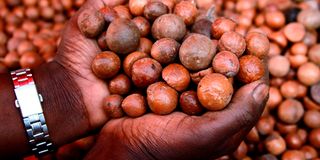
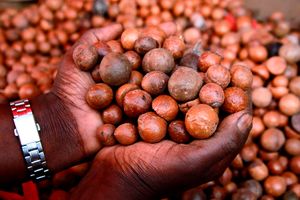
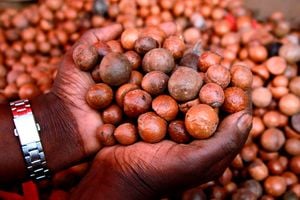
A farmer sorts macadamia nuts at his home in Ichamaara village in Nyeri County.
Photo credit: File | Nation Media Group
The central region, particularly Murang’a, Meru, Embu and Kirinyaga, contributes the largest share of macadamia output.
“A notable driver of improved yields in 2025 was pest control interventions. This coordinated effort significantly reduced pest-related losses and improved nut quality and recovery rates, thereby increasing overall productivity per hectare,” the regulator said.
“In contrast, Kiambu County continues to experience a gradual decline in both area and production. Rapid urbanisation, land subdivision, and real estate development have led to the conversion of agricultural land into residential and commercial uses. In addition, some aging orchards have not been replaced at a comparable rate, contributing to reduced output in 2025.”
To boost its macadamia industry, Kenya now targets India to drive exports and expand its export base and limit the risks of overreliance on five traditional markets. India is ranked as an early, high-growth-phase market for macadamia due to an expanding consumer population, rising health consciousness and increased affordability following reduced import tariffs.