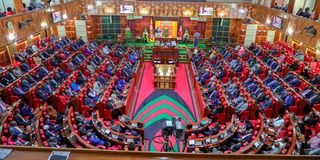
MPs have allocated themselves an additional Sh1.62 billion for travel, entertainment and other administrative costs in last-minute changes to a mini-budget prepared by the National Treasury.
Nearly half of the extra allocation, Sh771,900,000, was to facilitate the National Assembly's legislation, representation and oversight role, the Liaison Committee, chaired by the Deputy Speaker Gladys Boss revealed.
Before it took a 10-day recess on Thursday, the National Assembly passed the adjustments on the second supplementary budget for the current financial year by the Liaison Committee, pushing up the budgetary allocation to Sh42.58 billion.
This piles pressure on the National Treasury which is struggling to collect taxes in an environment of an anaemic economy in which purchasing power of most households has been severely eroded.
In its submission on the supplementary budget before the committee, the National Treasury had indicated that among the additional requests it had received, were Parliament’s Sh120 million.
However, when they made their report, the Sholei-led committee increased allocation to the National Assembly more than six-fold.
A big chunk of the National Assembly's allocation was for unfunded priorities which took up Sh651.9 million while the Parliamentary Joint Service which coordinates both the Senate and National Assembly was allocated an additional Sh416 million.
Of the funds allocated to the Parliamentary Joint Services, Sh216 has gone into unfunded priorities while the other Sh200 million is for the development of 28-storey Bunge Tower.
The Senate has been allocated Sh343.1 million which most of it, Sh214.5 million, going to unfunded priorities.
Treasury came up with the second supplementary budget citing the need to increase budgetary allocation to critical sectors such as security and education while ensuring that expenditures that had not been approved by the National Assembly were appropriated in line with the requirement of the Article 223 of the Constitution.
"Since the approval of the FY 2024/25, the National Treasury has received additional requests for funding to cater for emerging priorities and shortfalls under critical expenditures. Included in the FY Supplementary Estimates No. II is additional expenditure to cater for salaries shortfall, security related interventions, drought related expenditures among other emerging priorities," said Mr Mbadi.
In its Supplementary budget, Treasury had allocated the National Assembly an additional Sh75,330,000, and an extra Sh19,530,000 for the Senate. The Parliamentary Joint Services had not been allocated any fresh funds, with Treasury citing a tough economic environment.
Besides MPs, Treasury had received several requests for additional expenditures from other State bodies but turned them down due to inadequate resources.
However, the MPs took this opportunity to allocate themselves more funds, even as they chastised the Treasury against bringing mini budgets on expenditures that are not emergency.
Studies have shown that when comparing MPs' salaries to the country's Gross Domestic Product (GDP) per capita, Kenyan MPs are among the highest paid globally. This means that relative to the average income of their citizens, their pay is very high.
MPs receive various allowances, which significantly increase their total compensation. This includes allowances for travel, housing and committee sittings.
The high pay of MPs has drawn sharp criticism from the public, especially given the economic challenges facing many Kenyans.