MPs reject changes to Affordable Housing loans payments
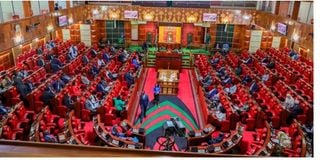
Members of the National Assembly during a past sitting.

MPs have rejected a proposal to amend the Land Act to reduce the default period and timelines for buyers of affordable housing units from three months to 45 days, arguing that it is discriminatory.
The National Assembly’s committee on Trade, Industry and Cooperatives threw out the proposal contained in the Business Laws (Amendment) Bill, 2024 on the grounds that it favours lenders and not borrowers.
The committee, in a report on its consideration of the Bill that originated in the Senate, said the proposal only targets purchasers of units of affordable housing and reduces their protection against lenders contrary to Article 43(1) (b) of the Constitution that provides that every person has a right to accessible and adequate housing.


“The committee therefore proposed that Clause 14 of the Bill be deleted,” said Ikolomani MP Bernard Shenli, who chairs the committee, in a report to the House.
Senators approved the Business Laws (Amendment) Bill (Senate Bill NO. 51 of 2024), without amendments, on August 7, 2025.
The omnibus Bill, which was forwarded to the National Assembly for concurrence, seeks to amend the Investment Promotion Act, Cap. 485, the Employment Act, Cap. 226, the Occupational Safety and Health Act, Cap. 236A, the Affordable Housing Act, NO. 2 of 2024, the Land Act, Cap. 280, and the Anti-Counterfeit Act, Cap. 510 to create a conducive environment for doing business.
The Senate sought to amend the Land Act, Cap. 280, among others, to reduce the period within which a chargor may comply with a notice set by a chargee under section 90(2) of the Act in relation to default under a charge for an affordable housing unit.
The Bill also proposed to reduce the period for rectifying a default from three months to forty-five days.
“Under the Bill, the Land Act is amended in section 90 by reducing the timelines given to a chargee to forty-five days when dealing with affordable housing,” the Senate proposal reads.
“Further, section 96 of the Land Act is also amended by introducing a new subsection which requires a chargee, before exercising the power of sale, to take twenty days while seeking to sell property that is under the Affordable Housing Act.”
The National Assembly’s Lands Committee, which scrutinised the Senate’s amendments, rejected the proposal, arguing it selectively targets buyers of affordable housing.
“The committee observed that the proposal is discriminatory because it only targets purchasers of units of affordable housing and reduces their protections against lenders contrary to the provisions of Article of the Constitution that provides that every person has the right to accessible and adequate housing,” Mr. Shenli said in a consolidated report on the omnibus Bill.
“The committee therefore proposed that clauses 14 and 15 of the Bill be deleted.”
In separate submissions to the committee on the proposed changes to the Land Act, Lands Principal Secretary Nixon Kori and his Trade counterpart Regina Obama rejected the Senate’s amendments.
In a letter Ref: MOLFWHlJD/LPP/L/BlLLS/GEN/2 dated August 6, 2026, the State Department for Lands and Physical Planning said the Bill seeks to reduce the period within which the chargee in respect to affordable housing could quickly secure its securities in case of default by the chargor, and is disadvantaged in so far as the period of notice is concerned.
“The proposal to amend bears the risks of being termed as discriminatory since it only targets affordable housing purchasers by disadvantaging them on the part of shortened notice within which they are supposed to do certain things to avert their properties from being sold in default cases,” Mr. Kori said.
Trade PS Ombam said that while the amendments proposed to the Land Act specifically focus on properties tied to the affordable housing framework to encourage banks and financial institutions to extend credit to lower risk, the State Department proposed that, in view of the target group for affordable housing, the default period and timelines for discharge be retained as they appear in existing legislation, which is 90 days to allow more time for purchasers of affordable housing units to organise their finances.
“The committees having reviewed the Business Laws (Amendment) Bill (Senate Bill NO. 51 of 2024) recommend that the House approves the Bill with amendments as proposed in the Schedule in Chapter Six of this Report,” Mr. Shenli said.
The Affordable Housing Levy Fund Act, 2024 requires employers to deduct 1.5 percent of employees’ salaries and match the same for the construction of affordable housing units.
President William Ruto has made affordable housing one of the key pillars of his Kenya Kwanza administration and plans to deliver 200,000 units annually through the Housing Levy.
Beginning in July, 2023, employers and employees were each deducted 1.5 percent of the worker's gross monthly salary towards the construction of the affordable houses.
The National Assembly allocated Sh25 billion, invested by the Affordable Housing Board in Treasury Bills, to complete 1,700 ongoing affordable housing projects.
The allocation followed a warning by Housing and Urban Development Principal Secretary Charles Hinga that more than 1,700 affordable houses were at risk of stalling after the National Treasury failed to allocate money invested by the Affordable Housing Board in Treasury Bills.
Follow our WhatsApp channel for breaking news updates and more stories like this.