The National Assembly Committee on Agriculture and Livestock is expected to table its report on tea prices and low bonuses to farmers on Tuesday, amid a tough balancing act over demands presented by stakeholders during public hearings.
The team, which retreated on Thursday to write its report, has been meeting various stakeholders in the tea industry for the past two weeks.
According to the schedule seen by Nation, the committee was set to complete its report writing on Saturday, then hold a final meeting today (Sunday) to adopt it.
Chaired by Tigania West MP John Mutunga, the committee was tasked by the House to look into unfair tea prices and low bonuses after several MPs from tea-growing areas petitioned the Speaker over the matter.
In its report, the committee is expected to address key questions such as how tea pricing in Kenya is conducted.
National Assembly Committee on Agriculture and Livestock chairperson and Tigania West MP John Mutunga.
Photo credit: Wachira Mwangi | Nation Media Group
It will also identify value chain-related costs and how they are minimised in both the East and West of the Rift Valley.
East of the Rift includes tea-growing zones in counties such as Murang’a, Kiambu, Embu, Kirinyaga, Nyeri, and Tharaka Nithi, while West of the Rift covers Kericho, Bomet, Nandi, Bungoma, and Trans Nzoia.
The inquiry will seek answers to why tea prices from the East of the Rift are generally higher than those from the West, and establish inefficiencies leading to low returns for tea farmers.
The report will also address why operational costs incurred by factories in the West of the Rift are higher than those in the East.
One key issue raised during meetings with stakeholders, especially tea growers from the West Rift region, is the tasting method used by the Kenya Tea Development Agency (KTDA).
The agency currently uses a traditional sensory evaluation method, often referred to as "tongue testing," to grade tea quality.
However, during a meeting with West Rift stakeholders, they protested this method, calling for a scientific approach, arguing that tongue testing is subjective and does not accurately reflect tea quality.
The stakeholders also demanded fair representation on the 12-member KTDA board, adding that despite being the majority producers, they have only five members, unlike their counterparts in the East who produce less tea.
They also called for the abolition of the current A, B, and C classification of tea factories, where Class A comprises factories from the East Rift, while those from the West Rift fall under Classes B and C.
They argued that this classification is discriminatory and urged the committee to treat all factories equally.
During a meeting with KTDA management on Wednesday, the committee sought explanations over these issues.
“The West produces more tea than the East, yet they feel underrepresented. These are issues that need addressing because there is now a serious demand for equal representation, with some calling for separation,” Dr Mutunga told KTDA management.
However, KTDA chairman Chege Kirundi warned that the strength of the association lies in its unity, cautioning that any attempt at separation could lead to its collapse.
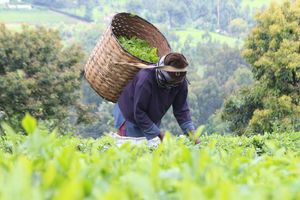
A worker at Nandi Tea Estate Limited in Nandi Hills plucks tea leaves on April 4, 2014.
Photo credit: Jared Nyataya | Nation Media Group
“There is a need to protect the aggregation of KTDA because without it, it does not exist,” Mr Kirundi told the committee.
Management of the West Rift factories also blamed the KTDA board for allowing many multinational and private factories to operate in the region.
They also raised concerns that the presence of many private and multinational firms makes the playing field unfair, as these firms do not pay tea bonuses like local factories.
The committee’s report is also expected to address the high cost of local production, limited market expansion initiatives, and uncoordinated value-addition efforts, which were highlighted by the Kenya Tea Growers Association (KTGA) as major factors affecting Kenyan tea in the global market.
On the high cost of local production, the association noted that it suppresses incentives for further local investment in value addition.
Since Kenyan tea already attracts a premium as a raw material, processors face even higher input costs when undertaking value addition.
While presenting to the committee, KTGA CEO Linda Oluoch said, “This cost structure results in value-added products that are priced above comparable offerings from competitor origins, making it difficult to compete in global consumer markets.”
The association proposed accelerating energy cost reductions by enabling factories to transition to cheaper, greener alternatives, including biomass, hydro, and solar power, supported by concessional financing.
They also called for simplified and harmonised regulatory processes through one-stop regulatory windows for tea processors, and a review and rationalisation of fees, timelines, and duplicative requirements.
Chairman of Momul Tea Factory, Isaiah Langat, told the committee that since the government removed the tea reserve price in November last year without consultation, earnings have significantly reduced.
Mr Langat said that between 2021 and 2023, they had good earnings, but started performing poorly after November last year.
In July 2021, the government set a minimum tea price for KTDA produce to boost earnings.
East African Tea Trade Association Managing Director George Omuga told the committee that due to geopolitics, countries like Sudan, which used to buy between 20 and 30 million kilograms of Kenyan tea, have now stopped, causing the country to lose that market.
Workers harvest tea in Bomet County on November 28, 2024.
Photo credit: File | Nation
“We have told the government that whatever they have been using to buy subsidised fertilisers should now be given to industry players to research new markets for our tea,” Mr Omuga told the committee.
Other stakeholders decried multiple regulatory requirements from agencies such as the Kenya Bureau of Standards (Kebs), National Environment Management Authority (Nema), Kenya Revenue Authority (KRA), and the Tea Board of Kenya, which increase compliance costs and create delays, discouraging investment in value addition.
During its inquiry, the committee visited Bomet, Kericho, Mombasa, Nyamira, Meru, Embu, Murang’a, and Kiambu counties, as well as the Mombasa Tea Auction, Chai Trading Limited, KTDA warehouse, and quality analysis and tea testing laboratories.
Various tea stakeholders, including the State Department of Agriculture, Tea Board of Kenya, Kenya Agricultural and Livestock Research Organization, Kenya Tea Development Agency, Kenya Tea Growers Association, Independent Tea Producers’ Association, Eastern Produce Kenya Limited, and William Tea Kenya, also submitted proposals to the committee.