Premium
Onion prices double as low production forces traders to source from Tanzania
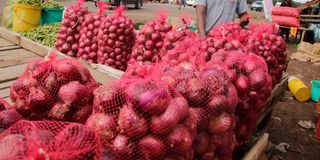
An onion trader. Shortages reported in key onion-growing regions have pushed prices to nearly double, leaving consumers grappling with the scarcity.

The price of onions across the country is expected to continue rising due to low local production, forcing traders to turn to neighbouring Tanzania for supply.
Shortages reported in key onion-growing regions have pushed prices to nearly double, leaving consumers grappling with the scarcity of the commonly used kitchen staple.
In Kajiado County’s Loitokitok agricultural belt, which is traditionally known for bulb onion farming, many farmers opted out of production this season due to the high cost of farm inputs and the effects of erratic climate patterns.


Peter Mburu, a large-scale agribusiness farmer in Kimana on the outskirts of Loitokitok town, said onion farming has become too costly compared to the returns that depend on unpredictable market forces.
“This season, production was low, leading to reduced supply. To most farmers, onion farming is no longer viable considering that a kilogramme of red coach onion seeds costs between Sh36,000 and Sh40,000 locally. Middlemen are currently buying a kilogramme of dry onions from farmers at Sh90—that’s the most a farmer can earn even when demand is high and supply is low,” said Mr Mburu.
Some farmers also suffered losses last season after being duped into buying counterfeit onion seeds. As a result, many have shifted to tomato farming.
A spot check on Monday in Kajiado’s satellite towns—including Ngong, Ong’ata Rongai, Kiserian, and Kitengela—showed that a kilogramme of onions retailed at between Sh130 and Sh150 depending on size. Just two months ago, the same quantity sold for between Sh60 and Sh80.
At major supermarkets in the region, prices were slightly higher, ranging between Sh140 and Sh170 per kilogramme, with stocks visibly low.
“We have minimal local supply and are relying on imports, which has pushed prices up for consumers. The imported onions, however, have a longer shelf life,” said Nelly Wairimu, a retail trader in Kitengela.
Large-scale traders have now turned to Tanzania to fill the deficit, benefiting from Kenya-Tanzania free trade arrangements.
Anna Mugendi, a trader at Nairobi’s Wakulima Market, said most large-scale Kenyan traders are currently sourcing onions from Mang’ola region in Tanzania. In the past, they relied on Moshi and Singida, but supplies there have since dwindled.
“Farmers in Mang’ola are harvesting in bulk, forcing prices down from Tsh160,000 (about Sh8,000) to Tsh100,000 (about Sh5,000) per 105-kilogramme net. A six-wheel truck carries 110 to 112 nets, or about 12 tonnes per trip. After deducting expenses, the profit margin is better than sourcing locally,” said Ms Mugendi.
In Tanzania, a net of onions is capped at 105 kilogrammes to prevent farmers from being exploited by middlemen.
According to World Bank WITS data, Tanzania exported onions and shallots worth $3,790 (Sh500,000) to Kenya in 2023, totalling about 100,000 kilogrammes.