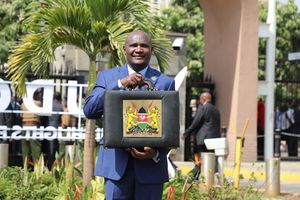
After promising Pay As You Earn (PAYE) cuts to support those earning Sh50,000 or less per month, National Treasury Cabinet Secretary John Mbadi’s U-turn on tax has drawn sharp criticism from financial experts.
The PAYE tax bands reforms were to stimulate revenue growth and expand the economy, as well as demonstrate the government’s commitment to cushioning the low-income earners from economic shocks.
Mr Mbadi had promised to have the reforms included in the Finance Bill 2026, under consideration in the National Assembly.
Cabinet Secretary for the National Treasury and Economic Planning John Mbadi (Right) and Chairperson of the National Assembly Finance and National Planning Committee and Molo MP Kuria Kimani at Parliament Buildings, Nairobi, on Thursday, June 11, 2026.
Photo credit: Dennis Onsongo| Nation Media Group
The Kenya Bankers Association (KBA) and the Institute of Certified Public Accountants of Kenya (ICPAK), as well as the Law Society of Kenya (LSK) are pushing the National Assembly’s Finance and National Planning committee to have the reforms included in the Bill.
The push is anchored on the fact that employees are facing the burden of additional taxes and levies on gross income, such as the Social Health Insurance Fund (SHIF) Levy, Affordable Housing Levy and the enhanced National Social Security Fund (NSSF) deductions. The higher deductions, they say, have led to a “decline in real wages”.
“Kenya’s PAYE tax bands are narrow and steep, with high marginal rates applying at much lower incomes than in peer countries,” said KBA Chief Executive Officer Raymond Molenje in a memorandum to Parliament. “A five percent PAYE cut expands the economy, creates jobs and increases the country’s tax revenue.”
Currently, SHIF is deducted at a monthly rate of 2.75 per cent of gross pay, Affordable Housing Levy at 1.5 per cent with employers matching it and NSSF contributions of Sh6,480.
A simulation done by KBA shows that a uniform 5 per cent reduction in PAYE across all the bands will release Sh28.1 billion into the economy annually, generating Sh42 billion “in immediate GDP output”, creating 36,000 new jobs annually, and unlocking Sh140 billion in formal lending capacity.
The bankers’ association further notes that if the PAYE rate were to be reduced by 5 per cent, the resultant effect would be the generation of between Sh27.1 billion and Sh31.5 billion in additional revenues, recovering what would have been “lost” by the reduction in the first year.
The current monthly individual PAYE rates are: on the first Sh24,000 earned, 10 per cent; 25 per cent on the next Sh8,333; on the next up to Sh467,667, 30 percent; 32.5 per cent on the next Sh300,000; and 35 per cent on all income over Sh800,000.
If the KBA proposal goes through, the new tax bands shall be: 10 percent on the first 30,000; 20 per cent on the next Sh8,333; 25 per cent on the next Sh461,667; 27.5 per cent on the next 300,000; and 30 per cent on amounts over Sh800,000.
Kenya Bankers Association (KBA) Chief Executive Officer (CEO) Raimond Molenje makes his remarks during the release of the 2024 Banking Customer Satisfaction Report held on February 12, 2025, at the Radisson Blu Hotel.
Photo credit: File| Nation Media Group
Robert Waruiru, the convener of the Public Finance Taxation Committee at ICPAK, said that a reduction in the marginal PAYE rate and the expansion of the PAYE bands to enhance progression would be in line with the government’s policy objectives under the Medium-Term Revenue Strategy.
“With higher deductions ... over the last two years, a more progressive tax rate would help increase disposable income among individuals,” said Mr Waruiru. “This would in turn enhance their purchasing power, savings and investment capacity; and consequently, spur economic growth.”
ICPAK argues that the proposed amendment would also align Kenya’s PAYE regime to its peers in Africa. For instance, Ghana has rates of 0 per cent, 5 per cent, 10 per cent, 17.5 per cent, 25 per cent, 30 per cent and 35 per cent, “with much wider tax bands, noting that the 30 per cent rate applies to a monthly income of above Sh255,000 in Ghana, as opposed to Sh32,333 in Kenya”.
“The proposed revision of PAYE tax bands seeks to enhance tax equity and increase disposable income for salaried workers in line with the revenue strategy,” said LSK.
The society added that the disparity between the highest personal income tax rate of 35 per cent and the corporate income tax rate of 30 per cent, alongside differences in tax base treatment, raises equity concerns.
“Rationalising the tax bands would improve fairness, strengthen voluntary compliance and reduce incentives for tax avoidance,” said LSK.
It proposes: on the first Sh30,000, 10 per cent; on the next Sh8,333, 20 per cent; on the next Sh461,667, 25 per cent; on the next Sh300,000, 27.5 percent; and on all income over Sh800,000, 30 per cent. Further, LSK wants the law amended to increase personal relief to Sh3,000 per month, “thereby effectively setting the tax-free threshold at Sh30,000”.