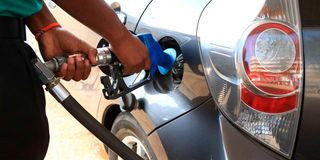
Petroleum dealers have protested the government’s directive on use of the Electronic Tax Invoice Management System (eTIMS) at fuel stations, saying its members were not consulted before the roll-out.
In a letter to the Kenya Revenue Authority (KRA), the United Energy and Petroleum Association (Unepa), through its chairperson Irene Kimathi, said implementation of the new system was being carried out without proper public participation.
The letter, which was copied to the National Assembly Energy Committee, the Principal Secretary of the State Department for Petroleum in the Ministry of Energy, Mohammed Liban, and the Director-General of the Energy and Petroleum Regulatory Authority (Epra), Daniel Kiptoo, calls for a meeting with the ministry, KRA and sector regulator to iron out outstanding issues before full roll-out.
“We respectfully request further consultations between KRA, Epra as the regulator, the Ministry of Energy and industry stakeholders before any enforcement actions are taken. We strongly urge that no punitive measures be imposed on petroleum stations until a mutually agreeable, practical and sustainable solution is developed,” Ms Kimathi said.
According to the association, on May 15, 2024, KRA invited its members to a consultative meeting at Ole Sereni Hotel to discuss the prospects of using eTIMS as a tax collection tool in the petroleum industry.
“We expressed the challenges our members would encounter if they were required to install the gadgets on their fuel dispensers,” Ms Kimathi said.
She said the KRA team promised to run a pilot during which consultations and feedback on findings would be shared, but no communication followed.
“Instead, we only found a notice of implementation in a local daily. The pilot failed to take into account the affordability of the system and other challenges, leaving our members facing possible shutdown of their businesses. Proper public participation was not conducted before implementation.”
The association has raised seven issues it wants addressed before full roll-out of the system. Top of the lobby's arguments is that under the new system, Value Added Tax (VAT) computation conflicts with fuel price regulation. Fuel prices, it says, are regulated by Epra, with the VAT component already built into the pump price.
“This means dealers have no discretion in pricing. KRA can collect all the VAT at the point of import and spare our businesses the installation and administrative costs associated with the system, which many businesses cannot afford, while still achieving 100 percent collection,” the dealers say.
The association has also raised concerns over affordability of the system, saying it is prohibitively expensive for most dealers, particularly small and medium-sized operators.
“This creates a financial burden that makes compliance difficult and unsustainable for many businesses.”
According to Unepa, the system also introduces administrative and staffing burdens. Dealers say most petrol stations operate with minimal staff. thus introducing an additional system that requires constant monitoring and technical handling imposes extra operational costs.
The association further cited internet connectivity challenges, noting that a significant number of fuel stations are located in remote or underserved areas with poor or unreliable internet access, which the system requires for optimal operation. It also pointed out that the system does not seamlessly integrate with all dispenser models used by most petrol stations, warning that incompatibility could result in frequent system failures, downtime and disruption of operations.
“These challenges negatively impact business continuity,” the letter reads.
The association further noted that since the introduction of VAT on fuel in 2018, petroleum dealers have complied with tax requirements despite operational challenges. However, past technological rollouts have often resulted in increased costs and operational disruptions, with limited benefits to businesses.
“This was the case with the migration from TIMS to eTIMS, which many members struggled to comply with due to cost. This new system is multiple times more expensive than the previous one and is no longer just a challenge but a barrier to running businesses,” the letter states.
On November 25, 2025, KRA issued a public notice regarding the implementation of eTIMS for fuel stations.
The notice was the second after the first, issued in June 2025, elapsed with 98 percent of petrol stations failing to comply due to various challenges.