Cyrus Jirongo came into Kenyan politics like a gust — too loud to ignore, too useful to resist, too dangerous to fully trust.
For a season, he wasn’t just a man; he was a method: the young face of an old machine, the courier of cash in an era when money spoke louder than manifestos.
When Jirongo reigned, he did not merely walk through Kenyan politics; he oiled it with cash. In the fevered multiparty election season of 1992, as chairman of Youth for KANU ’92 (YK’92), Jirongo became less of a politician and more of an automated cash machine for a ruling party fighting for survival.
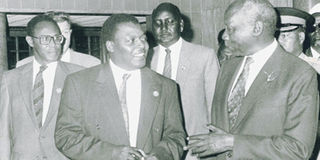
Cyrus Jirongo, the leader of Youth for Kanu 92, speaks to President Daniel Arap Moi in the presence of Vice president George Saitoti and other party officials.
“Every politician has a price,” he was reported to have said, a sentence that landed like a threat disguised as wisdom. To his admirers, this was hard-headed realism; to his critics, it was a confession of how YK92 wished buy power in the open market.
From the Kenyatta International Conference Centre’s YK’92 offices to Anniversary Towers in Nairobi, the money did not just flow — it flooded. It surfaced at rallies, in envelopes and briefcases as “facilitation” fee.
The country was experiencing sudden wealth that seemed to defy the economy outside the campaign caravan. YK‘92 moved with such audacity, so loudly and so often that Kenyans did what they always do when politics stains their daily life: they renamed the new Sh500 note “Jirongo”— as a rare, brutal honour of the man behind the scandalous affair.
By the time he died in a road accident, Jirongo was fighting many cases tethered to the management of the whirlwind that he collected within YK’92.
Though Jirongo may have risen to become a Cabinet minister in the Moi regime, he always carried the face of a power-broker; a man in a hurry and always haunted by his YK’92 years.
So powerful was Jirongo that he would be spotted walking together with President Moi on the lawns of State House for hours. At one point, his friends say, he attended the national security council briefing — usually reserved for just a handful of top officials led by the President — and when he was in YK’92, he reportedly always carried grenades in his car.
Youth for Kanu ‘92 Chairman Cyrus Jirongo with President Moi before the 1992 General Election. PHOTO | NATION MEDIA GROUP
If corruption in the 1990s ever wore a youthful face, it was through Jirongo, a man who maintained the mask as he rallied the youth to steal the thunder from a roaring opposition, dulling its momentum and splintering its ranks through calculated defections, intimidation, and—some allege—episodes of violence.
To write about Jirongo is to revisit Kenya’s complex plunge into multiparty politics, when ideals arrived with speeches but patronage arrived with envelopes. It is also to confront the question that has never stopped haunting the YK’92 legend: where did the money come from?
No serious observer disputes that YK’92 spent extravagantly from its bottomless coffers. It did not just fund campaigns but staged a circus of defection. Rallies were organised with the polish of corporate launches.
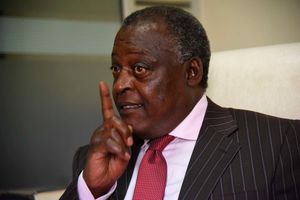
Cyrus Jirongo during an interview at his Mayfair Suites offices in Nairobi on October 28, 2021.
Photo credit: File | Nation Media Group
Voters were transported in lorries and buses, entertained, and often rewarded in cash or kind.
KANU candidates were said to have received large sums from the centre and spared no expense on mobilisation.
Press advertisements multiplied, television broadcasts were slick, and campaign merchandise flooded markets—posters, T-shirts, caps, and the small souvenirs that turned politics into a carnival of loyalty.
At the apex of this spectacle, the ruling elite moved like a touring company. Goldenberg International—the outfit registered by Kamlesh Pattni and the Special Branch supremo James Kanyotu — kept returning to the Central Bank of Kenya like a favoured creditor, raiding it with “compensation” claims for exported diamonds that only existed on paper.
The National Social Security Fund (NSSF) was leaned on, nudged and bullied into becoming a financier of the political kitty — buying grabbed land at grotesque prices, laundering private appetite through public transactions.
Parastatals, built to serve citizens, were refitted into campaign dispensers, their balance sheets bent into ballot strategy for YK’92.
The NSSF appears repeatedly in these accounts not because it was uniquely rotten by design, but because it was uniquely useful: deep pockets, weak transparency, and trustees exposed to political instruction. Jirongo, through his Sololo Outlets had a tender to build houses for NSSF.
In that season, influence was a master key. Doors did not open for Jirongo — they yielded. And no institution was too sacred, no mandate too public, to be converted into the quiet machinery of power.
One answer to the cash mystery surfaced under oath at the Judicial Commission of Inquiry into the Goldenberg Affair. Businessman Kamlesh Pattni told the commission that he bankrolled YK’92.
That claim has never fully settled the matter, in part because it sits beside a second theory that refuses to die: that the State, directly or indirectly, enabled money to flow at industrial scale.
Mr Cyrus Jirongo who was the chairman of YK'92.
Photo credit: File
In this view, the government did not need to publicly “print” cash for politicians; it merely needed to open doors.
Jirongo was also cited in a Parliamentary Investments Committee report for selling to the NSSF two properties at an inflated price of Sh1.2 billion. Parliament was also told the NSSF lost hundreds of millions through dealings linked to him.
The Nation reported one prominent scandal in which the NSSF purchased two properties belonging to Jirongo’s Sololo Outlets for Sh1.2 billion, a figure said to dwarf the properties’ estimated value.
The mechanics of the Sololo transaction were as revealing as the figures. Accounts describe how, in August 1992, an account was opened at Post Bank Credit to facilitate transfers associated with NSSF money and Sololo. Y
et Post Bank Credit was already in crisis, described as insolvent and surviving through practices such as cheque kiting and the processing of questionable documentation.
In total, it was reported that Sh2.5 billion was transferred to Sololo; only Sh900 million was said to have come from the NSSF, while the rest allegedly came from Post Bank Credit itself without security — an arrangement that contributed to the bank’s collapse.
Elsewhere, Parliament was told Postbank Credit carried bad loans worth Sh9.2 billion, of which Sh7.4 billion was reportedly owed by Sololo Outlets.
Cyrus Jirongo during an interview at his Mayfair Suites offices in Nairobi on October 28, 2021.
Photo credit: File | Nation Media Group
These figures captured the basic truth: the money behind YK’92 did not come from ordinary private wealth.
At the centre of it stood Cyrus Jirongo—not merely as a beneficiary, but as the presumed mastermind and chief engineer of the operation: a man who understood that elections could be financed not by supporters, but by systems.
Jirongo, critics argue, helped choreograph a scheme that drained pension savings, hollowed out parastatals, and pushed state-linked banks toward collapse—leaving them to carry the debt long after the rallies ended. As the YK folded out of the scene, it left the nation counting the bill.
YK’92, by many accounts, was the president’s strike team during primaries, pushing out incumbents deemed ineffective or unreliable. Third, it performed public relations, presenting young, articulate, media-friendly loyalists as proof that KANU could still dress itself in modern clothes.
To the cameras, it looked like a generational upgrade. Jirongo himself was marketed as a 31-year-old professional — an estate-agent-turned-organiser — whose emergence was sudden and whose confidence was unembarrassed. YK’92 set up structures across districts with speed that suggested not merely energy but access.
Around it sprouted smaller groups, each a miniature pressure outfit, each hoping to taste the larger feast. Where the opposition struggled with thin resources, KANU’s campaign machine, supplemented by such outfits, appeared to operate in a different economy.
At its headquarters sat William Samoei Ruto, the current president, dishing out cash and promises.
After the 1992 election, YK’92 began to frighten its patrons. The organisation that had been useful as a campaign weapon looked, to senior figures, like an unaccountable power centre. Secretary-General Joseph Kamotho called for it to be disbanded.
Moi initially defended it, but the relationship soured as internal rivalries sharpened. After Jirongo publicly attacked Vice President George Saitoti in April 1993, Moi suspended YK’92’s operations entirely. The message was plain: in KANU, youth could be used, but it could not be allowed to rule.
Then the system demonstrated its other talent: the ability to punish. Lawsuits proliferated. Jirongo’s companies were placed in receivership. Jirongo’s NSSF’s housing project was re-awarded to another firm.
He was reportedly hit with a Sh272 million income tax bill with only days to pay. Public accounts of the time describe senior officials at the NSSF and Post Bank Credit being removed — figures believed to be part of the conduit that enabled transfers — yet none, according to those accounts, faced criminal charges.
In Kenya’s political grammar, the State’s discipline is often selective: swift when convenient, hesitant when dangerous.
Yet Jirongo did not disappear. Like many actors forged in that era, he returned, chastened but unbowed. He served as Member of Parliament for Lugari twice—1997 to 2002, and again from 2007 to 2013 — and held a Cabinet position under President Daniel arap Moi.
Kakamega gubernatorial candidate on UDP party, Mr Cyrus Jirongo, casts his vote at Lumakanda Township Primary School polling station in Lugari Constituency on August 29, 2022.
Photo credit: Brian Ojamaa | Nation Media Group
He retained visibility in public life and, at different moments, sought to reposition himself as a national figure beyond the YK’92 controversy. But controversy, once attached, is hard to shake; it follows a politician the way dust follows a lorry on a dry road.
Jirongo’s name evokes abundance and distress: the swagger of 1992 and the litigation of later years, the spectacle of a campaign awash in cash and the slow crawl of legal and financial reckoning.
The question about YK’92’s cash persists because it was never merely about bookkeeping. It was a referendum on the boundaries of the State. It forced Kenyans to ask whether parastatals exist to guard public wealth or to underwrite private political ambition.
It exposed how elections can be financed not through transparent fundraising but through transactions that blur the line between party and government. It also revealed the country’s uncomfortable truth: when ideology is thin, money becomes the message; and when scrutiny is absent, intermediaries become empires.
Cyrus Jirongo remains, in that sense, a symbol more than a man: estate agent turned kingmaker, youth leader turned lightning rod, survivor turned litigant. In his rise Kenyans glimpse the potency of patronage; in his fall, the brutality of the same system; in his returns, the country’s appetite for political resurrection; and in his ongoing disputes, the stubborn way the past refuses to stay buried.
If Kenya ever wants to close the chapter that produced “Jirongo” as a nickname for money, it will not be by forgetting the man; it will be by fixing the system that made him possible.